
Phuket’s property boom brings pressure on local communities
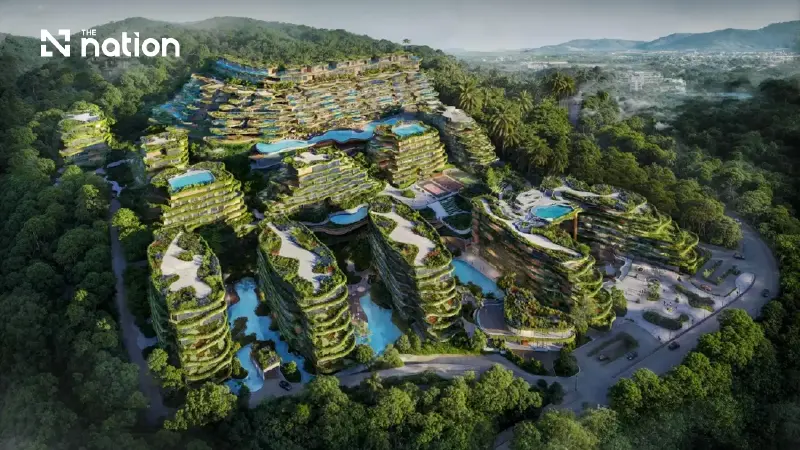


High rental yields draw foreign investors to Phuket, but rising competition, nominee investigations and public-land disputes complicate the boom.
- The property boom is leading to disputes over public space and encroachment on public land, prompting high-level government intervention.
- Increased foreign investment has triggered intensified government scrutiny and arrests related to suspected illegal "nominee" ownership schemes, where foreigners use locals to circumvent property laws.
- Phuket's market is now second only to Bangkok, with a high concentration of expensive homes (averaging 12.9 million baht) in areas like Bang Tao, increasing competition for land.
Phuket’s housing market has properties worth 194.545 billion baht awaiting buyers in 2026, placing it second only to Bangkok and its surrounding provinces, as continued investment brings closer scrutiny of nominee ownership and encroachment on public land.
The island’s appeal to developers and foreign purchasers remains strong, supported by rental returns and demand for expensive homes. Yet growing competition and signs of slower sales are complicating the outlook, while disputes over public space expose pressures on local communities.
Research cited from the Thai Real Estate Research and Valuation Information Centre of the Agency for Real Estate Affairs (AREA) puts the average price of available property in Phuket at 12.921 million baht per unit, above other surveyed markets.
Public land disputes and nominee investigations
Authorities intensified scrutiny of suspected nominee arrangements during 2026, examining cases in which Thai shareholders or titleholders allegedly act on behalf of foreigners to circumvent restrictions on property ownership or business operations.
The prime minister visited Bang Tao beach in Cherng Talay subdistrict, Thalang district, on May 10, 2026, to follow up on encroachment on public land. During the visit, the prime minister stressed that nominee arrangements and legal loopholes must not be allowed to threaten the public’s interests.

The Department of Special Investigation (DSI) arrested a foreign suspect on July 8 under a Criminal Court warrant in a nominee case involving a luxury villa rental business in Phuket.
A deputy interior minister subsequently inspected hotels and other businesses in Phuket on July 11 following complaints concerning suspected nominee ownership and construction permits.
Rental returns sustain new investment
Rental yields remain a major attraction for property investors. Post Today reported that Phuket and Pattaya were among the markets offering returns of around 8–10%, measured as annual rental income relative to the purchase price.
New condominium project launches in Phuket increased by 44.8% in the first half of 2026 compared with the preceding six months. Competition among developers is particularly intense along the west coast, including Bang Tao, Cherng Talay, Layan and Kamala.
International buyers accounted for 67% of purchasers in CBRE’s first-half transaction data, which highlighted demand for condominiums in Bang Tao and Cherng Talay.
Origin Property Public Company Limited plans to launch two condominium projects in Phuket during 2026 with a combined value of 3.5 billion baht. Another seven projects, worth more than 8.15 billion baht in total, are planned for 2027–2028.

Bang Tao concentrates Phuket’s expensive homes
Bang Tao’s importance becomes more pronounced at the upper end of the market, according to Vadym Bukhkalov, founder of VillaCarte Group, whose flagship Phuket development is Layan Verde.
Bukhkalov cited figures showing that Bang Tao accounted for 52.3% of residential units currently on the market across Phuket but 64.2% of their combined value, illustrating the concentration of expensive homes in the area.
Of 60 projects classified as “Premium” in the island-wide survey, 31 were in Bang Tao, including eight in Layan. Bang Tao also accounted for 58.6% of Phuket’s available units in the “Lux” and “Lux+” categories.
The concentration of high-value developments makes distinguishing one project from its competitors increasingly difficult, and increasingly important, Bukhkalov indicated.
Slower sales and delayed completions complicate growth
Phuket’s property market began losing some momentum in 2025 after a particularly strong 2024, according to Maetapong Upatising, president of the Phuket Real Estate Association.
Maetapong described the absorption rate in 2024—the pace at which available units were sold—as exceptionally high. Sales subsequently cooled while supply continued to expand.
Competition has intensified in Patong and Cherng Talay, where some condominiums are operated as hotel accommodation, adding to the supply of rooms competing for guests.
Construction figures also show a gap between new launches and completed homes. Only three condominium projects, comprising 1,196 units, were completed in the first half of 2026. Completed unit numbers fell by 56.8% from the second half of 2025 as several developments experienced construction delays or were not ready for handover.
Developers are also exploring lawful arrangements to support longer-term foreign demand. Maetapong said businesses were promoting the Long-Term Resident (LTR) visa to encourage foreigners to stay and invest in Thailand for longer periods.
Maetapong also highlighted growing interest in registered property-use rights, known as sap ing sit, as an alternative to nominee arrangements for Chinese customers seeking pool villas.

Souce: Post Today
