
Thailand's Data Centre Boom Tests the Grid, the Rules and the Workforce
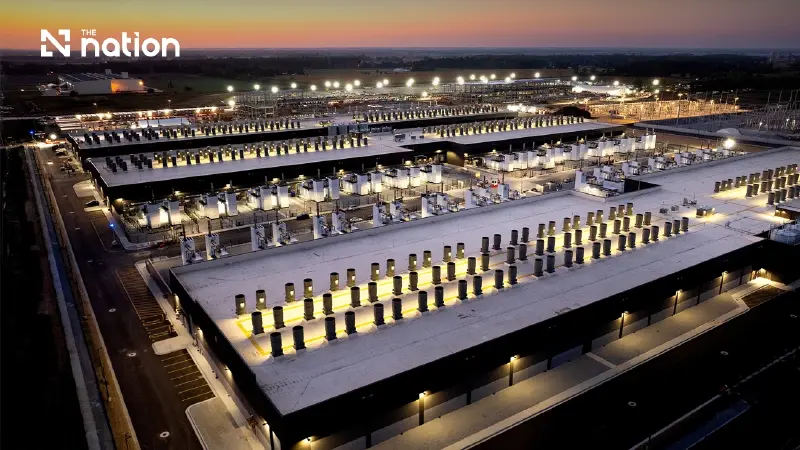


As Google, AWS and TikTok pour billions into Thailand, regulators, researchers and factory owners are asking how much the country actually gains
- The massive influx of data center investments is straining Thailand's electricity transmission grid, which was not built for such concentrated, high-demand loads, prompting a 31-billion-baht upgrade plan.
- Thai regulators are responding to the boom by tightening rules, introducing higher electricity tariffs specifically for data centers, and shifting investment criteria to prioritize sustainability over the sheer number of projects.
- The sector's high consumption of water and power is raising concerns among existing industries about resource competition and sparking a debate over whether the economic benefits and jobs created justify the strain on the grid and the local workforce.
As Google, AWS and TikTok pour billions into Thailand, regulators, researchers and factory owners are asking how much the country actually gains.
Thailand's pitch to the world's technology companies has, for the past two years, been built on numbers that keep climbing. The Board of Investment approved 26 data centre projects worth almost 500 billion baht in 2025, and by the first quarter of 2026, fresh applications had already reached 1.01 trillion baht — roughly 2.4 times what they were a year earlier.
The country's planned pipeline now stands near 2.87 gigawatts, concentrated overwhelmingly in the Eastern Economic Corridor provinces of Chonburi, Rayong and Chachoengsao.
What was, until recently, a story about how much capital was arriving has become a harder question: whether the electricity grid, the water supply and the workforce can actually absorb it.

The Google pitch
Google is among the hyperscalers building in that corridor. Bryan Yue, principal of global infrastructure for Asia Pacific at Google, who leads the company's Chonburi data centre project, argues that the investment case extends far beyond the physical buildings themselves.
"The internet lives within data centres," he said, describing them as the physical infrastructure behind everything from Google Maps to a QR-code payment at a Bangkok street stall.
Google's roughly USD 1 billion 2024 investment, he said, is projected to generate USD 4 billion in GDP uplift over four years, with construction alone requiring an average of 4,200 workers annually, and Google estimating that for every job created directly inside one of its data centres, nine more are supported outside it — in construction, utilities and local services.

Water and power
Water and power remain the more contested part of that pitch. Yue said Google conducts a site-specific water risk assessment before building anywhere, sometimes drawing on a century of local data, and defaults to air cooling in places already under strain, as it has done in Nevada, Texas and parts of India.
Where supply is healthier, the company uses water cooling because it consumes less electricity. Google has also committed to replenishing more water than it draws and to disclosing its efficiency data — it says it was the first hyperscaler to publish quarterly power usage effectiveness figures and annual site-level water use.
The "megawatt gap"
That transparency sits inside a national grid under mounting strain.
Jerin Raj, senior vice-president and head of Asia-Pacific and India at engineering firm Black & Veatch, has described the core problem as a "megawatt gap" — not a shortage of generation capacity, where Thailand's reserve margin exceeds 25 percent, but a transmission system built for conventional industrial loads rather than the concentrated, always-on demand of hyperscale campuses.
The Electricity Generating Authority of Thailand has responded with a 31-billion-baht plan to upgrade transmission in the Eastern Economic Corridor, where roughly 70 percent of approved projects are clustered, according to the state agency overseeing energy regulation.

Paying for capacity
That concentration has forced a broader rethink of how Thailand prices and rations electricity for the industry. Energy Regulatory Commission Secretary-General Poonpat Leesombatpiboon has estimated that if every approved data centre project ran at full capacity, demand could approach 30,000 megawatts — nearly half of the country's roughly 55,000-megawatt generating capacity.
In response, authorities introduced a new electricity tariff category specifically for data centres, expected to run at roughly 5 to 6 baht per kilowatt-hour against a household rate closer to 3 to 4 baht, alongside a requirement that developers post a financial guarantee of 4.5 million baht per megawatt of capacity, refunded in stages as projects reach real usage targets.
Finance Minister Ekniti Nitithanprapas said the tariff reflects the higher cost of the imported liquefied natural gas needed to meet the sector's demand.
Quality over quantity
The Board of Investment, which had spent three years courting projects on largely open terms, is now shifting its own criteria.
BOI Secretary-General Narit Therdsteerasukdi has said promotion will no longer be "a competition over the number of projects alone" but will instead weigh the benefit to the Thai economy against how sustainably electricity, water and environmental resources are managed.
He has been in talks with Prime Minister Anutin Charnvirakul on tightening the rules after finding that many Bangkok-area facilities draw heavily on electricity and water without triggering environmental impact assessments.
A researcher's caution
The Thailand Development Research Institute has pushed that scrutiny further.
Dr Areeporn Asawinpongphan, an energy policy researcher at the institute, told local media that charging data centres more than households for power is reasonable given how resource-intensive the industry is but cautioned that the government must weigh the country's overall capacity carefully so that data centre growth does not "come at the expense of existing industries" that need the same electricity, clean power and infrastructure.
TDRI has separately pointed to a starker asymmetry in the investment case: a 100-megawatt data centre, by the institute's estimate, creates around 50 direct jobs while consuming electricity equivalent to that of roughly 13 million people and water equivalent to that of 1.3 million — a ratio that has fed scepticism in parts of the Thai policy establishment about whether headline investment figures translate into commensurate local benefit.

Factories worry too
That scepticism is not confined to researchers and regulators. It also runs through Thailand's existing manufacturing base, which draws on the same grid and the same watersheds the new data centres are being built on.
The Federation of Thai Industries surveyed 160 member executives on the sector's expansion, and the results echo TDRI's concerns from inside the business community itself: 68.8 percent named insufficient water supply as their leading worry, and 61.3 percent each flagged rising electricity demand and doubt that regulation can keep pace with the industry's growth.
"We fear rising water demand could spark competition between industries and communities," said Montri Mahaplerkpong, FTI vice chairman, warning that unmanaged growth could eventually pit factories, households and data centres against one another for the same limited supplies.
He raised a similar concern on electricity, arguing that without active management of demand and supply, the expansion could ultimately affect the country's energy security.
A further 51.2 percent of respondents said they doubted Thai entrepreneurs would see much direct benefit from the boom, pointing to the sector's heavy reliance on imported technology and foreign specialists.
Even so, FTI's members were not uniformly negative: 48.1 percent said they expected data centres to meaningfully support the development of Thai industry, and 48.8 percent believed the country could still become a genuine regional hub if the resource constraints are managed well.

Closing the skills gap
Industry participants describe the labour question differently.
Budsarin Pradityont, Thailand's country head for ST Telemedia Global Data Centres, has argued that the country's workforce is quick to learn and digitally capable but has historically had fewer opportunities to work on genuinely difficult technical problems — a gap she believes the arrival of global operators helps close through direct exposure and knowledge transfer.
She has also framed data centres as only the first layer of a digital economy, describing them as the room the data runs in, with the more durable economic value sitting in the software and applications built on top.

A global squeeze
The pressure on Thailand's grid is not a local anomaly. Gartner projects global data centre electricity consumption will rise 26 percent in 2026 to 565 terawatt-hours, with worldwide power demand climbing toward 290 gigawatts by 2030.
Linglan Wang, a director analyst at the firm, has argued that power availability, not chip supply, has become the new battleground for scaling AI infrastructure.
Anders Maltesen, president of ABB's Energy Industries division for Asia, has made a related point specific to Thailand, arguing that new generation capacity and better use of existing grid assets need to advance together rather than sequentially — echoed locally by a Ministry of Energy plan to add more than 1,150 megawatts of supply points and transformers in the Eastern Economic Corridor.
Buying clean power directly
Thailand has also begun experimenting with mechanisms to let data centres buy clean power directly.
A Direct Power Purchase Agreement pilot, capped at 2,000 megawatts, would let facilities contract with renewable generators independent of the state utility's single-buyer system — the kind of arrangement Yue said Google is watching closely, since it underpins the company's own model of signing long-term contracts that give renewable developers the financial certainty to build.
Final rules for the scheme have moved slowly through public consultation and were still pending as of mid-2026.
What Thailand extracts from the capital
None of this settles the underlying dispute over whether Thailand's data centre wave is, on balance, a net gain. What has changed is the terms of the debate.
The conversation two years ago centred on how much capital the country could attract; the one now underway, spanning the Board of Investment, the energy regulator, TDRI, the Federation of Thai Industries and the operators themselves, centres on what Thailand extracts from that capital once it arrives – a question the country's grid, its water systems and its next generation of technicians will spend the coming decade answering.
