
The True Price of the Cloud: Inside Thailand's Battle for Water and Power
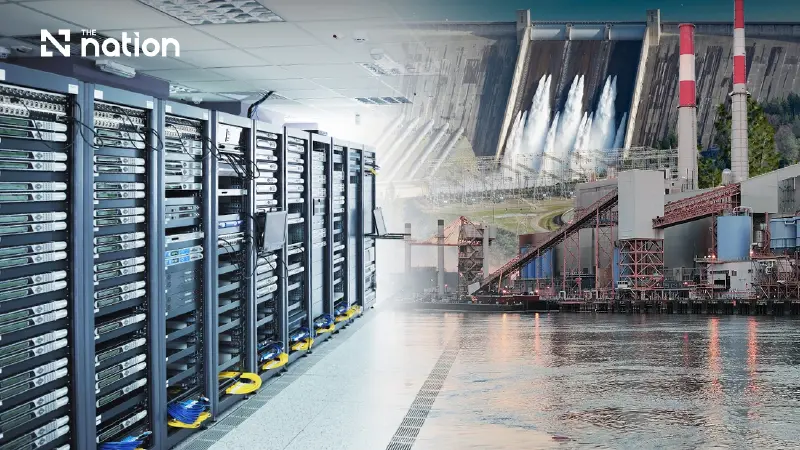


Thailand courts $20bn in data centre investment, but water shortages, grid strain and weak oversight are forcing a regulatory reckoning
- Thailand is attracting over $20 billion in data center investments, but this rapid growth is causing a severe strain on the nation's water supplies and electrical grid.
- The huge water consumption of data centers, with a single facility using as much as a small town, is threatening local communities and has led regulators to mandate more efficient cooling technologies.
- Massive and volatile electricity demand from data centers is overwhelming the power grid, forcing reliance on expensive imported gas and leading to new tariffs to protect household energy bills.
- In response, the Thai government has halted new investment applications and is implementing a strict screening framework to manage the sector's impact on national resources and ensure domestic economic benefits.
Thailand courts $20bn in data centre investment, but water shortages, grid strain and weak oversight are forcing a regulatory reckoning.
The headlines across South-East Asia read like an economic renaissance: multibillion-dollar pledges, sprawling server farms, and a digital transformation drive reshaping the region's economy.
Investment applications worth more than 728 billion baht ($20 billion), spanning 36 data centre and cloud-service projects, piled into Thailand's Board of Investment (BOI) before the agency halted new data-centre investment-promotion applications altogether in April 2026, as regulators moved to get ahead of a sector outpacing its own oversight.
The country already hosts 42 commercially operating data centres, according to the National Economic and Social Development Council (NESDC), with those 36 applications still working through the pipeline.
The stakes are real: second-quarter GDP grew a modest 1.9 per cent, but a surge in machinery and electronics trade tied to AI demand has emerged as one of the economy's few genuine growth engines, says Dr Supavud Saicheua, NESDC chairman.
Supachai Chearavanont, chief executive of Arise Ventures Group and senior vice-chairman of CP Group, calls the expansion an unprecedented economic catalyst.
Over five years, Thailand could scale up to 10 gigawatts (10,000MW) across ten provinces — a three-trillion-baht footprint lifting the country from its current baseline of 120–200MW towards benchmarks such as Japan (1.5GW) and South Korea (3.5GW).
Thailand's data centre market, worth $1.45 billion in 2025, is forecast to reach $6.29 billion by 2031, with Google, AWS, Microsoft, ByteDance and SIAM AI Cloud among the hyperscalers already committed.

Yet beneath these numbers lies an acute resource conflict.
As server farms proliferate across industrial corridors such as Chonburi and Rayong in the Eastern Economic Corridor, Thailand faces a high-stakes dilemma: how to balance AI's voracious resource demands against the water and power needs of its own citizens and traditional industries—without the dedicated regulatory architecture such a fast-moving sector demands.
The Localised Squeeze: Watersheds Under Strain
At the heart of the debate is an uncomfortable physical reality: data centres are not clean, weightless clouds. They are massive, resource-hungry structures that act, as one industry comparison puts it, like giant straws dipped directly into local water supplies.
Hyperscale facilities can draw up to five million gallons a day – equivalent to a town of 50,000 residents – historically lost through evaporative cooling towers that drain water tables and reduce river base flows.
Under the new Four-Pillar framework, regulators no longer permit such high-draw evaporative systems for new projects: operators must instead adopt closed-loop or liquid cooling technologies and secure verified proof of local water surplus before construction begins.
In the farming and fishing communities of Chonburi and Rayong, fears over water security have spiked.
Satha Vanalabhpatana, chief sustainability officer at Amata Corporation, says the sector's central challenge is integrating data centres without disrupting resources local communities depend on: traditional industries consume medium levels of water and medium-to-high electricity, while data centres consume very high volumes of both.

He warns Thailand may be “overexcited” about the trend without a blueprint, urging policymakers to define “balance”. Adding to the tension: investigations have revealed “phantom demand” — developers signing overlapping water-reservation contracts with multiple suppliers, artificially inflating scarcity figures and obscuring true supply limits.
Assistant Professor Dr Kessara Thanyalakpark, managing director of Sena Development, argues the state must look beyond simple investment tallies.
Data centres resemble industrial real estate, such as logistics warehouses, she notes, but consume a disproportionate share of national resources — so policymakers must weigh their worth in relative terms: if the same incentives were channelled towards industries with longer supply chains, would the country secure broader returns?
The question, in her view, is no longer whether to attract data centres but how to attract them on terms that give something proportionate back.
The Net-Zero Paradox and AI's Volatile Appetite
The debate extends well beyond water to the electrical grid. Akanat Promphan, Minister of Energy, points to a gap between corporate marketing and reality: operators publicly demand 100 per cent clean energy, yet on arrival often request “any power immediately” simply to begin operations.
Because Thailand's baseline grid relies heavily on natural gas, powering data centres with legacy electricity forces the state to import expensive LNG — costs that, pooled across ordinary rate classes, would unfairly raise household bills.
To prevent this, the government created a new user class, Category 9, requiring high-capacity data centres on fossil grid power to absorb the true, fluctuating cost of imported LNG directly, rather than passing it to households – a shift that has become a flashpoint with investors, who argue it erodes Thailand's cost advantage over neighbouring markets.
Operators wanting certified renewable power must instead use the Utility Green Tariff, carrying a 10–15 per cent premium — a meaningful cost given energy is roughly 70 per cent of a data centre's operating budget. The aim is to steer operators towards cheaper, more stable direct power purchase agreements.
Wattanapong Kurovat, director of the Energy Policy and Planning Office, says data centres are now the primary driver of Thailand's rising power demand, running around the clock.
Under the draft Power Development Plan (PDP 2026), the government has capped allocated growth capacity at roughly 8,000MW—even though Pongsakorn Yuthagowit, deputy governor of the Provincial Electricity Authority, reveals paper applications already exceed 30,000MW, many of them speculative.
Pongsakorn cautions against allocating capacity to data centres over higher-value manufacturing, such as petrochemicals, which tends to generate broader employment.
Technical risks vary by workload.
Jakgree Sirimaneewattana, assistant governor of EGAT, explains that traditional cloud storage draws flat, manageable power, while AI data centres – running GPU hardware up to five times costlier than standard servers, Supachai notes – create volatile spikes, threatening grid stability.
EGAT has responded with Grid Capability Maps, updated Grid Codes, and dedicated battery storage. William Zhang of Huawei Technologies Thailand argues the answer is an AI-enabled smart grid; Dr Areeporn Asawinpongphan of the TDRI adds that long-standing manufacturers also need green power and should not be crowded out of the queue.

Global Warnings, Local Consequences
Thailand's dilemma mirrors a wider pattern. In Ireland, data centres now consume more than a fifth of national metered electricity, a strain so severe operators have turned to polluting off-grid generators.
In Virginia's Loudoun County, the world's densest cluster, the sector consumes more than a quarter of state electricity, even as rapid load growth prompts utilities to propose new gas-fired plants.
In Uruguay and drought-hit Europe, public pushback over water use has pushed operators towards direct-to-chip liquid cooling.
As developers push closer to Bangkok to cut latency, the impact shifts to residential neighbourhoods: round-the-clock cooling towers test night-time noise limits of 50–55 dB(A), diesel backup generators release PM2.5 and NOx during testing, and superheated exhaust air worsens the urban heat-island effect.
Operators increasingly must install acoustic-attenuation packages, use ultra-low-sulphur diesel with catalytic reduction, and model heat dispersion at the design stage.

The Regulatory Counter-Attack
Recognising that unchecked expansion threatens local ecosystems and utility stability, the NESDC has warned Thailand still lacks a dedicated oversight law and a centralised governing body — even as those 36 applications worth 728 billion baht pile up.
It also flagged that more than 60 per cent of data centre investment goes towards imported IT equipment, leaving Thai firms concentrated in construction, land and utilities rather than higher-value work.
In response, the government has tightened the gate. No new data centre investment-promotion applications have been accepted by the BOI since April 2026, while the BOI, the Office of National Water Resources and the NESDC finalise a Four-Pillar Screening Framework that all future projects must clear:
|
Pillar |
Mandated requirement |
|
1. Energy Security |
Must demonstrate grid-stability protocols, use approved green-tariff structures, and avoid displacing capacity earmarked for manufacturing. |
|
2. Water Resource Limits |
Must use closed-loop or liquid-cooling technologies and obtain verified local surplus clearance before construction. |
|
3. Environmental Impact |
Must comply with strict thermal-discharge, urban heat-mitigation and 50–55 dB(A) acoustic thresholds. |
|
4. Domestic Benefit |
Must demonstrate concrete technology transfer, local high-skilled employment and supply-chain integration beyond raw land consumption. |
Joint Power and Water Resource Mapping will restrict future data centres to zones with documented resource surpluses, barring new water-cooled facilities from vulnerable watersheds.
The NESDC has also called for mandatory resource-use reporting, local-content requirements, workforce training and a formal mechanism for public participation in project planning — giving affected communities a route to raise concerns before, not after, construction begins.
Navigating the Digital Frontier
Thailand stands at a pivotal intersection. Housing the world's digital infrastructure offers genuine economic potential, but physical data centres carry equally real resource costs a headline investment figure does not capture.
As Satha Vanalabhpatana and Dr Kessara Thanyalakpark both argue, success depends less on how much capital arrives than on policy clarity and a clear-eyed view of what the country gets back.
Through targeted tariffs, grid mapping and resource-aware screening, Thailand is trying to ensure the digital economy's promise does not come at the expense of the rivers, grids and neighbourhoods that must carry its weight.
