
Thailand pauses 166 data centre projects to rewrite rules



Four panels have one month to draft standards covering water, power, sites and environmental safeguards, with three Bangkok applications on hold
- The government has paused 49 data centre projects under construction and 117 awaiting approval, totalling 166 projects.
- The board has established four subcommittees to develop standards covering economic benefits, infrastructure, locations and the environment within one month.
- The new rules will regulate water and electricity use, locations and safety, while promoting clean energy and technology transfers.
Thailand has ordered a temporary pause on 166 data centre projects while government agencies draw up nationwide standards governing resource use, locations, safety and economic benefits.
The data centre policy board issued the decision at its first meeting on September 4, 2026. It covers 49 projects under construction and 117 awaiting permission from various agencies.
Four subcommittees have been given one month to prepare the new criteria. The government intends to continue attracting investment while ensuring that projects generate jobs, income and technological benefits for Thailand, rather than simply providing space for servers.
Deputy Prime Minister and Finance Minister Ekniti Nitithanprapas, who chaired the meeting, identified three immediate priorities — consolidating industry data, establishing minimum standards and increasing the benefits Thailand receives from investment.

Project review extends to Bangkok
Danucha Pichayanan, secretary-general of the National Economic and Social Development Council (NESDC), said information gathered from 16 government agencies showed that 35 data centre projects were already operating.
Of these, 11 had received investment promotion from the Board of Investment (BOI), while 24 had obtained permission through other channels. Most of the latter were in industrial estates already subject to site controls. Financial institutions also operated about three or four smaller data centres.
Before approvals resume under common national standards, the board wants a fuller assessment of project details, locations, water and electricity sources, and effects on surrounding communities.
Bangkok Governor Chadchart Sittipunt said six data centre projects had applied for permission in the capital, each requiring between 9 and 23 megawatts of electricity.
Three were approved and began operating between 2022 and 2024. City officials will conduct spot checks covering noise, heat, safety and other nuisance impacts on communities, using the findings to inform the new rules.
The other three applications will remain on hold until the national board establishes clear policies and standards.


Fragmented approvals obscure resource demands
Investors currently seek permission separately from electricity utilities, water authorities and local building regulators. Each agency assesses matters within its remit, leaving no single body with a complete view of a project’s resource needs, proximity to communities or economic returns relative to its costs.
Some data centres are also registered under other business categories, including warehousing, making it harder to establish the industry’s true scale. The board has instructed the Department of Business Development to create a dedicated business classification.
Officials will also reconsider a proposal to regulate data centres with electricity demand exceeding 2 megawatts as industrial factories. The board considered that threshold too low for the scale of projects currently in the market.
Large data centres require electricity around the clock and substantial water supplies for cooling. Their locations therefore affect surrounding communities, local power networks and water resources.
Many projects also need substations and fuel storage for backup generators, adding safety concerns when facilities are located in urban areas or close to homes.
Minimum standards will cover both commercial facilities serving outside customers and data centres built for organisations’ own use.
New projects will have to meet requirements covering town planning, separation from neighbouring buildings, safety, electrical systems, backup fuel storage and environmental protection. Existing operators will receive a transition period to bring their premises and systems into compliance.

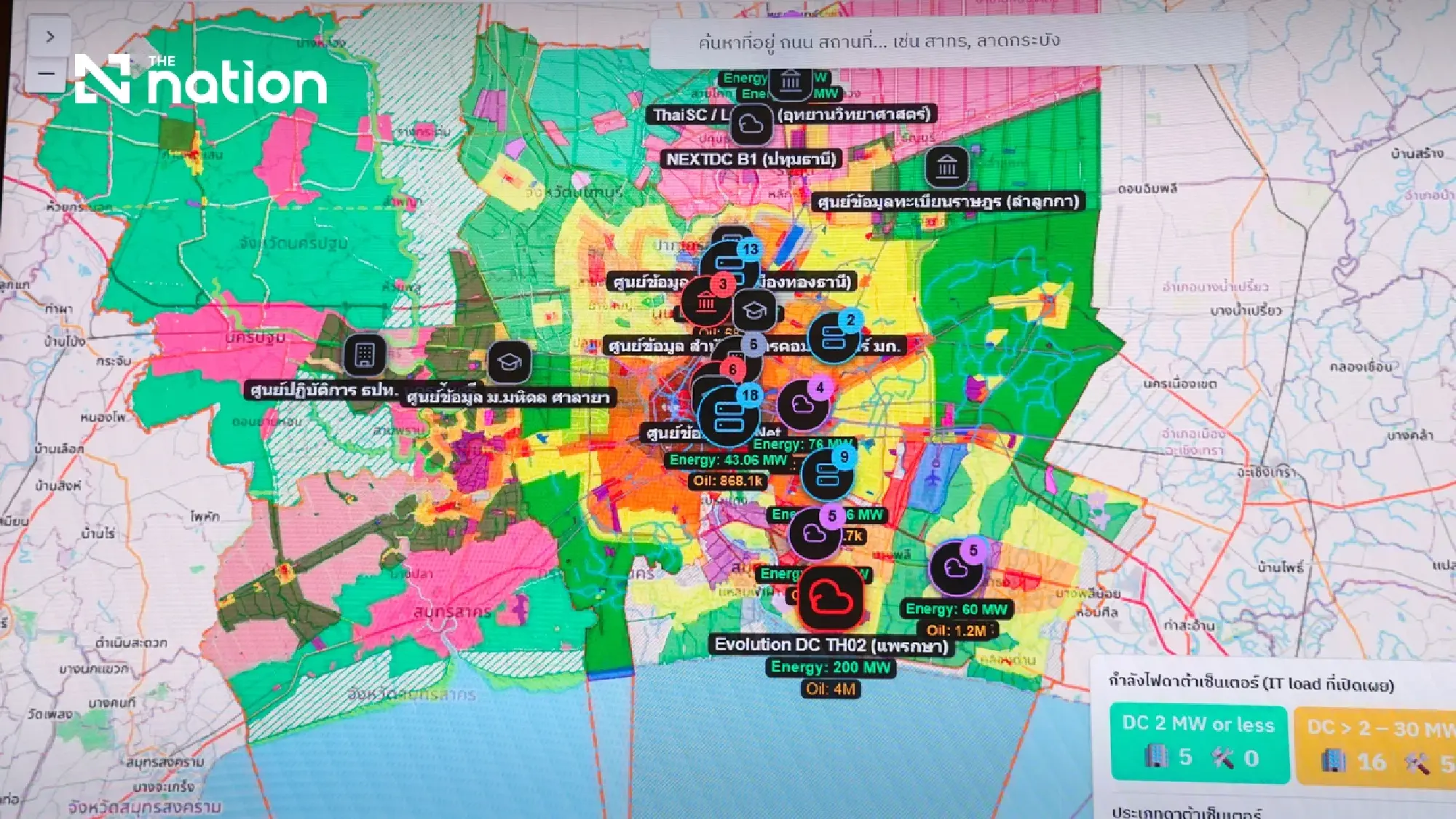
Digital Economy and Society Minister Chaichanok Chidchob proposed a central dashboard that can be updated immediately, displaying the following information.
- Project locations and status.
- Water sources and electricity supplies.
- Town-planning requirements.
- Applicable rules and regulations.
The dashboard would allow agencies to assess cumulative impacts and track projects from application through construction and operation to subsequent inspections.
Investment to be assessed on benefits for Thailand
The government wants data centres to give Thai people and small and medium-sized enterprises (SMEs) access to cloud services and artificial intelligence (AI) computing capacity at affordable costs.
It is also preparing a competitive proposal process for future projects, assessing investors on their contribution to Thai employment, technology transfers, clean-energy use and reductions in greenhouse gas emissions.
Water and electricity prices should reflect direct and indirect costs so that households and other businesses do not subsidise large operators’ resource use.
The board established four subcommittees to develop detailed criteria within one month.
- Economic benefits — Chaired by the NESDC secretary-general, this panel will assess value for money, employment and technological benefits.
- Infrastructure — Chaired by the permanent secretary for energy, it will examine water, electricity and digital-network provision, ensuring that allocation to data centres does not crowd out public needs.
- Sites and buildings — Chaired by the permanent secretary for interior, it will assess locations, buildings, substations and backup fuel-storage facilities.
- Environment — Chaired by the permanent secretary for natural resources and environment, it will develop green standards and procedures for inspections after facilities begin operating.
The measures form part of Thailand’s ambition to become an Asian hub for environmentally sustainable data centres.
BOI Secretary-General Narit Therdsteerasukdi said clear rules would strengthen long-term investor confidence by allowing businesses to understand costs, conditions and resource availability from the outset.
The four panels must submit their proposed criteria within one month.
