
Thailand reports agreement on core terms of US trade deal
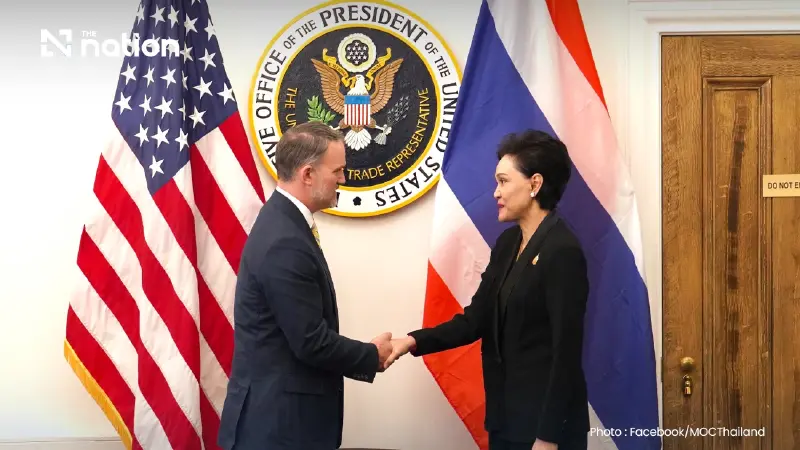


Suphajee says Washington has assured Thailand of fair, competitive tariffs, while negotiators work to settle remaining technical details
- Deputy Prime Minister and Commerce Minister Suphajee Suthumpun held talks with the US Trade Representative (USTR), reaching agreement on the main terms of the Agreement on Reciprocal Trade (ART).
- The United States assured Thailand that tariffs resulting from the Section 301 investigation into excess production capacity would be fair and competitive.
- The ART negotiations are crucial to maintaining the competitiveness of Thai goods in the United States, Thailand’s largest export market.
- Both sides agreed that their technical negotiating teams should finalise the remaining details of the agreement as quickly as possible.
Thailand and the United States have reached agreement on the main terms of a reciprocal trade pact, with Washington offering assurances on tariff competitiveness while negotiators work to resolve the remaining details, Deputy Prime Minister and Commerce Minister Suphajee Suthumpun said.
Suphajee announced the progress on Friday (September 4) following talks with US Trade Representative Jamieson Greer and Deputy US Trade Representative Rick Switzer in Washington on September 1.
She said the two sides had settled the substantive issues before the United States announced the outcome of its Section 301 investigation into structural excess production capacity. US officials assured Thailand that tariffs resulting from that investigation would be fair and competitive, she added.
Both sides agreed that their technical teams should complete the outstanding details as quickly as possible.

Four days of talks narrow differences
Suphajee described the discussions as constructive, saying US officials welcomed Thailand’s commitment and acknowledged concrete progress in the negotiations.
The visit was intended to bring the Thailand–US Agreement on Reciprocal Trade (ART) closer to completion. She said the prime minister and Cabinet had entrusted her with the negotiations, supported by close co-operation among relevant agencies, to safeguard both countries’ long-term interests.
Before travelling, Suphajee had closely monitored negotiations and spoken to Greer by telephone on August 27 to reiterate Thailand’s intention to accelerate the talks and reach a conclusion.
The Thai delegation also held four consecutive days of discussions with US counterparts, working through technical issues on which their positions had previously differed.
Suphajee said the visit followed months of Thai efforts to advance the agreement and strengthen relations with the United States across all areas.

Two tariff cases shape negotiations
Thailand has consistently recorded a trade surplus with the United States, with the imbalance tending to widen each year. Suphajee said Washington had used tariffs to press surplus-running trading partners into negotiations aimed at rebalancing trade.
Thailand initially faced a 36% reciprocal tariff under the International Emergency Economic Powers Act (IEEPA), later reduced to 19%. The joint framework announced on October 26, 2025, provided for the United States to maintain the 19% rate.
After the US Supreme Court ruled in February 2026 that IEEPA did not authorise the tariffs, Washington turned to Section 122 to impose a temporary 10% general import tariff. With that measure subject to a time limit, the United States pursued two Section 301 investigations covering Thailand and other trading partners.
The cases concern distinct issues
Forced-labour import restrictions — Whether trading partners prohibit and effectively prevent imports of goods made with forced labour. Washington has set a 12.5% tariff for economies that have failed to adopt a prohibition and a 10% rate for those making qualifying commitments to adopt and effectively enforce one, including through reciprocal trade agreements. Product exemptions apply.
Structural excess production capacity — The outcome remained under consideration at the time of Suphajee’s announcement. She said US officials intended to expedite tariff decisions alongside progress in the reciprocal trade negotiations.
The lower forced-labour-related rate therefore depends on the relevant commitments, rather than simply on concluding a trade agreement.
Export access and jobs at stake
Suphajee said completing the negotiations was crucial to preserving Thai exporters’ competitiveness in the United States, Thailand’s largest export market, and protecting more than 400,000 domestic jobs. It would also help maintain and strengthen investor confidence in Thailand.
The United States was Thailand’s second-largest trading partner in 2025. Bilateral trade figures showed the scale of the relationship.
- Total trade exceeded 3 trillion baht.
- Thai exports to the United States reached 2.37 trillion baht.
- Imports from the United States were valued at about 700 billion baht.
- Thailand’s reported trade surplus was 1.68 trillion baht.
Suphajee described ART as the framework Washington is pursuing with trading partners with which it runs a deficit. Its purpose is to rebalance bilateral trade, with negotiations covering issues including non-tariff barriers, digital trade and commercial opportunities.
She said a mutually beneficial final agreement could help Thailand secure tariff treatment competitive with neighbouring countries, preserve Thai businesses’ position in the US market and protect livelihoods in manufacturing, industry and agriculture, as well as household incomes.
Technical negotiators from both countries have been tasked with settling the remaining details as soon as possible.
