
AVEVA: Software Is the 'Brain' Behind Thailand's Energy Security Push
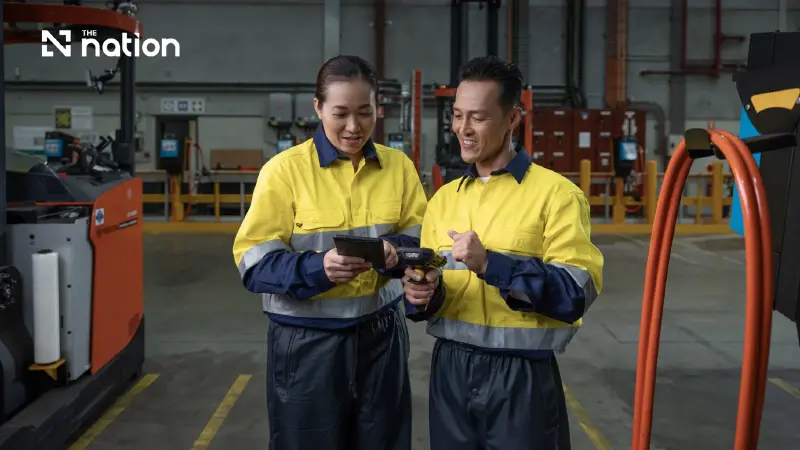


At Gastech, AVEVA executives say industrial AI is helping Thai energy firms cut downtime and manage volatile costs
- Thai energy companies are using AVEVA's industrial AI software to manage key threats to the nation's energy security, such as volatile costs, feedstock shortages, and geopolitical uncertainty.
- The software utilizes predictive analytics to anticipate equipment failures, significantly reducing unplanned downtime and increasing plant reliability for a more stable energy supply.
- AI-driven tools optimize the performance of gas plants and LNG trains, improving throughput while also helping to reduce resource consumption and carbon dioxide emissions.
- AVEVA's platform integrates data from traditionally separate gas and power sectors, breaking down information silos to enable more holistic management and smarter operational decisions.
At Gastech, AVEVA executives say industrial AI is helping Thai energy firms cut downtime and manage volatile costs.
Thailand's energy operators are turning to artificial intelligence to shore up supply security and rein in costs, as the kingdom's industrial base contends with feedstock shortages, price swings and a fast-approaching wave of data-centre demand, according to two senior executives at British-headquartered industrial software group AVEVA.
Speaking on the sidelines of Gastech in Bangkok on Wednesday (September 16th), Rob McGreevy, AVEVA's chief product officer, and Chris Lee, senior vice president and head of Asia Pacific, said the company's software was increasingly being used by Thai energy producers to navigate a difficult second half of the year, marked by geopolitical uncertainty and volatile input costs.
"Like the rest of the world, Thailand is also subject to geopolitical uncertainties," McGreevy said, pointing to feedstock shortages and price volatility as key concerns. "It's quite important for Thailand to make sure it has a resilient, strong energy base to provide for its citizens and its industries."
The comments come at a sensitive moment for the Thai industry. Retail fuel prices climbed roughly 34 per cent between January and May this year, while domestic urea prices surged by 50 to 75 per cent, driven largely by the kingdom's reliance on Middle Eastern crude and gas amid the conflict between the US, Israel and Iran and the resulting disruption to shipping through the Strait of Hormuz.
Natural gas alone accounts for 66 per cent of Thailand's energy mix, with fossil fuels making up roughly 85 per cent of electricity generation, leaving the country exposed to swings in global supply.

McGreevy said AVEVA's software could help producers manage that exposure by analysing which feedstocks are available and guiding purchasing decisions, as well as optimising the performance of gas plants and LNG trains.
"Our software can help optimise LNG trains and gas plants to improve performance and throughput," he said, adding that the technology also delivered productivity gains for the engineers, operators and maintenance staff who run the facilities.

AI moves from monitoring to prediction
Much of the conversation centred on how artificial intelligence is being layered onto AVEVA's existing engineering and operations software, which the company describes as the "centrepiece" of many industrial facilities.
McGreevy cited Malaysia's Petronas as an example of a customer using AVEVA's AI tools for predictive analytics, allowing the company to flag equipment problems before they occur.
"The AI predicts which equipment might have issues, might have problems, well before they become a problem," he said, adding that Petronas had saved "tens of millions of dollars" in cost avoidance as a result.
He also pointed to Saudi Arabia's Aramco, which he said was using AVEVA's optimisation software to run closed-loop control — AI systems that draw on physics-based models to lift production margins without human intervention at every step.
Beyond reliability, McGreevy said AI was also being used to cut resource use and emissions.
"Large facilities and plants use a lot of water, steam, air and natural gas just to run," he said. "The AI can look at how all those things are used and reduce consumption."
The same tools, he said, were being applied to reduce carbon dioxide emissions, helping plants "produce more, but do it in a safe and sustainable way."

On newer energy infrastructure, McGreevy said AVEVA's design software, Unified Engineering, was already being used to model hydrogen facilities and simulate carbon capture projects, while the company's operations software could then monitor emissions once such facilities were running to support compliance with local regulations.
"Transparency and traceability is a big part of it," he added.

Breaking down the wall between gas and power
Lee, who leads AVEVA's Asia Pacific business from Singapore, said one of the company's biggest contributions in a region where gas and power are increasingly intertwined had been to dismantle the data silos that traditionally separate the two.
"The source of real-time data can also be very drastically different," he said of gas and power production. "One of the biggest contributions AVEVA has made is to break down the wall of the silo."
He said the company's CONNECT platform allowed operators to bring together IT, engineering and operating data in a single system for the first time and to make that data available to whichever large language model a customer chose to deploy.
"We do not want to constrain our customers to any single model," Lee said, noting that PTT, Petronas and Sinopec might each favour different AI platforms. "For the first time in the industry, you do not have the constraint of operating within one language model."
Lee pointed to two Thai case studies to illustrate the impact. SCG Chemicals, he said, had lifted plant reliability from 98 to 100 per cent using AVEVA's predictive analytics — a gain he described as substantial given the scale of the operations involved — and had achieved a return on its investment within six months.
"That 2 per cent increase is a lot," he said. "And it happened very fast." Power producer B.Grimm, meanwhile, had used AVEVA's tools to improve its ability to plan and control downtime, including at newly built plants, generating savings of more than a million dollars on a single greenfield project.
"The biggest risk that they have is unplanned downtime," Lee said. "Every time you can reduce your unplanned downtime, it's a big differentiator for you as an energy producer."
Lee said AVEVA's platform was designed to be agnostic to underlying hardware, allowing it to draw in data from multiple vendors and rapidly build a digital twin of a customer's operations without manually tagging every piece of equipment.

Betting on the Eastern Economic Corridor
Asked about Thailand's Eastern Economic Corridor—the petrochemical, digital and bio-circular economy cluster at the heart of the government's Thailand 4.0 strategy—Lee called it "a very important initiative" that had created "an unprecedented opportunity for the country to really transform itself."
He said AVEVA was working with local enterprises to help them optimise production against variable raw material supply, citing one unnamed Chinese customer that had found a cheaper grade of feedstock actually performed better in its plant.
"Because they know how to bid at the right price, they have become very competitive and very profitable," he said.
He added that AVEVA offered customers the flexibility to run its software at the edge, on-premise or in the cloud, depending on where a facility sits in its digital transformation journey — a point he said mattered given the EEC's own data infrastructure ambitions.
"We are one of the few companies in the world that provide customers with edge, on-premise and cloud-native options," he said.
On AVEVA's own footprint, Lee said the company now had more than 10 staff dedicated to the Thai market and intended to keep growing, framing Thailand as a base for serving Southeast Asia more broadly, alongside customers such as PTT that have themselves expanded regionally.
"We are growing together with our customers from Thailand and across Southeast Asia," he said.
The remarks reflect the scale of the task facing Thai policymakers. The country's draft revised Power Development Plan targets 51 per cent renewable generation by 2037, a shift officials say could save some $16 billion in fuel costs, while data-centre and AI-driven electricity demand is projected to add a further 10 terawatt-hours to the grid by the same year.
McGreevy said the company saw software as central to bridging that gap without compromising reliability. "The software really can help mitigate a lot of the challenges we see with the energy landscape here in Thailand," he said.
