
Veolia maps sustainable path for Thailand’s data-centre boom
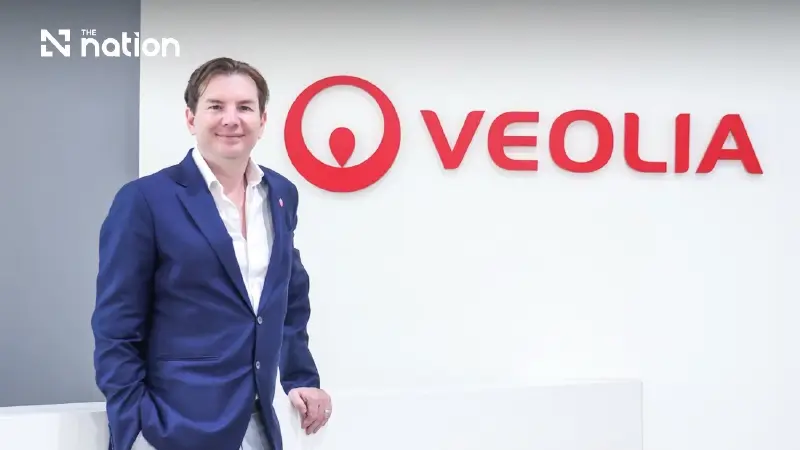


Veolia links Thailand’s data-centre growth to environmental security, cleaner energy, efficient water use and stronger waste systems.
- Thailand's ambition to become a digital hub is driving significant data-centre growth, which will place considerable strain on its power, water, and waste infrastructure.
- Veolia advocates for an "environmental security" approach, managing the interconnected impacts of data centres on energy, water, and waste in a holistic, rather than siloed, manner.
- The substantial and predictable energy needs of data centres can be used to catalyse investment in renewable power, while their waste heat can be recovered for community use if planned correctly.
- To mitigate environmental impact, solutions include recycling municipal wastewater for cooling, establishing circular systems for electronic waste, and strategically locating new facilities in areas with suitable infrastructure.
Thailand’s ambition to become a stronger artificial intelligence (AI) and digital hub will require more than additional data-centre capacity. It will also need parallel investment in power and water systems, waste management and other supporting infrastructure if rapid growth is to avoid creating new environmental pressures.
According to the Board of Investment (BOI), 42 projects approved for investment promotion between 2024 and 2026 represent a combined investment value of THB750 billion and an IT load of about 3,400 megawatts.
While the projects are expected to strengthen digital capabilities, create highly skilled jobs, support domestic supply chains and expand the country’s AI ecosystem, the BOI is also tightening its scrutiny of their electricity and water use and environmental impacts.

Data centres and environmental security
In an exclusive interview with The Nation, Jerome Le Borgne, Country Representative for Veolia in Thailand, described data centres as “two sides of the same coin”: facilities that consume substantial amounts of energy and water, while also providing the computing power needed to support economic development, efficiency and new technologies.
“On one side, it is definitely an asset that consumes energy and water. And on the other side, it’s also something that will provide compute power to provide intelligence. It’s all about managing the environmental impact of the data centre.”
For Veolia, that balance forms part of a wider concept of environmental security, in which energy, water and waste infrastructure are treated as interconnected systems rather than separate challenges.
The company’s Data Centre Resource 360 model reflects this approach, combining low-carbon energy systems, optimised cooling and water reuse with circular solutions covering electronic waste, hazardous waste and battery recycling.
Digital growth requires physical infrastructure
Le Borgne believes Thailand has the potential to develop into a strong regional digital hub, pointing to the country’s existing digital infrastructure. But he stressed that digital development ultimately depends on physical systems capable of supporting it.
“In order to become a digital hub, you need to have infrastructure. Because you need to go from the digital to the physical. It is the power, the water, everything we talked about.”
The challenge, he added, is to ensure that Thailand’s push into the digital economy does not create new environmental-security problems in the process.
This means planning new electricity generation and transmission capacity alongside data-centre development, while placing greater emphasis on low-carbon sources.
Le Borgne sees direct power purchase agreements (PPAs) as one mechanism that could help decarbonise the sector and suggested that Thailand could consider extending the model to a broader range of energy sources, including bioenergy, biogas and biomethane.
Data centres could also become a catalyst for renewable energy investment because their large and relatively predictable electricity demand can provide the offtake needed to support projects that might otherwise struggle to become commercially viable.
“The economic model of data centres relies a lot on energy, and they also have the capacity to drive renewable energy projects that might not be feasible today. You can look at it as an enabler of renewable energy projects.”

Managing water pressure
Water is another central issue as data-centre capacity expands, particularly because cooling systems can place additional pressure on local supplies.
Veolia’s approach includes water recycling, closed-loop systems, water-quality management and technologies designed to make cooling more efficient. In a project in Illinois in the United States, improvements to cooling-system chemistry and controls reduced water use by 50%.
Le Borgne also pointed to Veolia’s work with Amazon Web Services (AWS) in Mississippi, where the company developed a system to recycle municipal wastewater for use by a data centre rather than drawing water directly from a river.
Such solutions, however, depend heavily on the infrastructure surrounding a project.
“If you want to do things sustainably, you sometimes need time to plan and identify the gaps. It starts with the location: putting your data centre in a place where you already have that infrastructure.”
That planning principle also applies to waste heat generated by data centres. If facilities are located close to industries or communities capable of using the heat, it can potentially be recovered rather than discarded.
At Veolia’s project in Braunschweig, Germany, heat recovered from a data centre is integrated into a district heating network that supplies low-carbon heat to 56,000 residents.
Location and regulation become critical
For Thailand, Le Borgne sees industrial estates as potentially well suited to supporting data-centre campuses because they can provide an environment in which electricity, water, waste and other infrastructure are planned together.
He also believes regulators should establish clear criteria for where data centres should be located and set measurable environmental-efficiency targets, including water usage effectiveness (WUE) and power usage effectiveness (PUE). Such targets could also be linked to BOI incentives.
“Our view is that the answer is to stop looking at silos and look at a holistic approach. It’s not just finding land that has power, but finding places where you can have a positive impact on water and use your heat.”
Waste will become another consideration as servers, chips and other electronic equipment reach the end of their operating lives.
Le Borgne warned that without adequate recovery infrastructure, valuable materials could enter non-compliant waste streams rather than being properly recovered and returned to manufacturing.
He argued that building a stronger waste-recovery system could eventually support Thailand’s wider digital and microelectronics industry.

Veolia broadens environmental role in Thailand
Veolia’s activities in Thailand already extend beyond data centres. The company provides water systems and water-quality chemicals used to improve cooling performance, including direct-to-chip cooling applications, and operates a facility in Chonburi treating non-hazardous industrial waste.
Veolia’s Engineering and Consulting division is also working with the Asian Development Bank (ADB) on water and air projects in Thailand.
Water-related work includes stormwater management and sponge-city planning in Bangkok, Ayutthaya, Khon Kaen, Surat Thani and Phitsanulok, as well as projects involving Koh Samui, Koh Sichang, Koh Chang and Koh Phi Phi.
On Koh Samui, Veolia is examining water recycling as part of efforts to address water shortages, while recognising that wastewater-treatment infrastructure would also need to improve.
For Le Borgne, such projects illustrate the same principle that should underpin Thailand’s data-centre expansion: environmental challenges are interconnected and need to be planned as a system.
“The key message is really about environmental security, and how all issues are quite connected, and how you have to look at this in a holistic approach if you want to move forward.”
As Thailand attracts further investment in AI, data centres and microelectronics, the opportunity is therefore not simply to expand digital capacity, but to build the energy, water and circular-resource infrastructure around it, allowing the digital economy to grow while managing environmental pressures and delivering longer-term value to surrounding communities.
