
Thailand and Russia explore AI, robotics and smart city investment
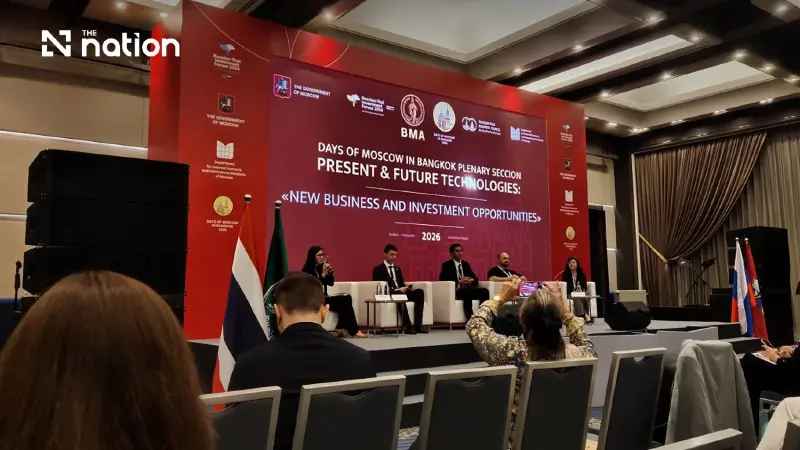


Russian-Thai Investment Forum 2026 speakers in Bangkok explore investment in AI, smart cities and robotics, stressing digital security and local partnerships.
- Representatives from Russia and Thailand have identified artificial intelligence, cybersecurity, smart city systems, and industrial automation as key areas for closer investment cooperation.
- Russian businesses are advised to collaborate with local Thai partners to understand market demands and concentrate on specific technological niches, such as video analytics, traffic management, and digital education.
- Thailand is actively seeking Russian investment for its Eastern Economic Corridor (EECiti) smart city project, offering opportunities in digital infrastructure, clean energy, and smart city management systems.
- Joint projects in industrial automation and robotics are seen as a significant opportunity, with Thai government incentives available for ventures that help upgrade the country's manufacturing sector.
Russian and Thai representatives have identified artificial intelligence (AI), cybersecurity, smart city systems and industrial automation as areas for closer investment cooperation, with local partnerships and secure technology deployment central to turning opportunities into projects.
They were speaking during the “Present & Future Technologies: New Business and Investment Opportunities” panel, held as part of Days of Moscow in Bangkok at the Russian-Thai Investment Forum 2026 at the Royal Orchid Sheraton Riverside Hotel Bangkok on Friday (October 30).
Local demand comes first
Egor Glukhov, digital attaché at the Trade Representation of the Russian Federation in the Kingdom of Thailand, identified cybersecurity, smart city infrastructure and AI as promising areas for cooperation.
He outlined applications ranging from video analytics and traffic management to public safety and the integration of data across different platforms. Cybersecurity opportunities included threat detection, access management, incident monitoring and protection for industrial systems.
Digital education offered further scope for collaboration through distance learning, robotics training and the development of digital skills.
Glukhov described the AI market as highly competitive and recommended technologies that complement existing products or offer something different. Solutions that reduce electricity and water costs could also deliver benefits for large projects.
For Russian businesses entering Thailand, Glukhov recommended working with local partners who understand customers, market conditions and emerging demand. Companies should concentrate on a specific niche and establish whether their technology addresses an actual local need, he explained.
Sending presentations indiscriminately would be ineffective in a competitive market. A solution regarded as important by its developer might address a problem that local customers did not yet consider a priority.
He also pointed to healthcare and AI applications as opportunities, suggesting that companies consider Thailand as an entry point to the wider regional market.
He cautioned that support was not automatic and that businesses needed to demonstrate their projects’ merits. The Trade Representation was ready to assist companies from both countries.
EECiti seeks investment partners
Korthong Thongtham na Ayutthaya, acting director of the EECiti Division at the Eastern Economic Corridor Office, outlined investment opportunities across five clusters: healthcare, digital industries, next-generation automotive, the bio-circular-green economy and services.
He presented EEC Capital City, or EECiti, as a planned centre for business and an international community in eastern Thailand. The project covers 24 square kilometres, with about nine square kilometres of land already secured, and has a goal of net zero carbon emissions by 2050.
The development would combine business premises, healthcare, education, technology industries, leisure and housing, including affordable homes. Korthong also described plans for sports facilities that could accommodate overseas athletes training in Thailand.
An integrated infrastructure package would bring together clean energy, electricity, water recycling, waste management, digital networks, transport and public spaces. He identified opportunities for Russian partners in digital infrastructure, smart city management systems and clean energy.
The office was inviting potential investors to discuss technical requirements, financial terms and business models, with the aim of preparing specifications for bidding by mid-2027. Korthong also invited proposals for the city’s six real estate zones and discussions on tax and non-tax incentives.
Asked about the planned rail link connecting three airports, he acknowledged longstanding obstacles and indicated that changes to the project were being considered.
Digital identity needs stronger safeguards
Nikolay Shiryaev, VisionLabs’ director of business development and sales for Southeast Asia, described opportunities in biometrics and video analytics, noting that customers had been deploying the company’s technology in Thailand for almost three years.
He illustrated how digital identification is already used at airports and in mobile applications and financial services. He also cited facial recognition for transport payments in Moscow and biometric registration at events as further potential applications.
However, wider adoption raised questions about who controls digital identities, how they are protected and which institutions should be responsible for safeguarding them.
“Just being accurate and fast is not enough anymore. We need to add more safety here,” Shiryaev said.
He highlighted “liveness” checks designed to stop photographs being used to impersonate account holders, alongside technology to detect AI-generated images and deepfakes. Such safeguards were needed to address identity theft and fraud.
VisionLabs was also developing an educational programme to help learners in Southeast Asia create computer vision algorithms. Shiryaev expressed interest in working with Thai universities in 2027.
He stressed that Russian companies needed to understand Thai business culture and build relationships through a local or regional presence and regular contact with customers.
“If you want to work in Thailand, you need to learn to speak Thai. Not in terms of language, but in terms of culture and tradition.”
Joint projects in automation and robotics
Pravee Chanatchavarin, manager of the Thai Automation and Robotics Association, identified industrial upgrading as a substantial opportunity for cooperation.
Moving manufacturers towards Industry 4.0 would require AI, automation and specialists capable of combining different technologies into functioning production systems, Pravee explained.
Pravee highlighted Board of Investment incentives linked to domestic participation in automation projects, including enhanced tax exemptions where at least 30% of the value of the relevant machinery, automation systems or robotics is linked to Thailand’s automation industry. Russian technology and services could be combined with Thai capabilities to develop and pitch projects jointly.
Healthcare was another promising field, although meeting its standards could be difficult. Logistics and warehouses also offered opportunities as online commerce and deliveries increased demand for technology that could improve cost competitiveness.
The association could help investors identify suitable Thai system integrators and business partners. Finding the right partner could save investors time, Pravee added.
