
Thailand seeks wider US tariff relief in August talks
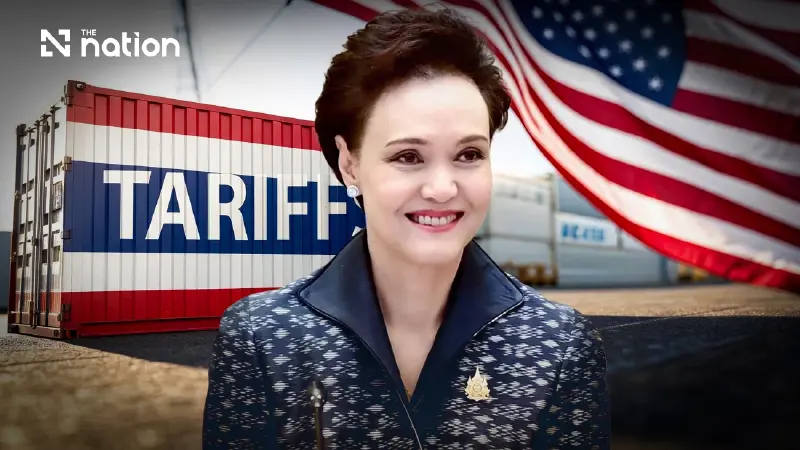


Thailand will seek more US tariff exemptions in late-August ART talks, using investment and economic cooperation to strengthen its position.
Thailand will use private-sector investment and broader economic cooperation as bargaining tools in late-August trade talks with the United States, as it seeks exemptions for 13 additional export items and relief for the roughly 28% of Thai products that remain subject to US duties, Deputy Prime Minister and Commerce Minister Suphajee Suthumpun said.
Suphajee said at Government House on Thursday (August 6) that she would lead Team Thailand to the United States at the end of the month for negotiations on the Agreement on Reciprocal Trade, or ART.
A technical delegation will accompany her, while Suphajee will handle policy-level discussions intended to broaden the negotiations beyond tariffs and the bilateral trade balance.
“Trade policy alone will probably not be enough because Thailand has a sizeable trade surplus with the United States. We need to bring other issues into the negotiations, including private-sector investment and other areas in which we can provide support,” she said.
Investment to support tariff negotiations
Suphajee said Thailand’s trade surplus meant the government needed to present a wider package covering investment and other forms of economic cooperation that could benefit the United States.
She said policy-level engagement was necessary because technical discussions could address only part of the remaining issues. During a previous visit, she held talks with the US commerce secretary to examine the broader economic relationship rather than focusing exclusively on the trade imbalance.
The strategy also draws on Thai private-sector investment in the United States. Suphajee previously said existing Thai investment there stood at US$19.3 billion, with a further US$5.5 billion planned.
Thailand seeks to expand exemption list
Suphajee said more than 2,000 Thai tariff lines had already secured exemptions.
The Commerce Ministry previously put the total number of exempted tariff lines under Section 301 at 2,120. Those exemptions cover agriculture and food, electronics, industrial products and raw materials, aircraft, medical equipment and other goods.
Once products covered by long-standing Section 232 exclusions are also counted, about 72% of Thai export products are exempt, leaving roughly 28% still subject to tariffs.
Suphajee said officials would continue examining which products could be added to the exemption list. Her latest remarks referred to a proposal covering 13 additional export items, although she did not identify the products concerned.
The ministry had earlier submitted a separate proposal covering seven product groups and 78 tariff lines, including rice, cassava products, seafood, medical rubber gloves, pet food and jewellery. The latest statement did not specify whether the 13 items form part of that request or constitute an additional group.
Previous talks focused on investment and market access
Thailand and the United States agreed to accelerate the ART negotiations during Suphajee’s visit to Washington in May.
She met US Trade Representative Jamieson Greer and Deputy US Trade Representative Rick Switzer on May 4, when the two sides discussed rebalancing bilateral trade, increasing Thai investment in the United States and expanding imports of US products that Thailand cannot produce domestically.
Thailand also pressed Washington to exempt Thai goods that are unavailable or not produced in sufficient quantities in the US market. The US side agreed to consider the proposal, while both countries committed to continuing negotiations at the technical and policy levels.
The talks build on the reciprocal trade framework announced in October 2025. Under its original terms, Thailand agreed to eliminate tariffs on approximately 99% of US goods, while Washington maintained a 19% reciprocal tariff on Thai imports and agreed to identify selected Thai products that could qualify for a zero rate.
The tariff landscape later changed, with Thailand placed in a 12.5% Section 301 band in July 2026, alongside normal most-favoured-nation duties for non-exempt products. The final ART remains under negotiation.
Tourism stimulus awaits budget clarity
Separately, Suphajee said the proposed Thai Tiew Thai Plus domestic tourism scheme remained under discussion because the government first needed to determine how much funding was available.
She said she had discussed the proposal with Deputy Prime Minister and Finance Minister Ekniti Nitithanprapas and that they would try to advance the measure.
Suphajee stressed that any support should reach businesses broadly, including small and micro-enterprises, rather than becoming concentrated among a limited group of operators.
