
Vietnam’s EVFTA advantage raises pressure on Thai exporters
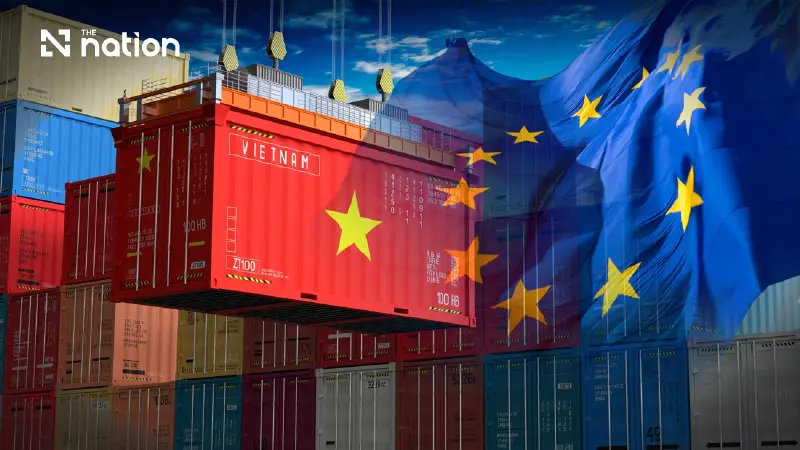


Vietnam’s access to nearly 99% of EU tariff lines could intensify competition for Thai exporters in agriculture, food, textiles and electronics.
Thai exporters could face tougher competition in the European Union as Vietnam enters the seventh year of its free trade agreement with the bloc, with nearly 99% of EU tariff lines now open to Vietnamese goods.
The Department of International Trade Promotion’s office in Ho Chi Minh City warned that Vietnam’s expanding tariff advantage could strengthen the cost competitiveness of its products and encourage European companies to direct more investment and purchase orders to the country.
Thai agriculture, food, textiles, footwear, furniture and electronics are among the sectors that could face greater pressure, along with products connected to international supply chains.
The office advised Thai businesses to reduce their reliance on price competition and differentiate themselves through product quality, standards, technology, innovation and sustainability.
August 1, 2026 marked six years since the Vietnam-European Union Free Trade Agreement, or EVFTA, took effect.
The agreement has moved bilateral economic relations beyond policy-level trade promotion towards deeper integration through market access, expanding commerce, supply-chain connections and investment.
Six EVFTA years generate 42.6% of cumulative trade
Data from Vietnam Customs and the country’s national statistics office showed that total trade between Vietnam and the EU exceeded US$900 billion between January 1995 and June 2026.
Of that amount, about US$383.8 billion, or 42.6% of accumulated trade over more than three decades, was generated during the six years after the EVFTA entered into force.
The figures indicate that tariff reductions and greater market access under the agreement accelerated bilateral trade.
The Vietnam Trade Office in Belgium and the EU reported that two-way trade increased from US$49.8 billion in 2019, before the agreement took effect, to US$74 billion in 2025.
Trade reached US$41.7 billion in the first six months of 2026. Vietnam exported goods worth US$31.8 billion to the EU and imported US$9.9 billion, producing a trade surplus of about US$22 billion.
The first-half surplus was already larger than Vietnam’s surplus with the EU for the whole of 2019.
The EVFTA also helped Vietnam maintain exports to Europe during disruption caused by the Covid-19 pandemic, geopolitical conflicts and uncertainty over international trade policies.
The EU, meanwhile, gained access to a broader and more stable range of goods and raw materials, supporting its efforts to diversify supply-chain risks and strengthen supply security.
European companies report lower business costs
The agreement’s benefits have extended beyond Vietnamese exporters to manufacturers and consumers.
Lower tariffs and greater market access have enabled Vietnamese businesses to sell more products in Europe, while imports of European machinery, technology, innovations and higher-quality goods have created opportunities to improve productivity and manufacturing efficiency.
These imports have also supported Vietnam’s efforts to increase industrial value added and move towards more technology- and innovation-intensive production.
EuroCham’s Business Confidence Index survey for the second quarter of 2026 found that 68% of European companies surveyed were involved in Vietnam-EU trade through imports, exports or links to regional supply chains.
Half reported benefiting directly from tariff preferences under the EVFTA, while more than two-thirds had achieved measurable reductions in business costs.
Most of those companies reported savings of between 5% and 15%, while 11% said their costs had fallen by more than 30%.
The findings suggest that the agreement has improved operating efficiency and competitiveness as well as increasing trade volumes.
Environmental compliance becomes the next test
As the EVFTA enters its seventh year, the main challenge for exporters is shifting from securing tariff benefits to meeting EU regulations and market standards.
The EU has now implemented tariff elimination for nearly 99% of tariff lines applying to Vietnamese exports, making the preferential access available across a wider range of products.
Vietnamese exporters must increasingly adapt to the bloc’s environmental and sustainability requirements, including the Carbon Border Adjustment Mechanism, the EU Deforestation Regulation and policies under the European Green Deal.
Vietnam consequently needs to update relevant laws and regulations, simplify customs procedures, improve digital trade systems and strengthen the inspection and certification of product origins.
The country must also build the ability of businesses, particularly small and medium-sized enterprises, to use EVFTA preferences while complying with EU market requirements.
The DITP report noted that Vietnam and the EU elevated their relationship to a Comprehensive Strategic Partnership in January 2026, creating opportunities to expand cooperation beyond trade into investment, technology transfer, industrial development and the green economy.
The EVFTA is therefore developing from a tariff-reduction and market-access agreement into a broader mechanism supporting Vietnam’s competitiveness, supply-chain resilience and movement into higher-value activities in global value chains.
Its development could also influence future economic cooperation between the EU and Asean by providing a case study of how a high-standard free trade agreement can support regional integration, higher production standards and more secure supply chains.
Thai exporters urged to compete beyond price
The DITP office in Ho Chi Minh City assessed that Vietnam’s access to nearly 99% of EU tariff lines would give Vietnamese products a broader cost advantage in Europe.
This could increase competitive pressure on Thai exporters, particularly in agriculture, food, textiles, footwear, furniture, electronics and products linked to international supply chains.
Vietnam’s growing recognition as a manufacturing base and supply-chain centre for European businesses could also accelerate the movement of investment and purchase orders towards the country.
At the same time, environmental standards, traceability and due-diligence requirements under the Carbon Border Adjustment Mechanism, the EU Deforestation Regulation and the European Green Deal are becoming important conditions for access to the European market.
Thai companies therefore need to prepare for competition based on both production costs and regulatory compliance.
The office recommended that Thai exporters develop stronger traceability systems, record the origins of raw materials and improve their capacity to measure and reduce greenhouse-gas emissions.
Businesses should also strengthen their data-management systems to meet EU requirements and systematically study rules of origin and the conditions governing tariff preferences under relevant trade agreements.
Quality, standards, technology, innovation and sustainability should increasingly form the basis of Thai companies’ competitive strategies rather than price alone.
Vietnam operations could provide a route to Europe
Thai companies with business operations in Vietnam could also use the country as a production base and a link to European supply chains.
The DITP office advised such companies to place greater emphasis on sourcing raw materials within Vietnam, increasing the proportion of higher-value manufacturing and developing partnerships with Vietnamese and European businesses.
However, each product should be assessed separately in terms of production costs, customs tariffs, rules of origin and applicable standards.
Such an assessment would help companies determine whether using Vietnam as a manufacturing base would deliver tariff and supply-chain benefits while remaining compliant with EU trade rules.
