
Steering Livestock into the Global Arena: How Thailand is Transforming Its Beef Industry to Capture the Chinese Market
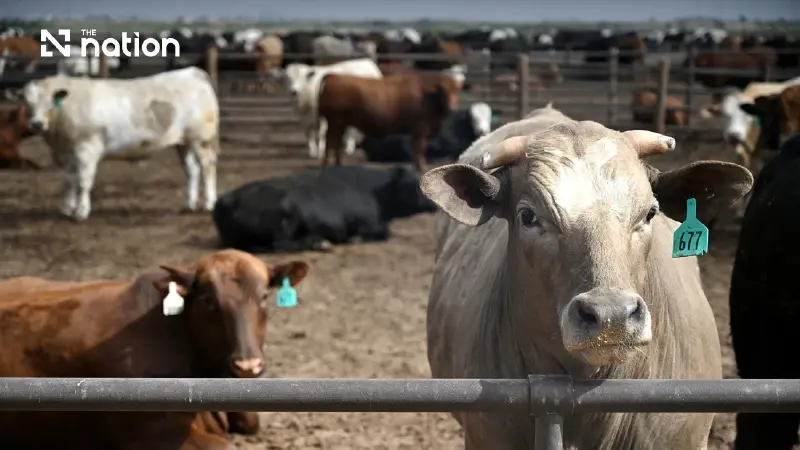


The Ministry of Agriculture and Cooperatives outlines an ambitious trade strategy, turning Bang Saphan Port into a state-of-the-art regional livestock hub
- Thailand's government is launching a national strategy to transform its beef industry by exporting 1.2 million live cattle annually to the lucrative Chinese market.
- The plan involves developing Bang Saphan Port into a state-of-the-art livestock hub, complete with a sophisticated animal quarantine station to meet international biosecurity standards.
- A public-private partnership has been formed with China Merchants Group, a major Chinese conglomerate, which will purchase 100,000 cattle per month and invest in modern abattoirs in Thailand.
- The initiative aims to empower local small-scale farmers by providing them with direct access to a premium international market, thereby ensuring stable incomes and boosting the rural economy.
The Ministry of Agriculture and Cooperatives outlines an ambitious trade strategy, turning Bang Saphan Port into a state-of-the-art regional livestock hub.
For thousands of Thai smallholders, cattle rearing has long been a traditional cornerstone of rural livelihood, insulated from international supply chains. However, under a sweeping economic modernisation drive led by the Royal Thai Government and the Ministry of Agriculture and Cooperatives, this grassroots industry is being systematically propelled onto the global stage.
By bridging domestic farming communities with multinational trade corridors, the public sector is turning agricultural tradition into a high-value commercial engine.
The spearhead of this transformation is an ambitious national trade policy: the establishment of a streamlined, large-scale export pipeline to transport 1.2 million live beef cattle annually to the People’s Republic of China.
This initiative promises to inject long-term economic security directly into Thailand's grassroots economy while redefining the nation's role in regional food security.
Tapping into a Multi-Billion Baht Market
China represents one of the largest beef consumer markets on earth. Current trade data indicates that the country imports approximately 2.7 million tonnes of beef every year—a massive demand valued between 675 billion and 810 billion baht (approx. $20 billion to $24 billion USD). When translated into live livestock, this equates to an annual consumption requirement of roughly 13.5 million cattle.

Recognising this immense opportunity, the Ministry of Agriculture and Cooperatives has moved swiftly to position Thai farmers at the forefront of this supply chain.
Speaking on the initiative, Deputy Government Spokesperson Captain Dr Patdarasmee Thongsaluaykorn emphasised that the state’s primary objective is to empower local cattle rearers by providing direct access to premium international markets, thereby sustainably elevating household incomes across the country.
To realise this vision, Chai Wacharonke, Assistant Minister to the Ministry of Agriculture and Cooperatives, recently chaired a high-level assembly uniting the Department of Livestock Development, domestic business leaders, and senior executives from the China Merchants Group—a major Chinese state-owned conglomerate.
This public-private partnership establishes a robust framework to safely source, test, and transport 100,000 cattle per month via maritime shipping routes.
Beyond simply buying livestock, the Chinese investment group has committed substantial capital to construct modern, international-standard abattoirs within Thailand, ensuring the long-term industrialisation of the domestic beef sector.

Building World-Class Biosecurity at Bang Saphan Port
Historically, the primary bottleneck preventing Thai livestock from entering highly regulated foreign markets has been stringent sanitary and phytosanitary barriers.
To overcome this hurdle, the Ministry of Agriculture and Cooperatives has completely overhauled its diplomatic and veterinary approach, working in lockstep with the General Administration of Customs of the People's Republic of China (GACC).

Through rigorous technical negotiations and the implementation of stricter domestic disease control protocols, the Ministry has achieved a monumental diplomatic breakthrough.
The GACC's extensive list of veterinary health and safety queries has been successfully reduced from over 40 complex issues to just four core technical points.
This rapid narrowing of regulatory concerns serves as a powerful validation of the quality, safety, and reliability of Thailand’s public veterinary systems.
Simultaneously, the government is focusing on building the physical infrastructure necessary to maintain this high standard of biosecurity.
Joint task forces are currently conducting on-site technical surveys at Bang Saphan Port in Prachuap Khiri Khan Province, which has been strategically designated to become the primary gateway for maritime livestock trade.
The crown jewel of this port expansion will be a state-of-the-art animal quarantine station. Operating under strict international veterinary standards, this facility will act as a highly sophisticated bio-shield. It will conduct comprehensive disease screenings, vaccinations, and health certifications before any livestock boards an export vessel.
By embedding advanced laboratory testing directly into the port infrastructure, the Ministry of Agriculture and Cooperatives is ensuring that Thai exports consistently meet global health benchmarks, effectively shielding the nation's trading reputation from biosecurity risks.

Securing a Sustainable Future for the Rural Economy
The Ministry’s livestock modernisation blueprint extends far beyond logistics and international trade agreements; it is fundamentally an inclusive social policy.
The Department of Livestock Development is rolling out standardised training programmes, genetic enhancement initiatives, and subsidised veterinary support to help small-scale farmers upgrade their local herds into premium beef breeds that meet strict export specifications.
By establishing a guaranteed, high-volume buyer in the China Merchants Group, the government is effectively insulating Thai farmers from domestic price volatility and seasonal market crashes. With a reliable monthly target of 100,000 cattle, rural families can invest in modern farming equipment, safer feeds, and sustainable land management with genuine financial confidence.
The Ministry of Agriculture and Cooperatives aims to see the inaugural shipment of live beef cattle depart Thai shores for China within the next twelve months.
Through strategic foresight, bold public-private diplomacy, and a deep commitment to infrastructure development, Thailand's public sector is successfully transforming a traditional rural pastime into an agile, globally competitive livestock powerhouse.
Source: www.thailand.go.th
