
Thailand sets Nov 19 review of US farm import plan worth US$2.6bn a year
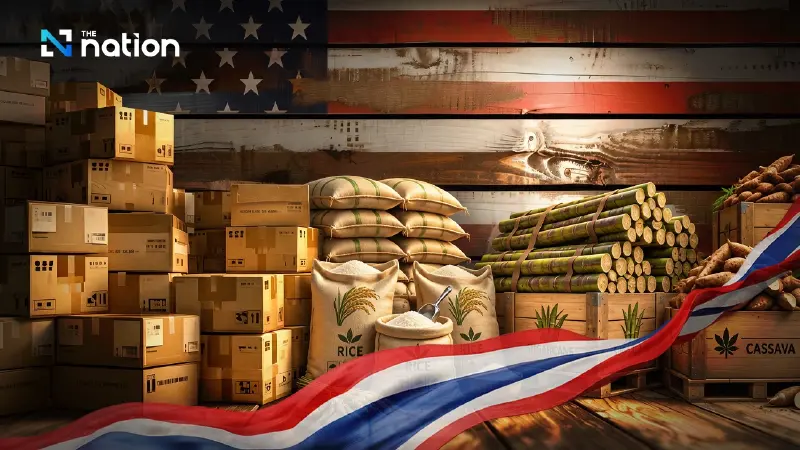


Thailand is weighing safeguards for farmers while trying to protect a US export market worth 2.37 trillion baht in 2025 and linked to 1.25 million jobs.
- Thailand's Agriculture Ministry will meet on November 19 to review a plan for importing US agricultural products valued at an estimated US$2.6 billion annually.
- The purpose of the review is to assess the potential impact of the imports on Thai farmers and consumers and to consider safeguards to protect them.
- The plan is part of a broader Agreement on Reciprocal Trade between the US and Thailand, which has been agreed upon in principle but not yet finalized.
- Thailand's main concerns involve increased competition for its domestic producers of pork, animal feed, and energy crops.
Thailand’s Agriculture and Cooperatives Minister Suriya Jungrungreangkit has ordered all ministry agencies to assess how wider access for US farm goods could affect Thai farmers and consumers. The ministry scheduled a meeting for November 19, 2026, to consider safeguards under a trade framework that envisages commercial purchases of US agricultural products worth an estimated US$2.6 billion a year.
Thai Prime Minister Anutin Charnvirakul and US President Donald Trump signed a joint statement in Manila on November 17 confirming that the two countries had agreed on the main terms of an Agreement on Reciprocal Trade. Both governments still have to complete domestic procedures before they can sign the agreement and bring it into force.

Pork and animal feed are among Thailand’s main concerns
Thai producers of animal feed, energy crops and pork could face greater competition if the market opens further. Thailand has consistently opposed imports of US pork from pigs given substances that promote lean growth. Suriya said protecting farmers and consumers would be the ministry’s priority as it examined the terms.
Deputy Prime Minister and Commerce Minister Suphajee Suthumpun told Nation TV on November 18 that Thailand had not abolished tariffs on all US goods, as Trump had suggested. She said Trump was restating for a US audience proposals dating to July 2025, under then prime minister Paetongtarn Shinawatra. Those proposals covered purchases of farm goods, energy and aircraft and helped Thailand secure a reduction in the US reciprocal tariff from 36% to 19%, she said.

The framework provides for duty-free access to Thailand for specified US goods. Suphajee said the principle was to open the market to products Thailand does not produce or cannot supply in sufficient quantities. Sensitive imports could still face quotas or other controls to protect domestic producers. Thai consumers and businesses would have more choice and would decide what to buy.
Thailand aims to protect its largest export market
The United States bought 2.37 trillion baht worth of Thai exports in 2025, making it Thailand’s largest export market and supporting about 1.25 million Thai jobs, according to Suphajee. She said the government expected Thai exporters to receive tariff treatment at least as favourable as that secured by countries that had already signed US reciprocal trade agreements.
The Board of Trade of Thailand and the Thai National Shippers’ Council welcomed the November statement as a step towards reducing uncertainty for exporters. Business groups asked the government to disclose the tariff rates and the concessions Thailand would make in return so that companies could assess the effects.
“This agreement affects many sectors, and each has different opportunities and concerns. I want everyone to have the full information and a chance to express their views in the next stages,” Suphajee said. She identified public hearings, parliamentary consideration and changes to laws and regulations as steps still to come.
Aat Pisanwanich, an associate professor at Rangsit University’s Faculty of Economics, distinguished the November statement from the first one Anutin and Trump signed on October 26, 2025. The first set the framework for negotiations. The second confirmed agreement on the substance, leaving both countries to finalise the legal text and prepare for signature and entry into force.

Thailand wants US forced labour tariff cut from 12.5% to 10%
The original US reciprocal tariff announced for Thailand on April 2, 2025, was 36%. A reduced rate of 19% took effect on August 7 that year. A separate 10% US import surcharge under Section 122 of the US Trade Act of 1974 applied to covered goods from Thailand and other trading partners for 150 days, from February 24 to July 24, 2026.
Thailand is now seeking a reduction in a separate US tariff linked to forced labour, from 12.5% to 10%, the rate applied to covered goods from Malaysia and Indonesia. Aat said a reduction would narrow the cost gap for Thai exporters. He said the outcome would depend in part on whether Thailand could convince the Office of the United States Trade Representative that it was tackling forced labour and preventing goods from other countries from being passed off as Thai exports.
A separate US investigation into excess manufacturing capacity leaves another tariff question open. If the two countries cannot agree on access for sensitive products, Washington could narrow a proposed list of 1,907 Thai product lines under consideration for a zero reciprocal tariff, retain the original 19% rate or impose additional duties over excess capacity.
Thai exporters face different competitive pressures across the region
Aat estimated that Thai export volumes to the US would fall in a worst-case scenario in which the original 19% reciprocal rate and the 12.5% forced labour tariff both applied, bringing the combined rate to 31.5%. For Vietnam, he put the comparable scenario at 32.5%, based on rates of 20% and 12.5%. Neither figure was a rate set by the November joint statement.
Aat identified processed agricultural products as a Thai strength. He said Malaysia held an advantage in electrical appliances, petrochemicals and rubber products, while Indonesia was better placed in fresh produce, raw rubber and vegetable oils. He said Vietnam’s economic and manufacturing scale, lower production costs and semiconductor ties with the US could strengthen its position in future negotiations.
Aat attributed part of Thailand’s growing trade surplus with the US over the past two years to companies diversifying production beyond China and to US importers bringing orders forward ahead of possible tariff increases. Nation TV reported that Thailand ranked fifth among economies with the largest trade surpluses with the US in the first half of 2026, up from seventh under Anutin’s first government and 11th under Paetongtarn.
Source: Bangkokbiznews, NationTV
