
Anutin calls for stronger digital trade links at Apec
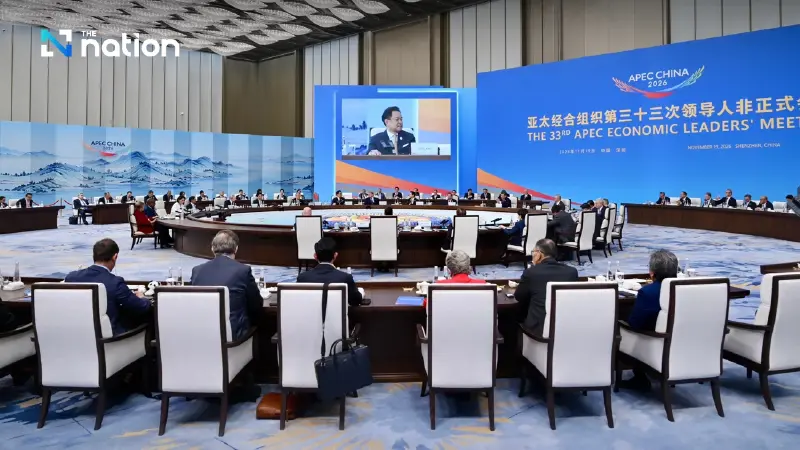


Thailand backs closer digital trade links, stronger safeguards against online fraud and workforce training to support growth across the Asia-Pacific.
- Thai Prime Minister Anutin Charnvirakul proposed that APEC prioritize stronger digital trade links to reduce trade barriers, reinforce supply chains, and improve business confidence, especially for small firms.
- He called for greater digital trade cooperation between ASEAN and APEC and supported a new APEC Connectivity Blueprint focusing on digital infrastructure.
- Anutin urged closer cooperation to combat online scams and financial fraud, aiming to make digital transactions safer and build trust in the digital economy.
- He also highlighted the need for workforce development, citing a Thai program to train workers in AI and cloud computing to support future digital industries.
Thai Prime Minister and Interior Minister Anutin Charnvirakul proposed three priorities for Asia-Pacific Economic Cooperation (APEC) in Shenzhen, China, on Thursday (November 19, 2026), led by closer digital trade links. The trade proposals aim to reduce barriers, strengthen supply chains and improve business confidence, particularly among small firms.
Government spokesman Ekkapob Pianpises said Anutin outlined the proposals at the retreat session of the 33rd APEC Economic Leaders’ Meeting at the Shenzhen International Communication Center, under the theme “Building an Asia-Pacific Community to Prosper Together”.
Thailand backs closer ASEAN–APEC digital trade ties
Anutin called for stronger digital trade cooperation between the Association of Southeast Asian Nations (ASEAN) and APEC, alongside progress towards the Free Trade Area of the Asia-Pacific (FTAAP).

Thailand also supports the development of a new APEC Connectivity Blueprint covering infrastructure, digital connectivity and people-to-people exchanges. Anutin said stronger regional links would help reduce trade barriers, reinforce supply chains and build confidence among businesses, especially small enterprises.
Thailand seeks joint action against online fraud
Anutin called for closer cooperation against online scams and financial fraud through the Bangkok Blueprint for Fraud-Resilient Financial Services, jointly initiated with the International Monetary Fund (IMF) and the World Bank Group.

Thailand was also ready to lead the development of APEC guidelines against online scams, Anutin said. The initiative aims to protect people’s savings and strengthen business confidence by making online transactions safer.
Skill Bridge targets AI and cloud skills for future industries
Anutin highlighted the Skill Bridge programme, through which Thailand is working with the private sector to train workers in artificial intelligence (AI) and cloud computing. The training aims to improve employment opportunities and enable more people to benefit from economic growth.
Anutin said workforce development should help people seize opportunities in the elderly-care economy, the transition to a green economy and future industries.
Anutin calls for economic openness and shared growth
Anutin said Thailand was ready to work with all APEC partners to address shared challenges, maintain economic openness and pursue shared prosperity.

Anutin thanked Chinese President Xi Jinping for the warm welcome and said he was pleased to meet IMF managing director Kristalina Georgieva again after the IMF–World Bank Group Annual Meetings in Bangkok and the ASEAN Summit in the Philippines. Thailand wanted to apply lessons from both forums to practical cooperation that would preserve economic links and help the region respond to global uncertainty, Anutin said.
Anutin described APEC as an important forum for exchanging experience and strengthening the capabilities of member economies, stressing that regional cooperation must deliver tangible benefits in people’s everyday lives.
