
Thailand advances high-speed rail amid Asia-wide expansion
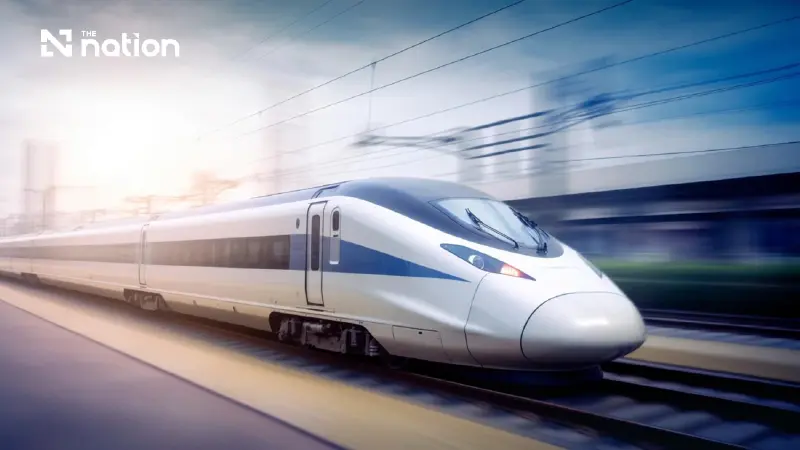


Asia’s high-speed rail expansion gathers pace while Thailand accelerates the Bangkok–Nakhon Ratchasima line and targets a year-end decision on a shared section.
- Thailand is advancing its high-speed rail program, specifically the Thai-Chinese project, as part of a broader trend of rail network expansion across Asia.
- The government is pushing to accelerate construction on the project's first phase (Bangkok to Nakhon Ratchasima) to meet a target opening date in 2031.
- The project is facing significant delays, with overall construction progress at 55.9% against a planned 90.4%.
- A key obstacle is an unresolved infrastructure overlap with the separate three-airport high-speed rail project in the Bang Sue–Don Mueang section.
High-speed rail development is gathering pace across Asia, supported by advances in technology and safety, a growing number of industry players and demand for transport that is faster, more convenient and more environmentally friendly than many other forms of travel.
East Asia, particularly China, has emerged as a leading high-speed rail market, with rapid and extensive network expansion driven by government policy and the country's large domestic market. Investment in Chinese railway projects has exceeded US$500 billion, helping China establish the world's largest high-speed rail network.
Japan, which pioneered high-speed rail technology through its Shinkansen system, continues to develop new technology while focusing on reliability and passenger experience. High-speed rail is estimated to contribute about US$20 billion a year to the Japanese economy.
ASEAN steps up high-speed rail development
Southeast Asia is also seeing significant expansion in high-speed rail development, while countries in the Middle East have begun exploring similar systems, attracted by their potential to support economic growth and improve connectivity.
Investment in individual projects typically ranges from US$5 billion to US$15 billion per route, equivalent to about THB100 billion to THB500 billion.
A forecast published by Data Insights Reports projected that the global high-speed rail market would reach about US$150 billion by 2025, supported by a compound annual growth rate of 8.5%.
The report attributed the expansion to rising demand for efficient, sustainable and fast transport solutions, describing the sector as a dynamic and developing industry.
Against this backdrop, Thailand is pushing ahead with its own high-speed rail programme.
Deputy Transport Minister Siripong Angkasakulkiat recently inspected Contract 4-7 of Phase 1 of the Thai–Chinese high-speed rail project, covering the Saraburi–Kaeng Khoi section and Saraburi Station on the Bangkok–Nakhon Ratchasima route.
Siripong explained that the visit was intended to monitor progress and accelerate construction to keep the project aligned with its timetable.
He instructed the State Railway of Thailand (SRT) to manage the project efficiently while placing the highest priority on safety standards, particularly at construction sites close to existing railway lines and areas used by the public.
Strict measures must be maintained to prevent accidents and minimise potential effects on surrounding areas.
Decision sought on three-airport rail overlap
For areas involving tunnel construction, Siripong instructed the SRT to closely monitor conditions and safety while preparing preventive measures and emergency response plans to maintain public confidence.
The Transport Ministry is seeking to accelerate construction so the Thai–Chinese high-speed rail project can be completed and opened for service in 2031, improving both passenger travel and freight transport.
Although overall construction remains behind schedule, Siripong expressed confidence that work could be accelerated sufficiently to meet the target.
Several construction contracts have yet to begin, most notably Contract 4-1 covering the Bang Sue–Don Mueang section, where infrastructure is shared with the three-airport high-speed rail project linking Don Mueang, Suvarnabhumi and U-Tapao airports.
Officials expect a conclusion on the overlapping section by the end of 2026.
“We now have to see how the EEC committee views amendments to the public-private partnership agreement for the three-airport high-speed rail project and how that project will proceed,” Siripong explained.
“The SRT has the option of putting the shared structure under Contract 4-1 back out to tender and starting construction so that the Thai–Chinese high-speed rail project is not affected.”
“If this section is built first, it could support the Thai–Chinese high-speed line as well as a two-airport high-speed connection between Don Mueang and Suvarnabhumi.”

Bangkok–Nakhon Ratchasima route reaches 55.978%
Kampol Boonchom, chief engineer for special projects and construction at the SRT, reported that Phase 1 of the Thai–Chinese high-speed rail project between Bangkok and Nakhon Ratchasima covers about 250.77 kilometres and is divided into 14 civil works contracts.
Scheduled cumulative progress currently stands at 90.487%, while actual progress has reached 55.978%, leaving construction 34.509 percentage points behind plan.
The SRT is closely monitoring and accelerating work under individual contracts while coordinating with relevant agencies to resolve obstacles and keep the project moving towards its targets.
Scheduled cumulative progress on Contract 4-7, covering the 12.99-kilometre Saraburi–Kaeng Khoi section, stands at 81.50%, compared with actual progress of 73.25%, putting it 8.25 percentage points behind plan.
Construction of elevated railway structures and other components of the high-speed rail system is continuing. Segment installation has reached 86%, balance-beam construction 33% and switch-beam construction 68%.
Saraburi high-speed rail station is located in Takut subdistrict of Mueang Saraburi district in Saraburi province and is being built as an elevated, four-level station.
The first level will house the building entrance and platforms for long-distance trains, while the second will contain ticketing facilities for both high-speed and long-distance rail services.
The third level will serve as a passenger waiting area, with the fourth level housing the high-speed rail platforms.
The station will have two 450-metre platforms and four tracks.
Construction of Saraburi Station has reached 29.30%, against scheduled progress of 47.22%, leaving the work 17.92 percentage points behind plan.
The SRT will continue monitoring and accelerating construction while overseeing compliance with required standards so that the station can support future high-speed rail services.

Private sector role grows in major rail projects
Data Insights Reports also noted that major global infrastructure tenders can exceed US$10 billion, while privatisation and public-private partnerships are increasingly reshaping competition for large-scale projects.
Private companies are competing for operating concessions and development rights, creating a market in which innovation and value for money are increasingly important in securing long-term contracts worth tens of billions of dollars.
Source: Bangkokbiznews
