
Across-the-board hike of 40% likely today


Labour permanent secretary confident of Bt300 by 2013
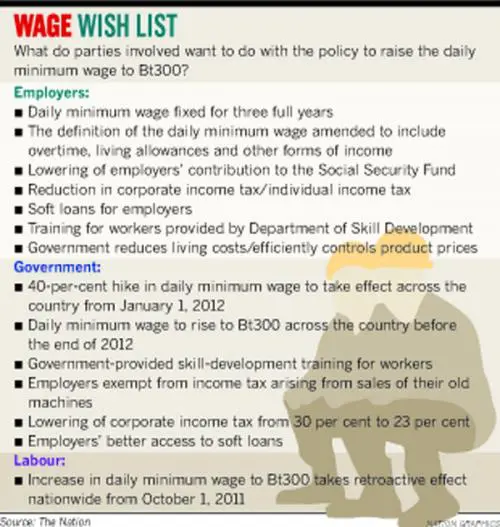
The Central Wage Committee looks set to approve a 40-per-cent hike in the daily minimum wage across the country at its meeting today, according to the Labour Ministry’s permanent secretary Somkiat Chayasriwong.
With the committee’s approval, the significant pay raise will take effect on January 1.
Moreover, Somkiat said he was confident that the government would be able to push the daily minimum wage to Bt300 around the country by the start of 2013.
“I have already spoken to representatives of the government, the employers and the workers,” he said.
During the recent election campaign, the Pheu Thai Party promised to immediately raise the daily minimum wage to Bt300 across the country. Since Pheu Thai now heads the government, labour organisations have been pushing hard for it to deliver on its promise. Leaders of labour organisations will call on Prime Minister Yingluck Shinawatra to discuss the matter on Friday.
In response to their planned visit, Somkiat said yesterday he was confident that they would listen to his explanation of the issues involved.
“I believe they will understand the impacts if we push for an immediate hike to Bt300 a day,” he said.
As it is, relevant authorities are now preparing to ensure that affected small- and medium-sized enterprises have access to soft loans. The Social Security Office (SSO) board will soon be asked to grant Bt10 billion in soft loans to affected entrepreneurs via commercial banks, he said.
The SSO will charge commercial banks a 1-per-cent interest rate, and the banks will impose a 2.5-per-cent interest rate on the entrepreneurs. Only entrepreneurs participating in the social-security scheme can seek soft loans under this project. Those outside the social-security scheme will be able to seek soft loans from the Small Business Credit Guarantee Corporation’s fund.
Somkiat said the government also proposed that the SSO reduce employers’ contributions to the social security fund from 5 per cent to just 3.5 per cent of the amount equivalent to employees’ salaries.
The maximum salary recognised by the scheme is no more than Bt15,000 a month.
Somkiat said the decrease would affect the amount of money allocated for employees’ benefits in the event of illnesses, disabilities, childbirth and deaths.
“The drop in employers’ contributions is just a temporary measure for about one or two years only. This is if the SSO board agrees and the Cabinet approves the plan,” Somkiat said.
As for the government’s contributions to the social-security scheme, Somkiat said it would be proposed that the government make up the 1.5-per-cent contribution the SSO would not longer receive from employers, and that this be directed to employees’ benefits in the event of illnesses, disabilities, childbirth or deaths, to employees’ benefits in the event of unemployment, and to pensions.
