
Boat fells Nakhon Sawan barrier


Play
Portion of dyke collapses, worsening flooding in town
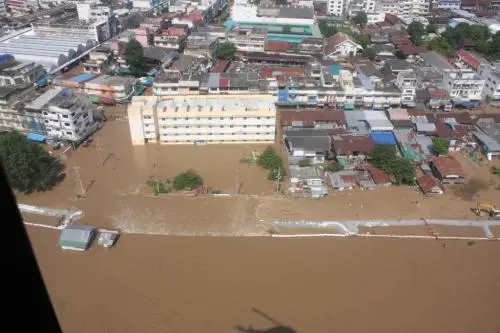
Nakhon Sawan’s efforts to combat flooding suffered a blow yesterday when a section of a dyke on the Chao Phraya River collapsed, resulting in a huge influx that raised the water level in urban areas of the already heavily inundated province.
A 100-metre-long stretch of dyke collapsed after being struck by the propeller of a long-tail boat transporting food supplies. Unlike other sections made from sandbags, the section of dyke that collapsed was made of loose gravel inside weak barriers.
The collapse at around 8 am further submerged urban areas in Muang district to an average depth of one metre, prompting evacuations of residents to five locations on higher ground. The evacuations were completed quickly, as most locations are only 3 km from the inundated residential areas.
The government’s flood-relief centre said evacuations were ordered because Nakhon Sawan is second only to Ayutthaya in terms of risk to residents. All four tributaries of the Chao Phraya River meet in Nakhon Sawan, making it highly prone to flash floods and accidents such as yesterday’s collapse.
A pork vendor who witnessed the large-scale collapse said the long-tail boat hit a loosely constructed dyke section with its propeller while heading out after dropping food supplies. The propeller broke a wooden frame fastening the dyke wall, leading to the eventual collapse of an entire section of dyke.
A statement by local authorities released at 3.30pm yesterday said the situation had been brought under control after the collapsed section was plugged, while water drainage was underway to reduce the flood level behind the barriers.
Armed with heavy machinery, military and civilian personnel were mobilised to fill the gap. The flood water is at its highest level in the province near a market in Muang district where the Ping and Chao Phraya rivers meet. As of press time, some holes were still leaking water into the town and residents continued to struggle containing it.
Two children drowned and one was unconscious after their rowboat capsized in Chumsaeng district, while their grandmother, who was with them, was unharmed. The four were heading to a market to buy food supplies when the boat encountered strong currents and overturned.
In Lop Buri, nine Army barracks were serving as temporary shelters for 30,000 evacuees. The barracks have total capacity of 59,000 people.
The situation at the Rojana Industrial Estate in Ayutthaya remains critical. While machinery had been moved from its zone 1, flooding remained a threat as water leaked through barriers surrounding zone 2. The zone needs another 500 metres of dykes to be constructed, but nearby residents would not give consent.
Speaking at a press conference, Prime Minister Yingluck Shinawatra said foreign aid was not needed, although China had donated US$1 million (about Bt30 million) in cash and relief supplies worth Bt80 million.
The premier said the government was focused on three immediate measures: strengthening flood-prevention efforts in areas not yet affected; evacuations where needed; and distribution of food and drinking water. Other measures to cope with existing flood waters are drainage; pushing water out of estuaries; restricting marine traffic in upstream areas; and clearance of water weeds.
Evacuations are underway in Ayutthaya, with evacuees residing at several locations in the province and at Thammasat University’s Rangsit campus in Pathum Thani.
