
Region's unis must trust each other


Play
Free flow of education will help Asean student exchanges
A free flow of higher education will be achieved more easily among Asean countries if universities in this network trust the quality of each other’s education.
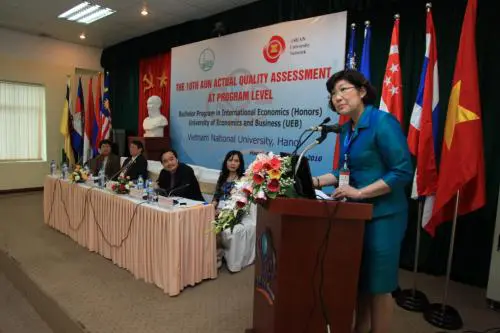
Quality assurance could be an answer to this. ASEAN University Network (AUN) has initiated AUN QA (quality assurance) in an attempt to ensure quality of education in the universities in different Asean countries since 2000, according to Assoc Prof Nantana Gajaseni, executivedirector of the Office of the AUN Secretariat.
“We have to prepare our students for the Asean Economic Community and ensure quality of education to make the student and labour exchange easier. We believe the AUN QA will be the regional system to help ensure education quality,” said Nantana.
She said when the universities in Asean trusted the quality of each other, it would help students when they exchanged with universities in other Asean countries and when they transferred credits. The QA was targeted to upgrade Asean higher education.
Also, the ASEAN Credit Transfer System (ACTS) has provided information about 12,000 courses offered by AUN’s 26 member universities that allow exchange students to transfer credits, she said.
With help from assessment experts from Europe, the QA’s manual was completed in 2005. AUN revised and adjusted the criteria while it did a trial assessment.
Since 2007, it has done actual assessments and guaranteed the quality of 26 programmes in seven universities in four countries – Malaysia, Indonesia, the Philippines and Vietnam.
“Chulalongkorn University (CU) will be the first Thai university to be assessed by the QA next year. Probably, the engineering and business administration programmes,” Nantana said.
“With limited budget and resources, including personnel who can work as part of the QA’s assessment team. AUN is unable to assess as many universities as we want,” she said, adding that the AUN board has not forced the universities to apply for the assessment but by voluntary application.
The AUN has to convince many more universities, including those not among the 26 members of AUN to join the assessment.
To draw more universities in and to increase capacity and number of university lecturers who can work as assessors, representatives from 24 universities from across Asean, including TimorLeste, took part in ASEANQA training last week in Bangkok. Nine of the universities are nonmembers of the AUN, according to Nantana.
“From 2013 on, engineering, business and economics programmes of all the 24 trained universities will be gradually assessed, including those of four Thai universities. We focus on these programmes because graduates in them will be among the professions allowed to mobilise first,” she said “The assessment team has only 25 members and only eight of them are experienced ones. We will choose a representative from each of the 24 universities to be tested if they are qualified enough. If any of them are eligible, they will be selected as new members of this team. So, they can assess more universities.”
She said many Vietnamese and Indonesian universities were the most active ones, having requested to be assessed by the QA although they were nonmembers of the AUN.
Assessment experts from Asean and Germany shared knowledge with the participants during the training. It is a threeyear training project from 2011, funded by the German Academic Exchange Service.
Apart from providing internal quality assurance training for the universities, there was parallel training held to provide external quality assurance training for personnel working for national quality assurance agencies in each Asean country. It was attended by Thailand’s Office for National Education Standards and Quality Assessment. Both groups (the universities and national quality assurance agencies) had to learn from each other.
Hence, Nantana hoped the training would help create more understanding and acceptance.
Assoc Prof Mana Sriyudthsak, associate dean of Faculty of Engineering at CU, said his faculty had eight international programmes from bachelor to doctorate degrees and he was sure they were ready for the AUN QA’s assessment.
He said the faculty had exchanged students with many universities in the US, Europe, Japan, Hong Kong, Taiwan and Singapore.
However, Mana urged AUN to check the number of students who wanted to exchange in Asean universities and see if the number was high enough, otherwise the QA and ACTS would be useless if only a small number of Asean students were interested in the exchange.
Not only is it important to get more universities to join the QA’s assessment, but also it seems AUN may have to encourage more students to exchange among Asean universities.
