
Chula team proposes super-express floodways


Play
A professor from Chulalongkorn University (CU) says his team has devised a New Thailand strategy to free the country from flooding disasters.
“We developed the long-term plan to prevent flooding as far back as 1999,” Professor Dr Thanawat Jarupongsakul said. The head of CU Unit for Disaster and Land Information Studies will next week hold a press conference to outline 11 measures needed to thwart flood threats in the future. Among them are super-express flood ways, flood tax, and Bangkok’s satellite towns.
“We believe the government will be interested [in our plan],” Thanawat said.
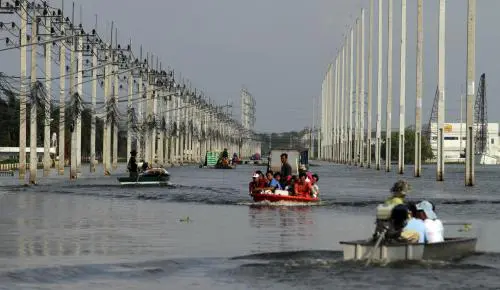
As Thailand battles its worst flood in decades, which is now ravaging many parts of the capital, the spotlight has turned to ways to stop the disaster.
Flood-related death tolls have already risen beyond 500 and economic damage runs into many billions of baht with at least seven industrial estates submerged.
“There is no need to enlist foreign help. We started the study on flood prevention in 1995 and it was completed in 1999,” Thanawat said. “We can adjust the study results to the current context”.
The expert recommends a holistic approach for long-term results. If his strategy is implemented, New Thailand will materialise in 50 years, not anytime soon.
Thanawat said he had warned many years ago that the lack of integration would only increase the severity of inundation. For example, when all riverside provinces started building embankments along the Chao Phraya River, water levels in the river can only rise and rage faster.
“I’d told authorities that embankments would crumble and that’s what has happened this year,” he said.
He estimated that 2,700-2,800 cubic metres of water raged past Ayutthaya’s Bang Sai district in 1995 but this year up to 3,900 cubic metres of water raged past the same spot.
“The embankments or floodwalls are causing rifts in society, too,” Thanawat pointed out.
To solve the problems, he recommended collecting direct flood tax from the owners of structures on natural flood ways or water-retention areas. The tax rate for buildings in the zones, for example, should be 20 or 30 times higher than the rate elsewhere. The difference can then be kept for use as compensation for flood victims.
“The Bang Pahan area in Ayutthaya is a natural water-retention area. Because land plots there had been flooded repeatedly, original owners are willing to sell their land at a cheap price to investors keen on building factories. In such cases, those who build structures there should pay higher tax,” Thanawat said.
He also recommended collecting flood tax from people living in zones equipped with flood-prevention measures like floodwalls. “As your measures affect others, you should pay higher tax,” the academic suggested.
Thanawat pushed for the construction of super-express flood ways, too, referring to the network of canals, adjacent land plots and high roads.
“The country has already had natural canals. What we need to do is to expropriate land plots within one-km radius from these waterways and then build roads that are six metres above ground level. Together, they will deliver the super-express flood way,” he said.
He said the high roads would ensure that if the canals overflowed, no communities would be affected. The super-express flood-way network, which should start from the Chai Nat-Pasak Canal, will stretch for about 100 kilometres. They will be able to hold up to 800 million cubic metres of run-off water from the upper part of the country.
“If we develop this network, we will be able to push 6,000 cubic metres of water to the sea per second. At some spots, we may have to build bridges and use pumps to push water across some roads but it will still be a very effective solution,” he said.
Asked if the super-express flood-way network would be very expensive, he said, “It’s relatively cheaper when compared with other alternative solutions such as digging the second Chao Phraya River”.
Thanawat said areas inside the super-express flood-way network could be used for paddy fields at some periods in the year.
Regarding Bangkok’s satellite towns, he said it would help with the city planning and efforts to keep some areas as green zones. “Bangkok’s urban zones must stop growing. We need to encourage urban development to expand in Ratchaburi, Saraburi, Chachoengsao and Suphan Buri instead,” Thanawat said.
The professor hoped to see the Disaster Prevention Ministry spring into operation because he believed only integrated efforts and a holistic approach could make a real change.
“Area-specific measures won’t help. Temporary measures such as handing out relief items won’t stop floods from recurring,” he said.
Thanawat said the country had much to learn from the raging flood crisis. “A fact-finding committee should be established to find out what caused the current crisis. If we can identify the root causes, we will be able to solve and prevent the problems. This is not about finding fault with someone,” he said, adding that he would be willing to play a role in the fact-finding committee if invited.
