
'If we want peace, just don't talk - that's it'


Play
General Sonthi Boonyaratglin's concept of "Forget the past, think about the present and create the future" might be confusing to many people.
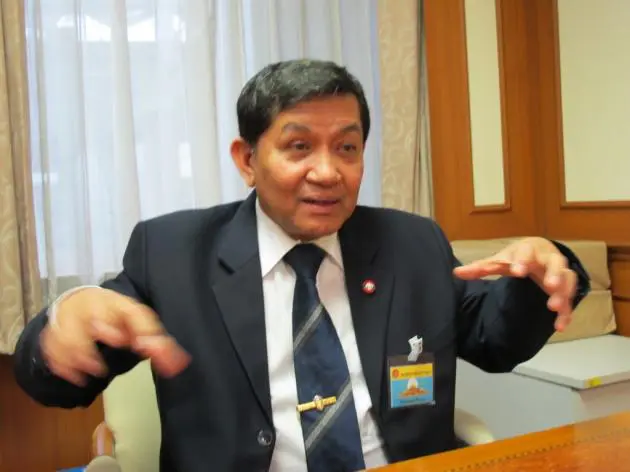
Attempting to clarify it in an exclusive interview with The Nation, the chairman of the House committee on reconciliation said the first step is to stop talking about the past.
To take the next steps, the House committee has asked the King Prajadhipok’s Institute to study the proposals recently put forth by the Truth for Reconciliation Commission of Thailand, chaired by Kanit na Nakhon, and determine how to make them realities.
“Don’t bring up [what happened in] the past as a topic. It’s like scratching a healing wound,” he said. “Don’t think too much, otherwise, we’ll never move on. How do we want to see our country? If we want to see it ruined, just keep scratching until it bleeds again and again. If we want peace and order so we can be proud of our Thailand, just don’t talk. That’s it.”
Sonthi, the leader of the 2006 coup, said he has military friends who have different opinions on the May 1992 violence and last year’s political turmoil. They avoid talking about politics so as not to quarrel.
“It’s impossible to forget the past literally. But we must take the events of the past as lessons and use the dharma and forgiveness principles to help,” he said.
Asked to clarify this idea, Sonthi said, “Don’t forget that such forgiveness has happened dozens of times in Thai history, including the 66/23 policy. At that time, we forgave and forgot. Now, many people who came back from the forest are in positions of leadership and ministerial posts.”
The 66/23 order, issued in 1980, allowed people who had joined the anti-government movement and fled into the forest to return to society and join in the country’s development.
Sonthi said the 38 members of his House committee and their advisers, despite expressing sharply differing opinions initially, now get along well at meetings. “We first remind all to keep in mind that we want to reconcile. That makes everything better. When politics [which he defined as anything involving politicians] improve, other things will follow.”
“Problems exist everywhere. We must not let this become an issue. In Parliament, it’s normal that political parties have different opinions. We don’t look at the different political opinions for now. Just let it go for now. With gradual adjustments, everything will fall into place eventually,” he said.
Asked about calls for changes to the lese majeste law, advocates of which have urged people to speak out instead of keeping quiet, Sonthi said, “In any society, people do not always agree. But if the majority agree, the minority will gradually follow. They might harbour disagreements for some time. But if society can provide good models, things will change accordingly.”
Sonthi spoke of the principle of “majority rule, minority rights.”
“We must listen to the minority view that problems related to Article 112 [of the Criminal Act] exist. So we allow Article 112 to be developed and improved.”
Asked whether that means amending the law, Sonthi said, “It has its own way.”
When asked to give a concrete example of the means by which this might be accomplished, Sonthi said, “How can a means under study can be concrete? It is still under study.”
However, he added that, “The case of 66/23 could be a very good example. We should not scratch the wound. We should not talk too much – that’s not good,” he said, chuckling.
Asked whether the Nitirat Group’s proposal to revoke all legal consequences of the 2006 coup would affect him in any way, Sonthi said, “Like I said, do not talk about the past. The past is the past. The situation changes all the time. At the time of the coup, don’t you see that people agreed? Right now, the military’s popularity is very high. But if you asked people last year, many people rejected the military.”
Asked if he had spoken recently with former premier Thaksin Shinawatra, who was toppled by the 2006 coup and is now de facto leader of the Pheu Thai Party, Sonthi replied at once, “No, no, no.” Asked whether he would ever want to talk to Thaksin, Sonthi laughed, before pausing.
“We have to think carefully: What good would come of it if I met him; what do we stand to lose if I don’t?” Sonthi said, appearing to choose his words carefully.
As to whether Thaksin should be considered someone whose opinion was worth seeking out, Sonthi said, “Like I said, today we don’t talk about an individual, understand?” He ended the interview there.
