
Suthep sees ulterior motive in probe


Play
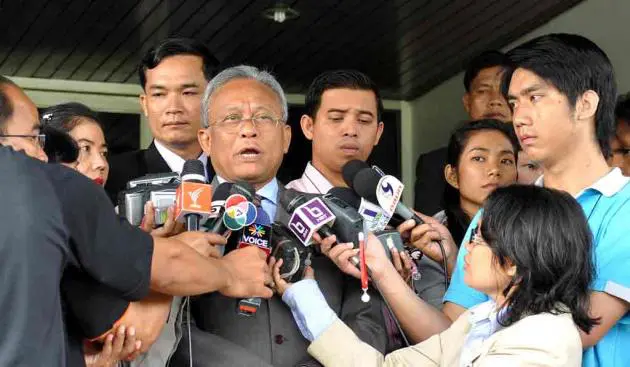
Democrat MP Suthep Thaugsuban yesterday voiced suspicion that investigators were supporting the red shirts' attempts to fault his involvement in the crackdown on last year's political disturbances as a way of pressuring him to support amnesty for former
“I wonder why investigators asked me questions similar to those previously raised by the red shirts,” he said.
Suthep said he still had complete confidence in the legal proceedings, although investigators had kept him for eight hours on Wednesday, taking his statement as a witness to anti-riot forces’ breaking up of the red-shirt rally at Ratchaprasong in May last year.
At that time he was deputy prime minister in charge of overseeing the Centre for Resolution of the Emergency Situation.
Suthep said he provided full details on the CRES’s work each day in the lead-up to the May 19 crowd-dispersal operations.
He said he accepted full responsibility for his supervision of the CRES, insisting his directives on the dispersal were lawful, and denying the involvement of the prime minister at the time, Abhisit Vejjajiva. Reacting to a question posed by investigators on the six fatalities at Wat Pathum, he said he could not comment on the deaths, which occurred after the CRES operation to end the rallies was complete. He urged police to resolve the cases in due course.
He described investigators’ questioning of him about the killing of Japanese cameraman Hiroyuki Muramoto as provocative, prompting him to ask in return how he could have information about the case or confirm where the cameraman was shot, since he was at the CRES at the time, not at the scene.
He said two factors made the Muramoto case a curious one – conflicting witness statements on where the killing happened, and the camera turning up on the stage at the red-shirt rally a few days later with the video erased.
Suthep said investigators’ questioning of him over why he had branded protesters as terrorists since none of those killed was armed echoed questions posed by the red shirts. He had replied that he, too, did not expect dead terrorists to carry their weapons to the hospital morgue.
The former deputy prime minister said he was puzzled by the appearance of lawyers from the red-shirt movement at his interview at the Metropolitan Police Bureau.
He suspected the red shirts might be attempting to sway investigators to fault his CRES work in order to prosecute him in a ploy to coerce the Democrats to agree to an amnesty deal for Thaksin, he said.
He vowed to fight and clear his name if he were framed in order to be prosecuted, rather than agree to any deal to help Thaksin.
Metropolitan Police commissioner Lt-General Winai Thongsong said investigators spent a long time with Suthep to cover all the complex details of the political disturbances. Suthep helped to shed light on the matter, he said.
He dismissed concern about political meddling in the police report on 16 cases in which state officials were suspected of involvement in killings connected with the crowd-dispersal operations.
