
Bangkok bomb scares raise some tricky questions for govt


The annals of modern history show that nearly all politically motivated bombing incidents have been domestic affairs rather than foreign ones.
Yet it is a curious coincidence that bomb scares are popping up at a time when Prime Minister Yingluck Shinawatra and her red-shirt allies appear to be diverging on a number of issues, such as the road map for a charter rewrite, amending the Defence Administration Act and the cosy friendship with the military that is leaving the reds out in the cold.
If the government is serious about solving these bomb scares, then it should pursue all leads, including taking a closer look at disgruntled red-shirt allies.
Although government leaders and their allies have been singing a chorus of solidarity, Deputy Prime Minister Chalerm Yoobamrung had made remarks indicative of a more extraordinary intrigue than what meets the eye.
Last week, police received a tip-off before detecting and defusing a home-made bomb planted on Rajdamnoen Avenue. This coincided with holiday festivities.
Chalerm, police, security officials and political commentators all agreed that this incident was politically motivated. While the police and security officials were cautious about speculating which political group might be responsible, Chalerm was quick to blame certain rogue soldiers for making moves to undermine the government and pave the way for a coup.
However, the burning question here is, why did Chalerm try to link the Rajdamnoen scare to his government’s opponents when the bomb found was assembled in a manner very similar to those linked to red-shirt supporters and found in connection with the rallies last year?
Bombs linked to disgruntled officers in the wake of the 2006 coup were different from the one found last week and the six uncovered early yesterday.
Furthermore, Chalerm has been circulating the initials of certain top brass who are allegedly behind these bomb scares, but these names are seen as being closer to the reds rather than to the yellow shirts.
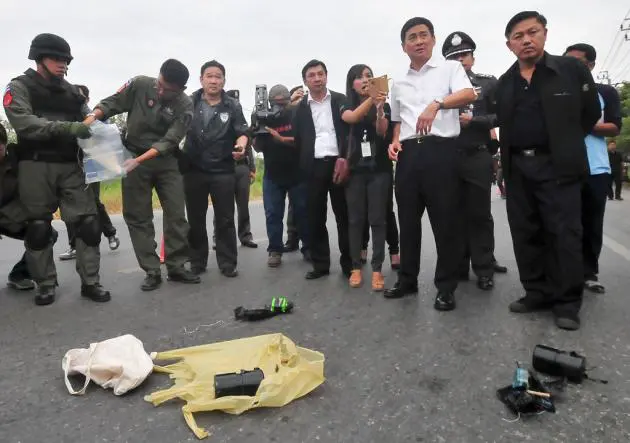
Yesterday at around 3am police arrested Sakon Nakhon native Jeerawat Janpeng, 55, on suspicion of planting bombs. After Jeerawat made his statement, police uncovered six home-made explosives in three spots in the eastern outskirts of Bangkok.
The bomb squad staged an elaborate and painstakingly slow operation for reporters to witness how the bombs were disposed of. Many see this bomb scare as a move to divert public attention from hot issues such as the questionable repeal of a passport ban for fugitive former prime minister Thaksin Shinawatra.
Chalerm chaired the morning’s press conference to showcase Jeerawat’s arrest, but he did not appear to be his usual boastful self and abruptly terminated the meeting in less than 20 minutes.
Jeerawat kept smiling while Chalerm took all the questions on his behalf. The deputy PM’s replies were short, terse and vague on Jeerawat’s background and his role in the bomb scares.
National police chief General Priewpan Damapong said Jeerawat had confessed to being involved in the Rajdamnoen bomb scare before tipping the police off about the six bombs yesterday morning. However, Chalerm played down this point, saying Jeerawat had decided only to testify in court.
Both Chalerm and the police chief chose not to mention that the bombs found were similar to those linked to last year’s political disturbances. The deputy PM also chose not to refer to his previous claims that the culprits included rogue soldiers bent on undermining this government.
Even though all key leaders in the red-shirt movement are advocates of a peaceful struggle, last year’s bombing incidents took place in connection with their rallies. A powerful bomb exploded by accident in Metta Mansion in Nonthaburi, leading to the discovery of a link between the explosives and certain red-shirt supporters.
It sounds strange and illogical that certain red shirts or rogue elements would want to push out the very government they tried so hard to install. Yet past politically motivated bomb scares have proved to come from friends rather than foes.
When the government came to power in August, Pheu Thai leaders and their red-shirt allies spoke in unison about their distrust of the military.
This month Yingluck and her deputy Chalerm have made an about-turn and are warming up to the top brass. Red-shirt leaders appear to be left isolated within the main coalition party in their push to revise the military appointment process.
Yingluck has openly supported Army chief General Prayuth Chan-ocha, while the red leaders are demanding his removal.
More important, the government seems to have switched tracks, giving charter rewrite a lower priority even though the reds want to move at full speed to repeal the 2007 Constitution.
Despite Pheu Thai being in power, the red shirts are still finding themselves embroiled in legal wrangling with no end or amnesty in sight.
Many reds, including Kwanchai Praipana, have been heard wondering aloud why the controlling majority in Parliament is failing them.
All past political bomb incidents have faded away without being solved. At issue is whether the recent bomb scares would intensify before dissipating. The answer may hinge on how well and how quickly the power brokers can work behind the scenes to quell discontent within the rank and file.
