
Country will only reunite if the reds are disbanded, Abhisit says


Play
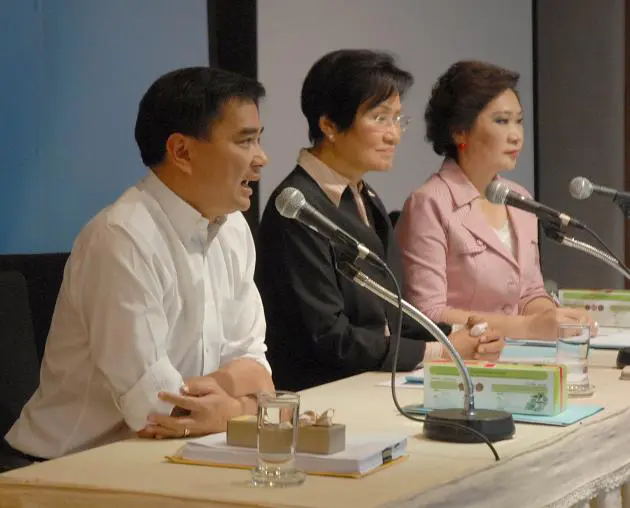
Opposition leader Abhisit Vejjajiva said yesterday that he would work to bring all sides together provided there were no more red-shirt villages and the movement was dispersed.
“If the red-shirt movement does not come to an end, then the reconciliation cannot be achieved as per the 66/23 model,” he said.
Pheu Thai MP Wattana Muangsuk, who is also deputy chairman of the House of Representatives committee on reconciliation, said earlier that his panel would study the 66/23 formula for reconciliation.
The 66/23 model was used by General Prem Tinsulanonda’s government, which allowed communists to return to society and join a national development programme.
Abhisit said Kanit na Nakhon, chairman of the Truth for Reconciliation Committee of Thailand (TRCT), had said the definition of political prisoners should not include those who used weapons in political protests after the 2006 military coup.
General Sonthi Boonyaratglin, chairman of the House panel on reconciliation, said the committee had asked the Council of State to clarify the definition of political vocabulary as well as provide examples of amnesty being provided to political prisoners.
Committee spokesman Nakorn Machim said the King Prajadhipok Institute had agreed to research the steps that must be taken to bring about reconciliation, but would not draft legislation because that was the job of the Council of State.
In the past, amnesty has been granted to prisoners in cases related to national security, violators of the Communism Act, and students who participated in the 1973 Thammasat University uprising, he said. However, it was up to the public as to whether amnesty should be granted to political offenders, including those facing terrorism charges and violators of the emergency decree, rallies calling for basic rights and rights of expression as well as voting right revocation, Nakorn said.
Meanwhile, in reaction to TRCT’s proposal that political detainees be kept away from common criminals, the Department of Corrections has started renovating a temporary prison in Bangkok’s Lak Si district for the inmates, including detained red-shirt protesters.
However, Abhisit said it was clear nepotism if the centre was being prepared just so red-shirt detainees could be brought to the Lak Si prison from across the country.
Critics have also been saying that the temporary centre is being renovated to receive fugitive former prime minister Thaksin Shinawatra if he returns to the country.
Deputy Prime Minister Chalerm Yoobamrung said yesterday that there was no way Thaksin would be detained at the Lak Si prison, and called on people to stop turning the renovation of the centre into a political issue.
He said he too was jailed when he joined a failed military coup against Prem’s government, and his fellow detainees were communists or those waiting to be exiled.
“People who are turning this into a political issue don’t know the history of the prison,” Chalerm said. “In the first seven days of my detention, I was in solitary confinement and did not know whether it was day or night. Then I was moved to an ordinary cell. But I was still in jail.”
Asked whether the renovation had anything to do with Thaksin, Chalerm said: “Nobody [of Thaksin’s stature] will come. That’s all.”
When asked again if he meant Thaksin would not be detained if he returned to Thailand, Chalerm said: “I didn’t say so. But don’t wait, nobody will come.”
