
Pollution worsens following deluge as water quality drops


Play
Thai pollution situation remained severe after the flood disaster, as the quality of Chao Phraya River basin's nine main rivers deteriorated, while Bangkok City was the notorious champion of overwhelmed garbage with eight per cent increase in garbage amo
Reporting Thai pollution 2011, Wijarn said the flood disaster from October to December resulted to the deterioration by 70 per cent of Central Region’s Chao Phraya, Tha Chin, Bang Pakong,
Prachin Buri, Lop Buri, Pasak, Noi, Sakaekrang and Nakhon Nayok rivers. There were floodwater drainage from community and agricultural areas into rivers and canals, hence the level of dissolved oxygen lowered affecting the water quality of upper Gulf of Thailand.
However the overall quality of Thailand’s 48 rivers and four still-water sources was improving compared to the past five years (2007-2011), Wijarn said. The water sources with deteriorated quality lowered from 40 per cent to 28 per cent, while the water sources with good quality increased from 19 per cent to 30 per cent, he added.
The country’s garbage continued to rise each year, Wijarn said there were now 16 million tons per year or 43,800 tons per day – a 5.5 per cent increase from previous year because of the community and population increases. Bangkok City had a 22 per cent increase of garbage or 9,500 tons per day while Pattaya City had a five per cent increase. Only four million tons of garbage went into recycle.
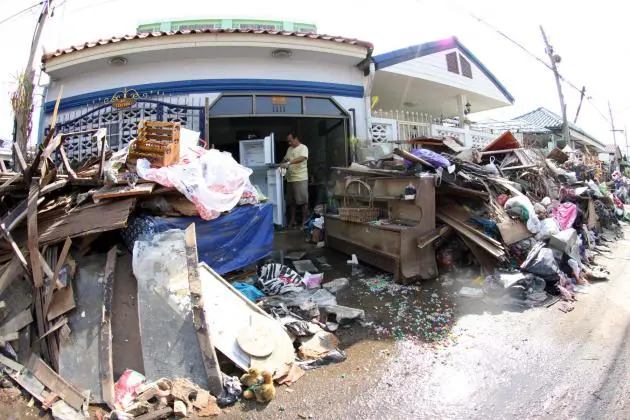
During the flood, the amount of garbage rose by two million tons – 750,000 tons in Bangkok and 1.3 million tons elsewhere, he said, Bangkok still had 4,000 tons of garbage to be rid of before the New Year.
Thailand’s hazard waste was at 3.12 million tons, a 1.2 per cent or 37,000 tons increase from previous year, he said, most of it (76 per cent) was from the industrial sector. The dangerous substance usage was at 80 million tons – 74.3 million tons were the substances produced domestically, he said the number of people getting ill from the dangerous substances was at 1,939 patients – 1,720 cases from agricultural chemicals and 210 cases from industrial chemicals.
This year’s air quality improved from last year because the La Nina influence brought a lot of rain and humidity hence the haze in eight northern provinces lowered graetly, he said. The volatile organic compounds (VOCs) in Rayong’s Map Ta Phut area tended to lower, although the amount of some substances remained above-standard at some time periods and stations, he said the measure to promote the use of Euro 4 standard gasoline, in effect from January 1, 2012, should also improved the air quality. The “20 Styrofoam trashes to exchange for an egg” project was also most welcome by public and gathered 1,087,500 pieces of styrofoam trash – equivalent to the Co2 reduction by 10 tons, he said.
