
Police find clues about 6th suspect
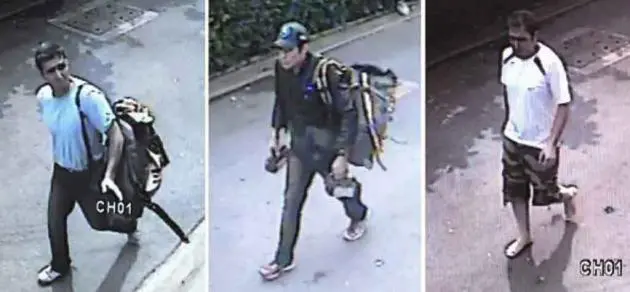


Footage found of man putting up 'Sejeal' stickers near embassies
Trying to solve the mysterious "Sejeal" stickers' link to the February 14 bombs' Iranian suspects, Thai police investigation found a suspicious man, captured by a security camera while posing the stickers near a Sukhumvit bank at night time.
Meanwhile the detained Iranian bomb suspect Mohammad Kharzei called for the holding cell change on ground of stress, while the recent Abac poll reported 64.7 per cent of people were worried about terrorist attacks.
Following the latest discovery of the “Sejeal” stickers in front of CTI Tower near the Sirikit Convention Hall and in Soi Sukhumvit 11 that was only one kilometer away from the Isaeli and Iran embassies, Deputy Police Chief Pol Gen Pansiri Prapawat said police was investigating if the stickers linked to the Iranian bomb suspects and their checking on security cameras in the areas found a male suspect posting the stickers in Sukhunvit area at might time. Police was looking fir more information about this suspect and should get clarity soon, he added.
Police investigators also traced for the sticker maker in Sukhumvit and nearby areas focusing on sticker shops with large machines to produce the stickers in large amount, while urging people and sticker shops to alert police about suspicious persons hiring them to make the “Sejeal” stickers, he said, it should take two days to find out.
Pansiri had presided over the twohour meeting at Khlong Ton police station about the case investigation progress on the stickers and the hunting for the sixth suspect.
Meanwhile, the Jewish church in Soi Sukhumvit 22 and surrounding areas were guarded by police for fear of attack, an informed source reported yesterday.
Metropolitan Police chief Winai Thongsong urged police officers to provide security and order, find intelligence information to prevent attacks, watch out for suspicious activities of foreigners especially Middle Easterners, as well as urging guesthouse and condominiums to list the names and information of their foreign guests or tenants.
Meanwhile, Bangkok Remand Prison director Sopon Teuthampreuk said the 42yearold Iranian bomb suspect Mohammad Kharzei, who was detained at the prison’s newcomer zone under close watch to prevent suicide, told him yesterday morning that he was stressful, couldn’t sleep and wanted the detention cell change. But the prison didn’t allow because the current cell was safe and had a security camera so officials could keep an eye on him 24 hours a day. Two weeks after this the prison committee would consider placing the persons held at the newcomer zone to other zones appropriately, Sopon explained, Kharzai would be moved to a safe cell with security camera but wouldn’t be in the same zone as the 48 yearold detained Lebanese Hezbollah terrorist suspect, Atris Hussein, who was kept at the Zone 8.
In related news, as the recent Assumption University’s Abac poll revealed 64.7 per cent of people were worried about terrorist attacks which mostly stemmed from political conflicts and target innocent civilians, Puntaree Issarangkul Na Ayuttaya, the assistant director for the university’s Analysis of Polling, Policy, Law, and Economics (APPLE) program said the program and leading academics from other countries had recommended some solutions. They urged for a fast and effective strategy to restore public’s confidence in the country and other countries, which also had to get most of the public agreed that the speedy solutions against terrorist issues might affect their convenience and some of their freedoms, she said.
The great success in battling terrorism and crimes was in preventing the attacks and arresting the terrorists before they launched the attacks, she said, hence the government must be expert in gathering intelligence, get cooperation from the public members as its eye and ear, while security agencies and police were attentive, act fast and didn’t ignore the public’s reports of suspicion. They urged for the establishment of the central war room and nine war rooms at nine metropolitan police areas to work on this mission during the highrisk period while officials shouldn’t talk much to press and media shouldn’t present news in the way that the terrorists wanted. CCTV cameras should be installed, suspects’ phones tapped, money transactions or moneylaundering activity that might fund terrorism traced while modern technology to scan for explosives and bomb ingredients should be used, she added. Sniffer dogs and officials should be dispatched at airport, tourist sites and business centers, she said, the immigration system should be reformed to online all over the country and to cover photos, fingerprints and DNA.
