
'Unbeatable Thailand, Unparalleled Opportunities'


Play
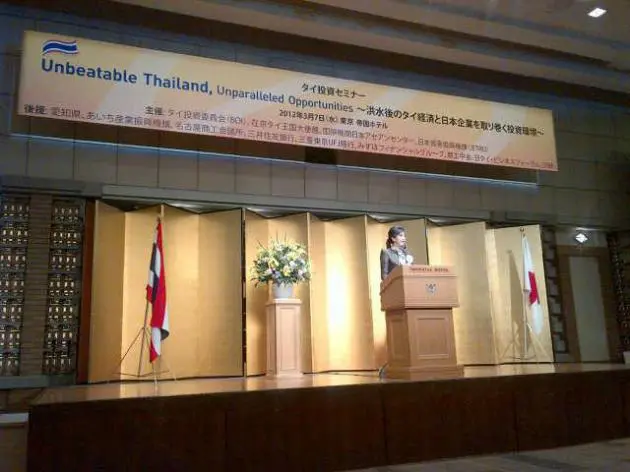
Full speech of Prime Minister Yingluck Shinawatra in a seminar in Tokyo.
Prime Minister of the Kingdom of Thailand
at an Investment Seminar “Unbeatable Thailand, Unparalleled Opportunities”
7 March 2012
Imperial Hotel, Tokyo
---------------------
Excellencies, Distinguished Guests,
Ladies and Gentlemen,
I am honoured to be here in Japan and I would like to thank our friends from the private sector for being here today.
Thailand and Japan are old friends whose economic future is linked to one another. From the establishment of diplomatic relations 125 years ago to the Strategic Partnership with an Economic Partnership Agreement (JTEPA) today, Japan and the private sector have played a key role in Thailand’s development. The strong ties between Thailand and Japan will be even more important as the world increasingly look to Asia to be the main driver of sustain global growth.
Japan is Thailand’s largest trading partner. Our exports to Japan grew by 8.3 percent last year. You are also Thailand’s largest investor. Japanese investments applying for Board of Investment promotion was 49 percent of total FDI last year. Japanese firms are doing more research, development and product design in Thailand. Moreover, the Thai Parliament has approved further negotiations under JTEPA in five areas, including trade, rules of origin, services, investment and implementing JTEPA commitments.
Last year, both Thailand and Japan suffered from the floods. But with your kind support, we have managed to emerge even stronger. Thailand will always be grateful for your help and for the confidence that you have in us.
I am pleased to inform you that, we are in the process of implementing an effective water management system to protect the communities and the important economic and industrial zones.
First, we are currently managing the existing dams by lowering the water level. This will allow the dams to store more water during the peak rainy season.
Second, we have identified natural water retention areas, which will act as another important source of water storage. These areas have direct links to the main rivers to allow for quick release of water after the flooding. In addition, we have already started to enhance the infrastructures system including sluice gates, canals, pumping stations and dykes.
Third, measures to protect the economic zones will include investment in the protective barriers around industrial estates. Roads will be elevated to ensure access for delivery of goods and services; this will ensure that industrial supply chain and logistics will not be disrupted. Furthermore, we are also improving water flow through the canals, in order to drain water quickly into the Gulf of Thailand.
Fourth, a single command center is in place to ensure effective management and timely response. In addition, we are also improving the forecasting and early warning system.
To ensure the success of these plans, around 47 billion yen (18 billion baht) will be spent this year and around 915 billion yen (350 billion baht) will be spent over the next couple of years. In addition, I have also personally visited all the key sites in the plan to gain their support.
In addition to the water management plans, the Government has also initiated several financial packages to assist the Japanese companies affected from the flooding including low interest rates loans to assist in building the flood protection barriers as well as an insurance fund to support those affected.
Despite the floods, our economic fundamentals continue to be strong. We have high level of foreign exchange reserves and a sound fiscal position with low public debt of GDP at around 40 percent. Because of this, the Thai economy is expected to rebound strongly. The forecast for economic growth this year is about 5.5 to 6.5 percent. I would also like to point out that, even with the floods, over 1.1 million Japanese tourists still visited Thailand last year, which is an increase of around 13 percent.
Our Government will continue to implement policies to accommodate foreign investment in Thailand. The corporate income tax has been reduced from 30 percent to 23 percent this year and will be further reduced to 20 percent next year. Several barriers have been removed to make it easier to set up regional headquarters in Thailand. Furthermore, Thai skilled labour continues to be an important asset for foreign companies.
Thailand is the existing hub for your products to a more connected ASEAN Community. This single market and production base currently comprises over 600 million consumers, a combined GDP of some 143.4 trillion yen and an annual economic growth of some 5 percent.
This Community opens up opportunities in regional growth areas such as transportation, energy, health care, tourism and agriculture. Given Thailand’s comparative advantage in some of these areas, we will be able to match the growing dynamism of the ASEAN Community and the growth of Japan’s investments in the region.
To support regional connectivity in the GMS and ASEAN, the Government is committed to invest in logistics and transportation network including roads and rails that will link Thailand with our neighbours through the important economic corridors. This will be supported by not only the Master Plan on ASEAN Connectivity but also the ASEAN Plus Three Connectivity Partnership involving China, Japan and the Republic of Korea which Thailand initiated.
One key project that strengthens regional connectivity is the Dawei deep sea port project which is being developed in cooperation with our close neighbours Myanmar. The success of this project, which is promoted by the Myanmar Government, will not only promote growth and development in Myanmar but also enhance Japanese investments in Thailand as well as the region. This will enhance our links with South Asia, East Asia and beyond.
In conclusion, I can reassure you that Thailand remains the best choice for your continued investment. I am confident that with our strong fundamentals, our supportive policies, our natural assets, and based on our mutual interests, the Thailand –Japan partnership will continue to grow, with the Japanese private sector continuing to serve as a key pillar of this partnership for many years to come.
Thank you.
