
House debate likely next week
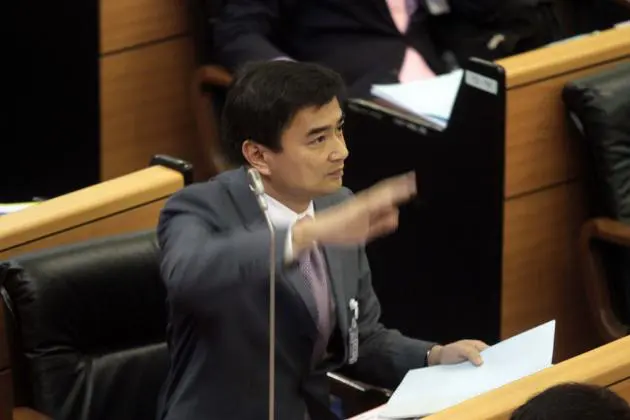


Abhisit says move is a precursor to bill paving the way for amnesty, but Pheu Thai rejects his suspicions
The House of Representatives is likely to start deliberating proposals from the House committee on national reconciliation next Wednesday, according to a government MP sitting on the panel.
Samart Kaewmeechai from the ruling Pheu Thai Party, who is deputy chairman of the reconciliation panel, yesterday said the House Speaker was expected to table the motion for deliberation on April 4 and the debate was likely to continue until the next day.
He denied that the debate was a precursor for a reconciliation law aimed at paving the way for granting amnesty to certain politicians. “That would only lead to more conflict,” he said.
Samart, who also chairs the parliamentary committee vetting the constitutional amendment bills, said he expected the second reading of the bills to take place on April 10 and 11. He said his panel had vetted all the important issues and would complete its work soon.
“I insist that the committee’s work is not aimed at paving the way for amnesty. The Constitution has no clauses about amnesty,” he added.
However, opposition leader Abhisit Vejjajiva yesterday said he suspected that after the reconciliation report is deliberated in the House of Representatives, the government would propose a reconciliation bill for the granting of amnesty.
Deputy Prime Minister Chalerm Yoobamrung has already mentioned such a bill, said the former PM.
Abhisit, who is Democrat Party leader, also complained about the chaos during Tuesday night’s parliamentary debate.
A joint sitting of the Senate and the House of Representatives had voted on Tuesday to allow the lower house to deliberate a motion on reconciliation proposals in the current legislative House session.
The vote came after a walkout by Democrat MPs, who left the chamber in protest after senators and government MPs had proposed an early end to the debate. Of the 366 parliamentarians who remained in the chamber following the opposition walkout, 346 voted in support and 13 against, with seven abstentions.
Earlier, the parliamentarians, minus the Democrat MPs, had voted to support an early end to the debate, even though 17 parliamentarians were waiting to take the floor on the matter.
Abhisit said he found it unusual for the government to push for deliberation of a non-legislative motion during a legislative House session.
He also said that the meeting chair had repeatedly switched off his microphone while he was asking reconciliation committee chairman General Sonthi Boonyaratglin to confirm whether his panel’s report submitted to Parliament was complete and genuine.
“I was just exercising my right. But the meeting chairman kept switching off my microphone and ordered a vote, so there was confusion,” Abhisit said.
When Sonthi finally rose to reply to his question, he did not actually answer it, he said, adding, “He talked about his life in the past.”
Abhisit was speaking yesterday during a programme on the satellite-based pro-Democrat Blue Sky Channel.
He said the opposition had walked out on Tuesday to express their dissatisfaction with the proceedings.
He also warned that by capitalising on its parliamentary majority in pushing for the laws they want, the government would bring about a new round of conflict.
“How will you bring about reconciliation by unilaterally pushing for laws the way they [Pheu Thai] like it? They are citing reconciliation in order to whitewash the wrongdoing of corruption. This is worrying and will finally lead to renewed violence,” Abhisit said.
Meanwhile, Prime Minister Yingluck Shinawatra yesterday said Parliament was the best place for discussion to find a way out for the country regarding reconciliation.
“We have to respect the majority while honouring the minority,” she said, adding that parliamentarians are representatives of people from all over the country.
When asked if the government would issue an amnesty law after Parliament passes the reconciliation proposals, the premier said: “That would take a long time.”
