
You can be too young to learn
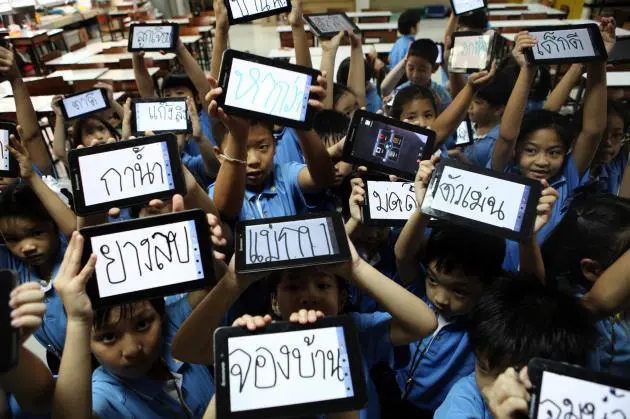


Older kids would make better use of tablets than Prathom 1, say researchers
The government should distribute tablet PCs to Prathom 1 and Prathom 4 (Grades 1 and 4) students, as well as to Matthayom 1 and 4 (Grades 7 and 10), a team of researchers said yesterday.
Distributing the gadgets to students of different ages and separate levels would help the government judge whether the scheme is actually worthwhile, the team, comprised of researchers from Srinakharinwirot University (SWU), said.
The researchers studied the impact tablet use might have on students in the previous semester.
The government has been planning to distribute tablet PCs to Prathom 1 students initially, before moving on to Matthayom 1 students.
However, in a study conducted last semester, the team concluded that Prathom 4 students were more prepared to use the tablets than Prathom 1 students. It also found that older students picked up lessons faster and were more creative while using the devices.
“The findings suggest that spending the taxpayers’ money on tablets for Prathom 4 students is better than giving them to younger Prathom 1 pupils,” Asst Prof Chalermchai Boonyaleepun, president of SWU, told a press conference yesterday.
However, he said, since the government has already announced that it will distribute the devices to Prathom 1 students, it could divide the shipment between both levels.
“It is not necessary to distribute the entire shipment of tablets [ordered from a Chinese firm] to just Prathom 1 students. They could instead give 400,000 to Prathom 1 students and another 400,000 to those in Prathom 4,” he said.
Chalermchai also cited recommendations from school directors and teachers, who proposed a “one tablet, one projector or one smart board” teaching technique, in which teachers can use a tablet plugged into a projector or a smart board to conduct a lesson.
This way, they said, it would be easier for them to control the class.
“Then, when it is time for students to use a tablet on their own, their schools can equip a classroom with enough of these devices and students in each class can take turns in using them. Using tablets in two classes per day is more than enough.
“We would like to see if students grasp things better if they have a tablet in front of them as the teacher leads the lesson using a projector or smart board, or if they have a tablet but the teacher does not have a projector or smart board,” he added.
Besides school directors and teachers, parents are also urging the authorities to not allow students to take the tablets home over concerns about them being lost or damaged.
The team discovered that many parents are worried that allowing youngsters to take their tablet home might create a digital divide, as many poor families cannot afford broadband Internet. They said the government could solve this problem by providing WiFi connections for poor communities.
The parents also asked to be taught to use the tablets so they could keep up with their children.
The study also found that learning objects created by the Office of the Basic Education Commission (Obec) were not interesting enough for young people and called on relevant agencies to develop better content to hold students’ attention. The team also suggested that the government provide funding for at least one technical assistant per school.
“Technical assistants are very important, especially while the policy is being implemented,” Chalermchai said.
Plan needed
He also called on the government to create a plan that will clarify the terms for school administrators, teachers, parents and students.
For instance, explaining how many hours students can use these tablets for and what subjects they can study on the devices.
Chalermchai also urged Obec to provide a budget to SWU so it can continue studying these and other issues like the impact tabletusage can have on a student’s eyesight, sleeping habits, addiction to games, eating behaviour and body weight. He said these issues could not be addressed this time due to time limits.
