
Four issues central to charter change inquiry


Play
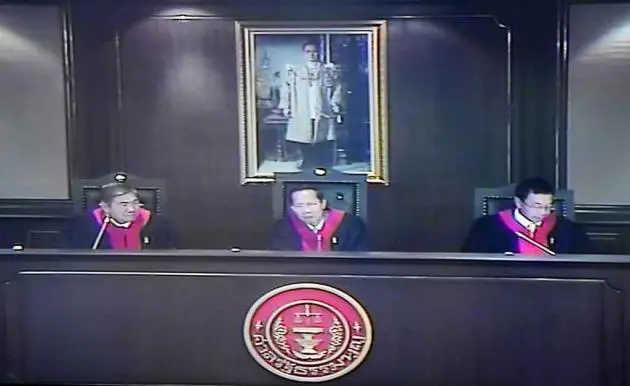
The Constitution Court on Wednesday spelled out four legal issues, which would serve as the basis for a verdict on charter change.
The four issues are:
1. The mandate of the inquiry under Article 68 of the Constitution, specifically whether complainants could petition for judicial intervention on any attempts to topple democratic rule with the King as head of state or to grab power by unconstitutional means.
2. Whether Article 291 of the Constitution empowers Parliament to overhaul the entire charter and write a new charter.
3. Whether the bill to amend Article 291 can be construed as an unconstitutional move to topple democratic rule with the King as head of state or to grab power by unconstitutional means.
4. If an offence under the above-mentioned provisions occurs, should this be a cause for punishment by party dissolution.
At the start of the inquiry, the high court heard the testimony of complainant Somjet Boonthanom.
Somjet was the first of seven witnesses to testify against charter change.
He told the high court that his opposition to the charter amendment bill was to prevent a campaign to topple the political system.
He said he suspected the ruling Pheu Thai Party had an ulterior motive in citing the charter rewrite as a pretext to tear up the Constitution and abolish the political system as sanctioned by existing charter provisions.
In cross-examination by defence legal adviser Wattana Sengpairoh, he said although he was a member of the parliamentary committee vetting the bill, he had consistently opposed the draft at every step of the legislative process.
“I believe the bill is a bogus legislation to conceal the true motive to topple democratic rule,” he said.
Even though the actual charter rewrite had not taken place yet, the prevailing activities, such as the partisanship shown by the Parliament president, had enforced his suspicion, he said.
“The tearing up of the Constitution by Parliament is no different from seizing power through a coup,” he said.
The second witness Dej-udom Krairit voiced concern about a draft provision empowering the Parliament president to rule on any disputes on constitutionality in place of the high court.
