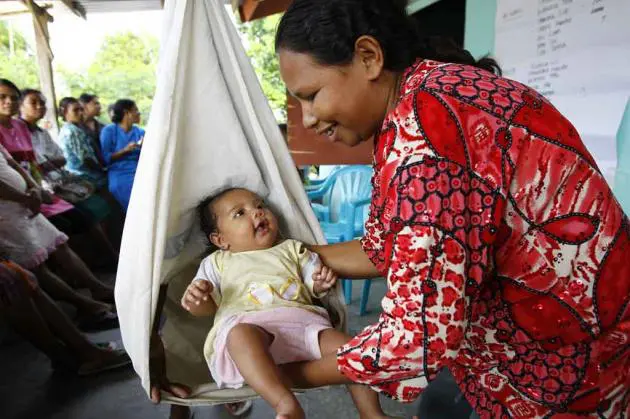
An estimated 7.6 million children under the age of five die every year, more than 70 per cent of them in Africa and Southeast Asia. Two-thirds of these deaths are caused by preventable diseases, while more than a third of all child deaths are linked to malnutrition.
Children from rural areas and poor, less educated families are most likely to succumb to illness and death. For 75 years, Plan International has been working in remote, impoverished parts of the world to teach parents better practices to keep their children healthy, happy and alive.
Nepal: Care before and at birth
In Piprahawa village in Nepal’s Mid-Western region, Ramawati Kori lost her four first babies: her first was a stillbirth, and the next three died within days.
“All my babies were delivered at home without the support of a health worker. My family did not opt for a hospital delivery since they did not know about it,” the 24-year-old said.
According to the latest national demographic survey, Nepal’s neonatal mortality rate is 33 per 1,000 live births, compared with 32 in India and 4 in the United States.
Key to saving children’s lives is safe childbirth and good neonatal care, especially during the first 28 days when nearly 40 per cent of under-five deaths occur. Educating expectant mothers and families is essential.
In the third month of her fifth pregnancy, Ramawati joined monthly pregnant women group meetings, organised by the local NGO Geruwa Rural Awareness Association and Plan.
She learned the importance of institutional delivery, physiological changes during pregnancy and danger signs. She also became aware of antenatal measures such as iron consumption and nutrition for herself, as well as newborn care.
She gave birth by caesarian section to a full-term healthy girl in February 2011. “I had her immunised against measles when she was nine months old. I breastfed her and feed her (a high-protein porridge), bananas and vegetable soup,” Ramawati said, praising the programme for pregnant women. “It helps save the lives of the mothers and newborn babies in our community.”
Vietnam: Breastfeeding and care for newborns
Regardless of the weather, Vang Thi May would strap her baby girl on her back and head to work in the rice paddies in northwest Vietnam.
“We are lucky that my first child survived though she suffered from malnutrition and frequently got sick because of the harsh weather when she stayed on the terraces with me,” 27-year-old May recalled.
Malnutrition is a major problem in Vietnam, where one in 10 Vietnamese children under the age of five weigh less than a child of the same height should. Nearly a third of children under five are smaller than their peers – symptoms accompanied by delayed motor development and impaired cognitive function.
When May became pregnant with a second child, to ease her worries, she joined a Plan-supported parenting group working to promote positive practices in remote mountainous areas.
May learned about symptoms and prevention of common childhood diseases. She was trained to collect her own milk by hand and store the bottled breastmilk in cool water or on ice so her baby could be fed by her grandmother at home while May worked in the paddies. She now makes nutritious meals from locally available foods.
“My second daughter is growing well these months,” she said. “I feel relieved.”
Sri Lanka: A village of underweight children
In Kudugama village of Sri Lanka’s North Central province, 47 percent of children under the age of five were underweight. The villagers, from a lower caste, received lower-quality health services than neighbouring villages and dared not complain to officials to improve the situation.
With Plan, facilitators from the Foundation for Health Promotion and Rajarata University began work to train public health midwives on issues of excluded communities. Eventually, villagers in Kudugama came to trust their midwife.
“We learned that if children are stimulated well during their early childhood, they will grow with enough strength and intelligence to achieve their dreams. We realised that our small world can improve immensely by simple changes that we can make happen,” several mothers shared after a community meeting.
They began collective feeding sessions, helping children to socialise and easing the burden on each household to provide a variety of foods for their children.
Within three months, the average monthly weight gain of their children, aged 2-5, increased from a meagre 57 grams to 261 grams. For those aged 0-5, the figure shot up from 52 grams to 305 grams per month.
“We used to hide when the public health midwife came for home visits,” the mothers said. “Now, we eagerly look forward to the next weighing session to share our progress.”