
NASA's Curiosity rover lands successfully on Mars


Play
Washington - The Curiosity rover survived a perilous landingon Mars early Monday in a never-before-tried technique that saw itlowered to the surface of the Red Planet like a spider on a string,the NASA space agency said.
Cheers broke out in NASA's Jet Propulsion Laboratory in California as the rover touched down after what had been dubbed "seven minutesof terror," when the craft entered the planet's atmosphere andundertook the most complicated landing yet for an unmanned craft.
Within minutes of its 0532 GMT landing, Curiosity sent its firstgrainy images, showing its wheels safely on the surface. Shouts of"It's the wheel, it's the wheel!" erupted in the control room.
Zooming toward the surface at more than 20,000 kilometres perhour, the craft carrying the rover had decelerated using thrustersand a parachute.
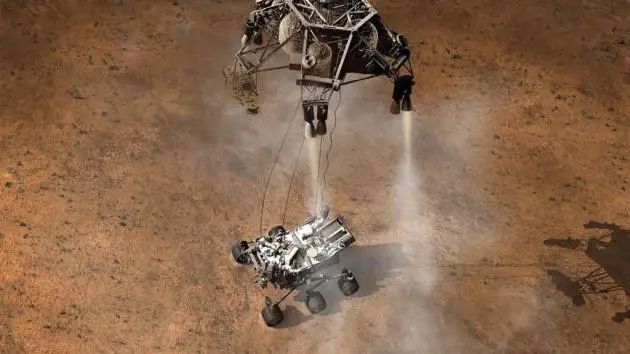
It jettisoned its cruising rockets, heat shield and outer shell -going through six different vehicle configurations - before ajet-pack like device known as a "sky crane" gently lowered the900-kilogramme rover to the Martian surface like a spider on athread.
NASA's Odyssey orbiter circling the planet sent the firstconfirmation of the landing via an antenna in Australia.
Launched in November, the 2.5 billion dollar rover programme ispart of a mission designed to determine whether conditions on Marswere ever right for life. Its mission is also part of broader plansto eventually send astronauts to Mars.
"Today the wheels of Curiosity have begun to blaze the path forhuman footprints on Mars," NASA chief Charlie Bolden told reportersand a room full of thrilled engineers and scientists. "Curiosity, themost sophisticated rover ever built, is now on the surface of the RedPlanet, where it will seek to answer age-old questions about whetherlife ever existed on Mars - or if the planet can sustain life in thefuture."
He called the landing an "amazing" feat and noted that only 40 percent of craft ever sent to Mars have successfully arrived. Thecomplicated landing manoeuvre was being employed with a rover for thefirst time, and earlier efforts with much smaller rovers alwaysinvolved an airbag-like structure.
Fans gathered around the United States, including in New York'sTimes Square, to watch a live broadcast from mission control.
US President Barack Obama called the landing a historic momentthat marked a major advance in space exploration.
"The successful landing of Curiosity - the most sophisticatedroving laboratory ever to land on another planet - marks anunprecedented feat of technology that will stand as a point ofnational pride far into the future," Obama said.
"It proves that eventhe longest of odds are no match for our unique blend of ingenuityand determination." The mission is to spend at least one Martian year - nearly twoEarth years - studying the Gale crater to transition from the searchfor water to the search for life by looking for other ingredientsnecessary for life, such as carbon.
It will study minerals on thesurface to get an idea about what conditions were like on the planetmillions of years ago.
The Gale crater, where Curiosity will focus its efforts, is nearly154 kilometres in diametre and features a mountain that rises some 5kilometres above the surface. The massive feature includes layers ofrock strata that will provide a virtual history of Mars' geologicalpast.
The rover landed in a low-lying area where water appears to haveonce flowed, allowing it to get to work right away before headingtoward the mountain.
Curiosity will make use of a range of new instruments. Armed withtwo cameras atop a mast, Curiosity can take 3-D and panoramic images,and a laser can be shot into rocks to determine their chemicalelements.
A two-metre long robotic arm can be extended out from the rover toexamine its surroundings more closely, and a drill will allow it totake samples from inside rocks.
The area has already been studied extensively from orbitingspacecraft, and scientists hope that Curiosity will provide clues toa probable wet Martian past. The area contains clay and sulfate-richareas, where organic compounds necessary to life could be found.
Curiosity builds on the work of past rovers, includingOpportunity, one of a pair of water-hunting twin rovers thatcontinued functioning years beyond their orginal missions.
NASA eventually hopes to send a manned mission to Mars, androbotic missions to Earth's nearest planetary neighbour havecontinued. On Thursday, India said it hopes to send an orbiter to theplanet as soon as 2013.
Within minutes of its 0532 GMT landing, Curiosity sent its firstgrainy images, showing its wheels safely on the surface. Shouts of"It's the wheel, it's the wheel!" erupted in the control room.
Zooming toward the surface at more than 20,000 kilometres perhour, the craft carrying the rover had decelerated using thrustersand a parachute.
It jettisoned its cruising rockets, heat shield and outer shell -going through six different vehicle configurations - before ajet-pack like device known as a "sky crane" gently lowered the900-kilogramme rover to the Martian surface like a spider on athread.
NASA's Odyssey orbiter circling the planet sent the firstconfirmation of the landing via an antenna in Australia.
Launched in November, the 2.5 billion dollar rover programme ispart of a mission designed to determine whether conditions on Marswere ever right for life. Its mission is also part of broader plansto eventually send astronauts to Mars.
"Today the wheels of Curiosity have begun to blaze the path forhuman footprints on Mars," NASA chief Charlie Bolden told reportersand a room full of thrilled engineers and scientists. "Curiosity, themost sophisticated rover ever built, is now on the surface of the RedPlanet, where it will seek to answer age-old questions about whetherlife ever existed on Mars - or if the planet can sustain life in thefuture."
He called the landing an "amazing" feat and noted that only 40 percent of craft ever sent to Mars have successfully arrived. Thecomplicated landing manoeuvre was being employed with a rover for thefirst time, and earlier efforts with much smaller rovers alwaysinvolved an airbag-like structure.
Fans gathered around the United States, including in New York'sTimes Square, to watch a live broadcast from mission control.
US President Barack Obama called the landing a historic momentthat marked a major advance in space exploration.
"The successful landing of Curiosity - the most sophisticatedroving laboratory ever to land on another planet - marks anunprecedented feat of technology that will stand as a point ofnational pride far into the future," Obama said.
"It proves that eventhe longest of odds are no match for our unique blend of ingenuityand determination." The mission is to spend at least one Martian year - nearly twoEarth years - studying the Gale crater to transition from the searchfor water to the search for life by looking for other ingredientsnecessary for life, such as carbon.
It will study minerals on thesurface to get an idea about what conditions were like on the planetmillions of years ago.
The Gale crater, where Curiosity will focus its efforts, is nearly154 kilometres in diametre and features a mountain that rises some 5kilometres above the surface. The massive feature includes layers ofrock strata that will provide a virtual history of Mars' geologicalpast.
The rover landed in a low-lying area where water appears to haveonce flowed, allowing it to get to work right away before headingtoward the mountain.
Curiosity will make use of a range of new instruments. Armed withtwo cameras atop a mast, Curiosity can take 3-D and panoramic images,and a laser can be shot into rocks to determine their chemicalelements.
A two-metre long robotic arm can be extended out from the rover toexamine its surroundings more closely, and a drill will allow it totake samples from inside rocks.
The area has already been studied extensively from orbitingspacecraft, and scientists hope that Curiosity will provide clues toa probable wet Martian past. The area contains clay and sulfate-richareas, where organic compounds necessary to life could be found.
Curiosity builds on the work of past rovers, includingOpportunity, one of a pair of water-hunting twin rovers thatcontinued functioning years beyond their orginal missions.
NASA eventually hopes to send a manned mission to Mars, androbotic missions to Earth's nearest planetary neighbour havecontinued. On Thursday, India said it hopes to send an orbiter to theplanet as soon as 2013.
