
Govt pins hopes on machines, barriers to beat the floods


Play
Water-flow push machines and flood barriers will play a key role in the government's flood-prevention plan this year.
After spending a massive amount of money on these items, the government is now fully confident the country, especially the economic zones, will be safe from serious inundation. Yet several water experts and civic groups in the northern region have their doubts.
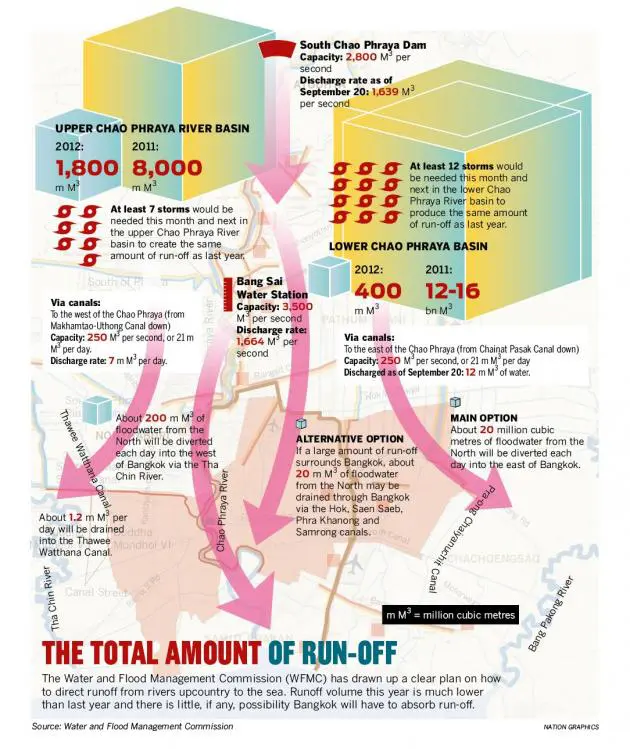
In the lower Chao Phraya river basin, the Royal Irrigation Department (RID) has increased the water drainage capacity to the sea by more than 76.7 million cubic metres of water per day as it installs 773 water-pumping machines to drain water. Over 500 of these are 12-inch pumping machines.
“This equipment is the key measure RID has prepared to deal with this year's flood,” Water and Flood Management Bureau's director Thongplew Kongjun told The Nation.
Hydro and Agro Infomatics Institute director Royol Chitdon, who sits on a Water and Flood Management Commission sub-panel, said Bangkok could avoid flooding if the Bangkok Metropolitan Administration (BMA) agreed to install the water-pumping and pushing machines to increase the capital’s drainage capacity via the canals.
The Chulalongkorn Water Gate in Pathum Thani has been relocated to an area just outside Rangsit, which was hard hit by last year’s flood.
Bangkok is in a low-lying area. Without the pumps, it would be difficult to drain water to the sea during the wet season.
BMA, therefore, has agreed to buy 50 water-pushing machines and plans to install them in its major canal by the end of this month. Also, the Royal Thai Navy Dockyard has produced another 40 water-pushing machines to help Bangkok drain the city.
A drainage test on September 7 in Lat Phrao canal had proved these machines could save the area from flooding caused by heavy downpours. They can drain floodwater in a canal at up to 17 cubic metres per second, Royol said.
However, he said a weakness in planning is that BMA staff have no expertise in using the machines. Also, the system that feeds water from the canals into the flood diversion tunnel needs to be improved.
Another important factor in the flood prevention fight is the embankment.
The government has allocated Bt24 billion for floodwalls and to raise the level of some 500 kilometres of roads. The mega projects cover Bangkok and adjacent provinces such as Samut Sakhon and Nakhon Pathom.
Additionally, the Transport Minister has ordered a temporary embankment around Bangkok as a second defence to block flood flow into the capital.
Some 20 per cent of the work building this temporary embankment is complete and the entire project is due to be finished by the end of the month, Deputy Transport Minister Chatchart Sithipan said.
Veteran water expert Prasert Povichien, a committee member of the Thai Hydra Association, welcomed the government’s move to rely on pumps. However he was not sure whether floodwall construction could really help.
“I believe that water-pumping machines are still the key to saving us from flooding this year,” he said.
Prasert said Bangkok’s existing canals were not designed to facilitate water flow to the sea because these waterways had served mainly agricultural and transport purposes in the past.
“These canals are not efficiently linked to Bangkok’s much-touted giant water-drainage tunnels either. These canals can’t fast push run-off water into the tunnels in the wake of downpours. That’s why Bangkok has continued to experience flooding during heavy-rain days. So, we really have to pin hopes on the pumps,” Prasert said.
