
Cost will limit positions for nurses
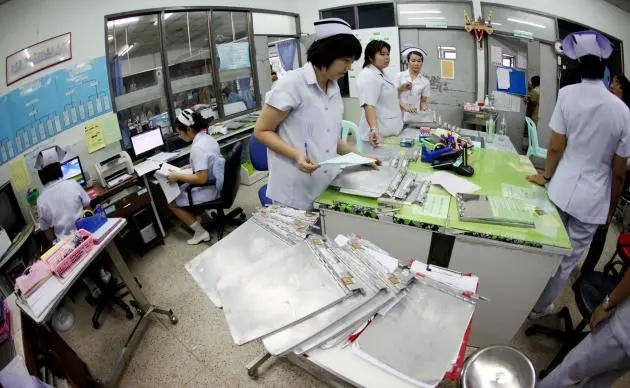


Thousands to rally today for full-time jobs and better working conditions
Government agencies appear unlikely to agree to all 17,000 temporary nurses who are demanding permanent positions, saying this would be a huge financial burden. But an effort looks likely to be made to alleviate the shortage in health staff at state hospitals.
Today, about 3,000 temporary nurses will gather in front of Government House to call for a change in their job conditions. They want the government to improve their job security - to offer them permanent contracts and reduce their workloads.
According to Kanniga Panya-Amornwat, a committee member of the Nursing and Midwifery Council, about 17,000 temporary nurses were threatening to resign from state hospitals, if their demands are not met within three months.
Office of the Civil Service Commission secretary-general Nontigorn Kanchanachitra said the Public Health Ministry has asked the government to allocate over 70,000 civil servant positions as the ministry will be able to employ more medical workers with permanent employment contracts.
"This is a huge amount of employment by state agencies. It is impossible to hire all 70,000 positions as civil servants. Maybe we could hire only 17,000 positions but let’s see that we can or cannot do," he said.
To date, the health ministry has more than 160,000 civil servants who work as officials and medical workers. The number of civil servants is the second largest in the country, followed Education and Finance Ministry.
"If we employ all of 70,000 people [demanded] as civil servants that means we have to spend about Bt14 billion per year," Nontigorn told The Nation in an exclusive interview.
"The budget amount for employment will be double next year," he said.
Increasing the number of state civil servants depends on the urgent need and priority of each state agency. Moreover, civil servants have to work in the rural areas not in central areas.
But for the ministry's request to allow more civil servant positions, Nontigorn said the ministry had never informed it of the exact number of health personnel it needs. The ministry just reported its demand to increase health personnel but it never disclosed the number of patients they serve or how its workload will be increase in the future.
"We need to know which health professionals are most important to designate as civil servants, but in the past the ministry only gave us an overview figure and there was no answer for us," he said.
"Do you think there is a nursing shortage? The answer may be yes in rural areas but when we allocate civil servant positions to rural hospitals, they suddenly ask to move to work at other state hospitals in the big cities. We are now sure that if we give civil servant positions to them, they will move to other areas or not," he explained.
Krisada Sawaengdee, second vice-president of the Nursing and Midwifery Council, said if the government couldn't allocate civil servant positions to the health ministry, it should improve the welfare and benefit for temporary nurses such as medical benefits for their family and should allow them to continue education without leaving their current positions.
However, she said most civil servant positions that government had given to the health ministry were allocated to physicians not nurses.
Dr Suphan Srithamma, deputy permanent secretary for health, said the ministry was studying an appropriate number and approach to employ health personnel. Some may be employed as civil servants, public officials, or public health officials depending on the results of a study. For health officials, the ministry will upgrade medical benefits, which will be similar to civil servant medical benefits."We expect that we will get a clear answer for health personnel employment within three months,"
The Nation
