
Rising costs offset gains of rice price-pledging


Play
Populist policies partly responsible for farmers' predicament, say some experts
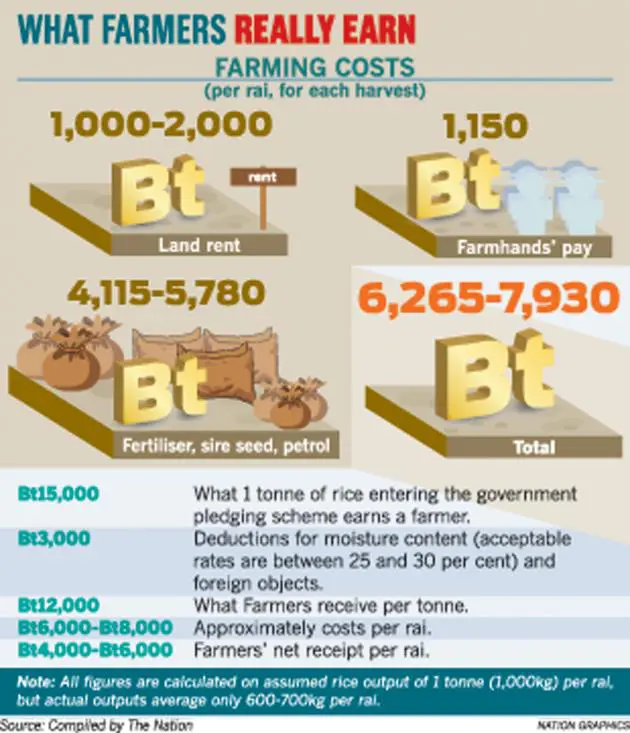
Despite the government’s much-hyped rice price-pledging policy guaranteeing a minimum rate of Bt15,000 per tonne of rice per rai for one crop, farmers are still burdened with high farming costs which reduce their margin to only Bt4,000 to Bt6,000.
The figure will be even lower, given the ideal farming output at one tonne of rice per rai of farmland. However, in reality unfertile rice paddies yield only Bt600 to Bt700 per kilo of rice per rai. Even worse, the populist policy has prompted a rise in the rent of farmland by about 30 per cent across the country.
Opas Pinkaew, a farmer based in Nonthaburi’s Bang Yai district, said he had earned about Bt8,000 per tonne per rai because of already high farming costs, which would rise further in the future. “Without the government’s rice price-pledging policy, farmers will simply face a dead-end in their career shouldering high farming costs,” he added.
The 48-year-old, who owns 20 rai of farmland and leases another 11 rai, has a long list of expenditures: rent at Bt700 per rai, fertiliser Bt800 per rai, rice seed sire Bt600 per rai, insecticides, petrol for motorised insecticide sprayers, in addition to wages paid to farmhands, to people who spray insecticides, all of which total up to Bt7,000 per rai.
Another farmer living nearby, Amphorn Buajan, gave a detailed list of her spending on farming per rai: rent Bt1,000 – 30 per cent higher, which she said was a result of the populist policy; pre-ploughing steps and ploughing Bt350; scattering of seed sire Bt50; weed-killing chemicals Bt50; insecticide spraying Bt200; rent for crop harvesting tractor Bt300.
The list continues: fees for trucks transporting rice to milling houses Bt200, fertiliser Bt850, secondary use of rice-killing chemicals and insecticides Bt1,665, or Bt333 each on five occasions. This amount will double during a locust attack. Traditionally, hirers of farmhands will also have to provide them free drinking water and meals, or even liquor and energy drinks in after-work feasts, she said.
Amphorn, 58, said the other costs per rai included rice seed sire Bt600; petrol for motorised insecticide sprayers Bt1,000; rent for water pumps and petrol Bt1,150. After adding wages for farmhands, her cost could go up to Bt6,252, or Bt7,930 occasionally if locusts have to be dealt with.
After automatic deduction for moisture content and foreign objects of about Bt3,000 per tonne, Amphorn said the government-pledged rate of Bt15,000 was reduced to Bt12,000. For her 12-rai rice paddies, Amphorn said she would receive about Bt48,800 from the amount supposedly set at Bt144,000 based on the Bt12,000 moist-deducted rate.
Withoon Plianjamroon, director of Bio Thai – an NGO promoting farming relying on biochemistry – said the rent had increased from Bt1,000 to Bt1,500 after the price-pledging policy came into effect, especially in central provinces which have long been home to Thailand’s rice production. “For three crops, a farmer will pay Bt4,500 per rai as farmland rent,” he added.
The price of fertilisers have increased from Bt750 per 25kg sack to Bt900 in one year, and so have the prices of insecticides and other chemicals. Another populist policy raising the daily minimum wage to Bt300 has made it more difficult for farmers to seek willing and punctual farmhands, or expect them to reach their full productivity. Citing a figure by the Office of Agricultural Economics, Withoon said the per-rai farming cost at Bt4,800 had increased to Bt6,240.
Wichian Phuanglamjiak, a deputy head of the Thai Rice Growers’ Association, said the estimate of per-rai farming cost was higher at Bt7,000 to Bt9,000, while the post-deduction rate for a similar policy initiated, but no longer in use, by the Democrat-led government would earn farmers Bt7,500 while the rate designated by the current government would earn them Bt12,000, however, with a delay in payment. He did not elaborate.
According to figures by the US Department of Agriculture, Thailand is ranked seventh in an eight-country rice output table among Asean countries. Vietnam tops the list with 874kg per rai, while Thailand’s output is 452kg, slightly better than Cambodia’s 415kg.
