
Dems to 'keep pressure on'
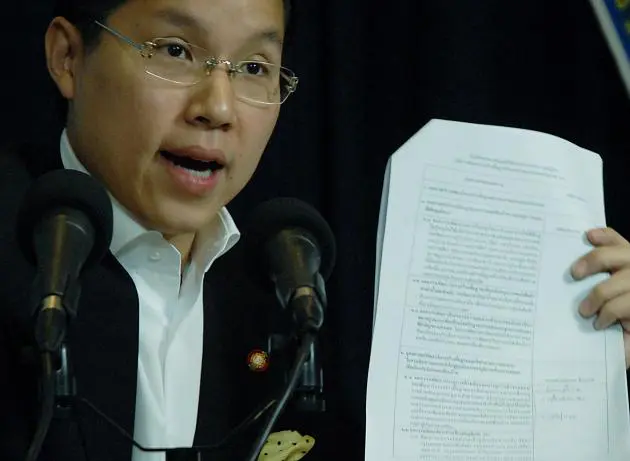


House debate on govt's Bt2-trillion borrowing bill kicks off today, Opposition to make case that on-budget spending is the best option
The Democrats do not expect that the House debate will spell defeat for the Bt2-trillion borrowing bill, given the ruling coalition’s majority, but they are hopeful that their arguments will raise social awareness and win public support for investment checks-and-balances.
The two-day debate on the borrowing bill, initiated under the government’s ambitious plan to increase Thailand’s logistics competitiveness and regional connectivity, kicks off today.
Democrat MP Atavit Suwannapakdee said the opposition did not expect it would be able to stop government MPs from passing the bill. But on the other hand, it was placing hope on social pressure being generated.
“If social pressure is put on the government, we might be able to stop the borrowing. The opposition is trying to make the public understand that the government’s plans are not clear and would allow changes like issuing blank cheques. We won’t let that happen. If the media and academics understand and keep an eye on [the projects], it won’t happen,” Atavit said.
The opposition plans to aim attacks mainly at the government’s debt burden, the suitability and effectiveness of the projects, and their transparency.

According to Atavit, the Democrats insist the government could best finance the infrastructure projects through normal budget channels, believing this would ensure better project screening. He said there was no clause to say that the government was bound to proceed with projects annexed to the bills.
Democrat MP Rachada Dhnadirek said the lists included many projects that the government was not ready to implement at the moment. “Many projects still lack a feasibility study and environmental impact assessments,” she said.
She said that to finance the projects, the government could instead run additional budget deficits of Bt300 billion per year. She suspected the government had a hidden agenda, and pinned her hopes on the bill being unconstitutional.
The Democrats said the bill might be in violation of Articles 169 and 170 of the Constitution, which govern public spending.
Deputy Prime Minister Kittiratt Na-Ranong earlier said the government chose to borrow rather than run budget deficits to finance the projects, and not send a wrong message that the government wanted to stimulate the economy. “Budget deficits or fiscal policies are exercised when a government wants to boost the economy. Our objective is however to invest in new infrastructure projects, after years of their absence.”
The Bt2 trillion will fund a number of rail, road, water-transport and air-transport projects, under a vision to place Thailand at the centre of Asean.
This would be highlighted through its presence in the Bay of Bengal Initiative for Multi-Sectoral Technical and Economic Cooperation (Bimstec), the Greater Mekong Subregion (GMS), the Ayeyawady-Chao Phraya-Mekong Economic Cooperation Strategy (ACMECS), and the Indonesia-Malaysia-Thailand Growth Triangle.
After the seven-year investment, Thailand would be linked with the regional groups through the Southern Economic Corridor (Bangkok-Phnom Penh-Ho Chi Minh City), the East-West Economic Corridor (Malamang-Phitsanulok-Khon Kaen-Savannakhet-Danang), and the North-South Economic Corridor (which links Thailand with Kunming, China, via Laos and Myanmar). Through Route R9, Thailand would be linked with Vietnam, Cambodia and Myanmar.
Academics have voiced their concern over the public debt, fearing it could breach the non-binding threshold of 60 per cent of gross domestic product (GDP). The government announced the loans would be cleared within 50 years and insisted that the debt ratio would not exceed 50 per cent.
The Democrats have clearly stated they disagree with four high-speed train projects.
“We agree with the investment, but not in the way the government proposed it. The routes [as proposed by the government] would not be linked with neighbouring countries, and that would not be cost-effective,” Atavit said.
Both sides are prepared to present their cases today.
The Pheu Thai Party has set up another war room comprising party strategists and legal advisers to cope with today’s debate, in addition to the first one, which consists of party heavyweights who would launch verbal countermeasures against any off-topic statements by the opposition.
The second team, which like the first team will be stationed in Room 3310 at Parliament House, will also be tasked with protecting Prime Minister Yingluck Shinawatra or de-facto leader Thaksin in case they are attacked verbally by the Democrats or opposition ally Bhum Jai Thai.
Ahead of the debate, former prime minister Thaksin Shinawatra made a Skype call to the Pheu Thai Party’s annual meeting. In his 10-minute message on Tuesday, he instructed government MPs to study the loan bill thoroughly and stand ready to rebut the opposition’s attack. He threatened to mete out the severest punishment if the House deliberation of the bill collapsed due to a lack of quorum. He also said he would not endorse the re-election bids for MPs who were a no-show at next week’s debate on charter change.
Sixty Democrat MPs have been designated as speakers. Bhum Jai Thai has selected 10 in support of the Democrats, while Pheu Thai has arranged 40 MPs, including members of the two war rooms, to support or protect Yingluck and the three key speakers in defence of the bill, Finance Minister Kittiratt Na-Ranong, Transport Minister Chadchart Sittipunt and PM’s Office Minister Varathep Ratanakorn.
The key guardian of Yingluck, whom a Pheu Thai source said would be present only when needed during the debate, is Deputy Prime Minister Chalerm Yoobamrung. His assistants are senior MPs known for their verbal acuity, who will jump to the defence of Yingluck and Thaksin when implicated by issues not on the agenda.
Both sides are given 12-and-a-half hours in the two-day debate, which begins today at 9.30am and is televised live on government-run Channel 11. Yingluck would make an opening speech while the three ministers would go into the details of more than 100 projects, which are explained in an annex containing 268 pages attached to the 19-article bill.
