
Democrats reveal discrepancies in education budget


Play
Deputy Education Minister Sermsak Pongpanich yesterday claimed that the Bt2.34 billion sought by the ministry for the procurement of school vans was a mistype, as the actual funds sought were Bt1.23 billion.
Sermsak was responding to allegations by Democrat MP Jurit Laksanavisit, who said there were several discrepancies in the Education Ministry’s plan to buy 1,000 12-seat diesel vans for school children.
For instance, he said, the market price for a 12-seat diesel van was Bt956,000, but the ministry had set the median price for bidding at Bt1.2 million per van. Worse yet, he said, the ministry was seeking an exact sum of Bt2,343.724 million for the 1,000 vans, which would price each van at Bt2,343,724. Jurit noted that the price of a vehicle was usually rounded off and the last two digits are zero instead of 24 as proposed by the ministry.
“This is very suspicious, so I would like to call this project a way of wasting students’ money,” Jurit said.
In response, Sermsak said that the median price for each van was indeed Bt1.2 million, but the request budget for the project should have been Bt1,232.4 million instead of Bt2,343.724 million as stated in the Education Ministry’s part of the 2014 budget bill.
“It was a typing error,” Sermsak told the House.
“There are errors at several spots so the MPs were given incorrect information. In fact, the ministry is seeking B1,232.4 million for buying 1,000 vehicles at the price of Bt1,232,400 for each vehicle.”
He said 850 vans would be delivered to 850 outstanding schools at the tambon level and the remaining 150 vans would be given to small schools, which have been merged in the pilot project to dissolve small schools.
Also during the debate, Education Minister Phongthep Thepkanjana insisted that the government would provide Bt5 billion to support research projects at state universities.
Meanwhile, both sides in Parliament were seen standing firm and offering starkly different views of the government’s proposed Bt2.2-trillion in mega-projects.
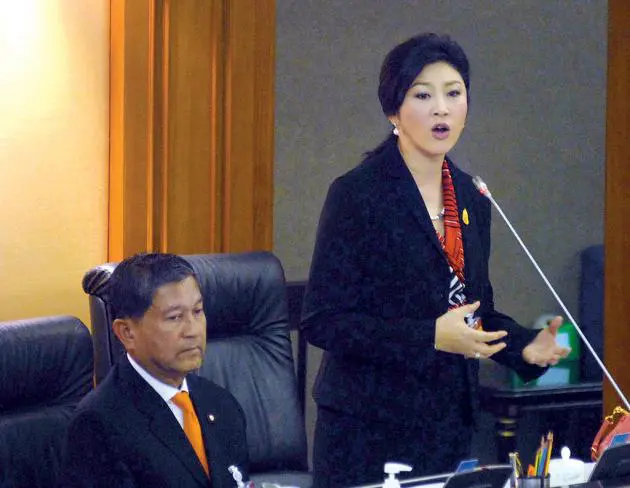
Prime Minister Yingluck Shinawatra insisted her administration was doing what it can to narrow the income gap, while Democrat MPs took turns in telling the House they did not trust the government. They also voiced opposition to several of the Pheu Thai-led administration’s policies, particularly the minimum-wage increase, which they say has led to higher costs of living.
Apirak Kosayodhin, deputy Democrat leader, told the House yesterday that the cost of basic necessities had risen dramatically as a result of the minimum daily wage being increased to Bt300. He said a simple plate of rice and curry now costs between Bt35 and Bt45, while the price of eggs, limes and other basic commodities has also risen considerably. Apirak added that though the government had pledged to set up 10,000 subsidised groceries across the Kingdom, so far only 6,800 were ready.
Apirak said that judging from previous failures, the government did not deserve the amount it was seeking. Another Democrat MP asked whether the administration would introduce progressive property and inheritance taxes.
However, Yingluck said it was her government’s priority to address the problem of income disparity and boost people’s quality of life by granting equal access to state welfare schemes.
She insisted that proposed high-speed train projects would create more jobs and spread opportunities. “Thailand needs proper infrastructure development, something we have not done for a long time,” she said.
