
Abhisit takes on govt over rice losses


Play
Democrat chief says figures prove losses amount to Bt260 billion
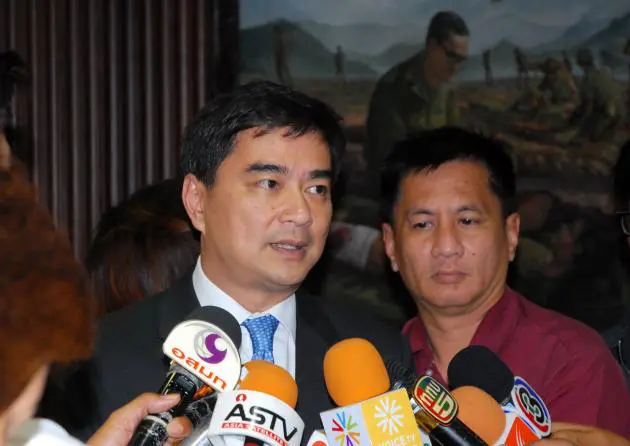
Opposition leader Abhisit Vejjajiva yesterday said that figures released by concerned state agencies show that the government’s rice-pledging scheme had suffered a loss of Bt260 billion.
The Democrat Party chief said that only Bt80 billion of the state subsidies had reached the farmers. A massive amount of money is wasted through corruption, he said.
Abhisit called a press conference yesterday, and dismissed statements by Commerce Minister Boonsong Teriyapirom and his deputy, Natthawut Saikua and Deputy Finance Minister Thanusak Lek-uthai, who denied on Friday that the rice-pledging scheme has suffered a Bt260-billion loss as revealed by a Finance Ministry committee.
Abhisit said Thanusak had earlier admitted at press conferences that the scheme had suffered a Bt220-billion loss for both in- and off-season crops in 2011-12. He rejected the arguments of the government that until it had sold the rice stocks in its warehouses across the country, it would never know whether the scheme was profitable or loss-making.
Abhisit said the Finance Ministry’s accounting methodology involved calculating how much money the government had received from selling rice and how much it had spent for the pledging and the market value of the unsold grains.
“It is like buying an item at Bt100 and you keep this item in your stock while the market price is Bt80. So it means you lost Bt20 even though you have not sold it. In fact, in the case of rice the losses maybe even more because rice keeps degrading, unless there is a market fluctuation that causes prices to skyrocket, but that is an unlikely scenario for rice,” he said.
Abhisit rejected the government’s claim that the losses also included those from all agricultural produce subsidised by the previous government. He said the Yingluck government’s first round of rice-pledging had suffered a loss of Bt42 billion. The loss was lower than the rice-pledging rounds that followed because the scheme could not fully operate due to the massive flooding in 2011. But following the second and third crops, the scheme suffered a total loss of Bt178 billion, excluding Bt40 billion operation cost. Thus, the total loss is definitely more than Bt200 billion, he said.
The Finance Ministry committee showed that as of May 31, 2012, the 17 subsidy schemes for agricultural produce suffered a loss of Bt206 billion but the January 3, 2013 figure rose to Bt393, which means the losses rose by Bt187 billion, excluding operating costs. “These figures all confirm that the rice-pledging scheme definitely has suffered losses which could amount to Bt260 billion,” Abhisit said.
The government has so far spent Bt661 billion for the rice-pledging scheme. The government said it had paid back the Bank for Agriculture and Agricultural Cooperatives Bt120 billion borrowed for the scheme while the rice stored in warehouses was worth Bt226 billion. “That means Bt315 billion is still missing from the total Bt661 billion spent. The government cannot deny that the rice-pledging scheme has suffered a loss of Bt260 billion,” he said.
The Bank for Agriculture and Agricultural Cooperatives, Abhisit said, had revealed that benefit to farmers from the scheme amounted to only Bt86 billion. “That means farmers enjoy less than half of the money lost. The government should have just given the money to farmers [without pledging it] and the country’s rice markets would not have been destroyed and the country would not have lost its status as the world’s No 1 rice exporter,” he said.
The opposition leader also dismissed the government claim that the scheme had increased farmers’ income. Citing statistics released by the Bank of Thailand, he said they showed that agricultural income in the third quarter of last year plunged 4.1 per cent and the last quarter last year was minus .7 per cent, the first quarter of this year was minus 2.2 per cent and at the end of April, the figure was minus 7.7.
Pheu Thai’s Nakhon Phanom MP Paijit Srivarakan said he believed Boonsong had failed to clarify about the losses under the rice-pledging scheme. He said the minister should not make the public feel as if the project is under a cloud.
“Although farmers are happy with the project, the management of the scheme must be more transparent. If the minister fails to give a clear explanation, the opposition will move politically to attack us and there are other groups waiting in the wings to topple the government. Therefore, the government must fully understand the scheme and give a better explanation,” he said.
Pheu Thai’s Ubon Ratchathani MP Somkid Chuakong said he was irritated with Boonsong’s clarification on the rice-pledging scheme, saying it was difficult for the public to understand even though he was able to give easy-to-understand messages.
“I believe Boonsong does not have the figures on rice stocks in the warehouses and how much rice has been sold last year and this year. The concerned agencies have yet to provide him with the figures. This makes the public sceptical about his clarification. He is a quiet man but next time he must be better prepared with information so that the government does not fall a victim to attacks by critics,” he said.
