
Problems lie ahead for water projects


As bidders queue up, environmental groups threaten to mobilise protesters.
Problems with implementation of the government’s water-management and flood-prevention mega-projects became more clear once the list of contenders that passed technical review was unveiled yesterday.
Environmental groups are preparing to mobilise supporters against the project’s nine modules, some of which are controversial.
Prachern Khonthet, adviser to the We Love Tha Chin River Club, said his organisation and its allies would reveal their opposition to the proposed flood-diversion channel on June 22 or June 23.
The channel would block the river flow on the western flank of Bangkok and cause floods in Nakhon Pathom, he said. “People on both sides of the Tha Chin will suffer if this module is implemented,” he said.
Harnnarong Yaowalert, chairman of the Foundation for Integrated Water Management, said conflicts between locals and bid winners would become even clearer very soon.
“After they know which firm will start construction in their areas, they will speak up,” he said.
If the government really required the successful bidders to complete their projects within five years, the conflicts could be really intense as the bidders will try hard to meet the deadline, he said.
Even without the protest, it was almost impossible for the consortia to complete the projects as scheduled, he said.
“The firm that looks set to win Modules A1 and B1 will have to build 28 dams. I wonder how it will accomplish this mission in time. It’s hard enough to complete the environmental impact assessments for these dams alone,” he said.
The government has approved a Bt350-billion budget for the nine modules.
The Water and Flood Management Commission (WFMC) is holding the tender. The panel, chaired by Tongthong Chandransu, permanent secretary of the PM’s Office, disclosed the results of the technical review yesterday.
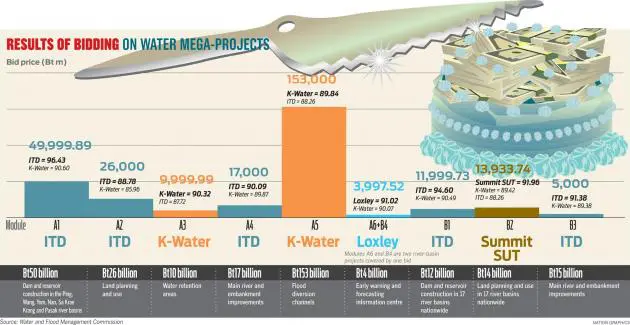
All four bidders in the final round came up with at least one of the nine modules. Their quotes for the modules were barely different, prompting speculation that these firms might have engaged in some sort of conspiracy.
The firms are ITD-Power China Joint Venture, Korea Water Resources Corp (K-Water), Summit SUT Joint Venture and Loxley Joint Venture, with K-Water looking to receive the biggest pieces of the pie. From the technical- review round, it is poised to claim two projects about flood diversion channel and water retention areas in Chao Phra Ya river basin worth Bt 163 billion. ITD-Power China Joint-Venture, meanwhile, has pocketed five projects worth Bt110 billion from technical-review round.
Loxley Joint-Venture has won one module A6/B4 worth 4 billion while Summit SUT has won module B2 worth Bt14 billion.
Today, the government will start negotiating with the qualified bidders to try to bring down prices. The process will take about three days, after which successful bidders for each module will be chosen and Cabinet asked to endorse the list.
Loxley JV and Summit SUT will be the first group to enter price negotiations with the WFMC at Government House. ITD-Power China JV will be next tomorrow and K-Water on Thursday.
“If they can’t give us the best price, we will immediately ask the next most qualified contender to negotiate with us,” Tongthong said.
Suwat Chaopreecha, president of the Engineering Institute of Thailand, said he was worried about talks with the bidders. Even though the government had set a guaranteed maximum price, it had no middle price and the details of each project to negotiate with the contenders.
The institute will hold a press conference to voice its concerns after the government comes up with the final bidders next week, he said.
Monton Panupokin, managing director of K-Water, said his company could complete the projects within five years.
“If we are selected to run the project we will avoid any impact that might affect the environment and communities,” he said,
However, Pathai Chakornbundit, senior executive vice president of Italian-Thai Development Plc, expressed some concerns with the tight timeline.
“Land expropriation alone may take many years and the company also needs to conduct the environmental impact assessment,” he said.
