
Govt ready to sign contracts


Play
Phongthep says deals will go ahead despite lack of assessments
The government is getting ready to sign construction contracts for its Bt350-billion water-management project over the next few months.
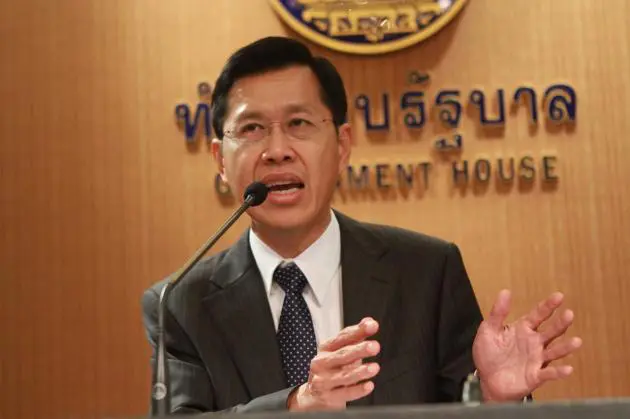
Deputy Prime Minister Phongthep Thepkanjana announced the decision yesterday, shrugging off concerns about the possibility of any legal trouble. He was speaking in his capacity as head of a panel reviewing the implementation of the modules after the Central Administrative Court ruled that the project be put on hold until all legal requirements are met.
For instance, the Constitution requires public participation as well as environmental and health impact assessments (EHIAs) for projects that could potentially have a serious impact on people, their health and the environment.
While relevant authorities may decide to appeal against the court’s ruling, there is also a possibility that the Supreme Administrative Court will uphold it.
Yet, Phongthep insisted that there was no reason to worry about this. “If the government is afraid, it won’t be able to implement its policies,” he said.
He also said that there should be no problem in organising public hearings and adjusting the terms of reference (ToRs) for the modules later.
Krai Tangsa-nga, vice-president of the Engineering Institute of Thailand, has said the current ToRs do not follow engineering procedures.
The government earmarked a huge budget of Bt350 billion to overhaul the country’s water-management system in the wake of the 2011 flood crisis.
It also put the Water and Flood Management Commission (WFMC) in charge of choosing proposed modules and construction firms. WFMC’s choices have already won Cabinet approval.
However, the Central Administrative Court’s ruling poses a major threat to the WFMC water modules.
Dr Apichart Anukularmphai, who chairs the WFMC committee on academic affairs, said yesterday that only projects expected to have a serious impact would be subject to the EHIA, hence the ruling would only affect some parts of the modules.
“Of the nine modules, only two will need to undergo EHIAs. If we look into it even more deeply, we will realise that only five of the 21 dams in the two modules need EHIAs,” he pointed out.
Apichart said the WFMC and construction firms would need to work more on explaining the procedures to the public.
“It’s not that we won’t do environmental impact assessments, we’re just not at that stage yet,” he said.
He explained that contracts must be signed first before feasibility studies can begin in line with the “design and build” concept. He added that EIAs would then follow where needed.
Apichart said the WFMC would go ahead with hiring programme management consultants to ensure the chosen construction firms draw up proper designs.
“Public hearings should not take too long, they can be arranged in various forms,” he said.
Deputy Prime Minister Plodprasop Suraswadi, who chairs the WFMC, said the Office of the National Water and Flood Management Policy and the Interior Ministry would be |in charge of organising public hearings in upstream, midstream and downstream areas. “We will complete this process in a few months,” he said.
Sakulchai Phattarakampol, an Italian-Thai Development (ITD) executive, said yesterday that his firm was waiting to see contracts and public-hearing results.
“We will also listen to the voice of the locals,” he said, suggesting that if local people recommended smaller dams in place of big dams, the firm would be willing to make adjustments.
ITD is part of the ITP-Power China Joint Venture, which is among the chosen construction firms.
