
More 'public participation needed'


Play
Influence of big businesses, vested interests must be removed to develop the system, seminar hears
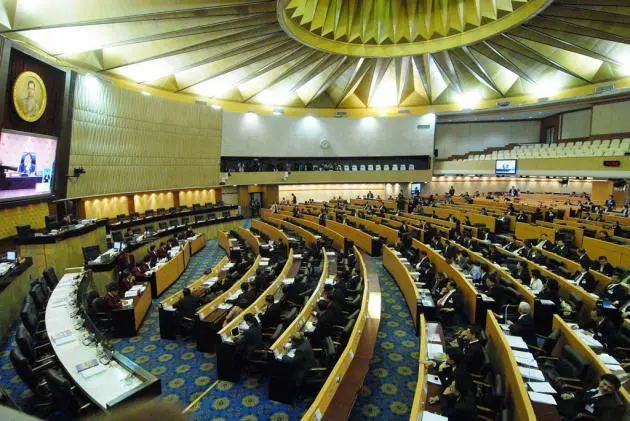
The Thai Parliament needs greater public participation and requires to be less under the influence of big businesses and groups with vested interests, a seminar organised by the King Prajadhipok Institute (KPI) was told yesterday.
The seminar, held to discuss challenges facing Parliament, said the performance was satisfactory though the administrative branch and independent agencies required greater scrutiny. Also, Thailand was urged to end the culture of military coups so that the parliamentary system could be given a chance to develop.
Pornsan Liangboonlertchai, a law lecturer at Assumption University, said Parliament
was being negatively portrayed as having become a “parliamentary dictatorship” or “dictatorship of the majority”, which could be seen as a move to prevent the legislative branch from exercising its power.
KPI said the World Justice Project gave the Thai Parliament 57 out of 100 points in 2010, which dropped to 51 in 2011 but inched up to 67 in 2012. The latest score came with the recommendation of strengthening the country’s parliamentary system.
Appointed Senator Vicharn Sirichai-ekwat said the Senate was divided and hence could not function fully as stipulated by the Constitution. Some senators side with the government and refuse to scrutinise the administrative branch, while others are simply not interested in their work, he said, adding that sometimes only 10 out of 150 senators attend meetings to examine proposed bills. He said the lack of responsibility was another major obstacle.
The Pheu Thai MP for Chiang Rai, Pichet Chuamuangpan, said bringing the cycle of military coups to an end was a key prerequisite for the parliamentary system to develop. He also decried the practice of vote buying at local levels, such as the election of subdistrict chief or kamnan, where some spent as much as Bt1 million to buy 250 of the 400 votes to win.
The Democrat MP for Rayong, Sathit Pitutecha, said he wanted to see the Pheu Thai Party launch a no-confidence motion against the government in order to fully scrutinise the Yingluck Shinawatra government.
Meanwhile, Suwit Mesinsri, director of Sasin Institute for Global Affairs, said lawmakers should rewrite the charter to improve the country’s competitiveness or it will soon become a failed state in the world market.
Suwit said that by adopting a new mindset of solving the country’s problems in the long term, lawmakers could help tackle the shortfall in the country’s competitiveness despite the ageing population.
He said studies showed that Thais in general still possessed the attitude and behaviour of people living in an agricultural society even though the country is gearing up for industrialisation.
“The studies said that most people in the country lack motivation and drive. This cultural factor will always hamper development,” he said.
He added that governments have failed to resolve political conflicts, hence a new charter was needed so every side could participate in running the country.
