
Groups vow rice checks


No decline in orders, exporters say; foundation seeks talks with PM on ways to protect consumers.
As the government scurries to restore consumer confidence in Thai rice, buyers abroad are unfazed by problems with pesticides and fumigation.
“Foreign importers are still placing orders for our rice,” Wallop Pitchyapongsa, secretary-general of the Thai Rice Exporters Association, said yesterday.
“Those countries understand there’s a need for fumigation to get rid of insects,” Wallop, who is also managing director of Capital Rice, told a seminar on Thai rice quality that was held after the use of methyl bromide and phosphine became controversial.
The Thai Rice Packer Association and Foundation for Consumers yesterday agreed to conduct regular joint tests on all brands of packed rice registered with the association and sold in the market. This move came after tests ordered by the foundation and conducted by an independent lab found traces of methyl bromide in more than 70 per cent of 46 bagged rice samples.
State agencies also plan to launch a programme of quality checks of rice in granaries and wholesale and retail shops.
The random tests will be performed by a third party accredited by international inspection agencies, said Krongthip Thanatvornlap, secretary-general of the rice packers association.
The laboratory is expected to take four days to study the samples and the test results will be revealed to the public via the association’s website every month. People can learn the contamination level of agricultural chemical substances of each brand registered with the association.
“All manufacturers who are association members have complied with the United Nations’ Food and Agriculture Organisation’s codex,” she said.
Saree Ongsomwang, secretary-general of the Foundation for Consumers, said her organisation agreed to regular joint tests of packaged rice. She claimed that the lab the foundation used was certified, but declined to identify it.
The foundation said it wanted to protect the lab’s privacy and did not want the lab to suffer from any political pressure.
Representatives from the consumers foundation and Bio Thai Foundation, which co-organised the tests on packed rice, also agreed to meet with the prime minister to discuss the matter. In their statement, the foundations said that in reference to the prime minister’s invitation for them to meet with her, they would like to discuss the protection of consumers.
The Thai Rice Packer Association has pressured the Foundation for Consumers to identify the lab.
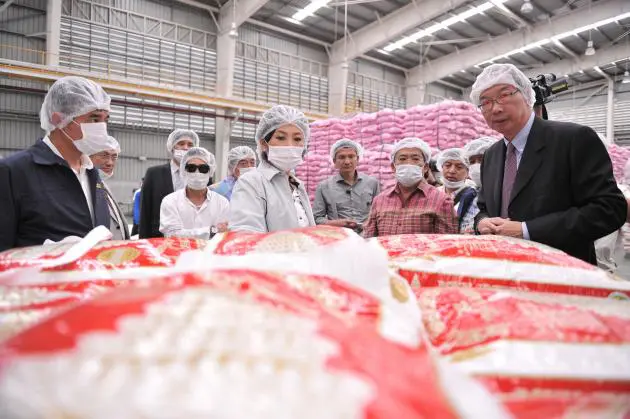
Prime Minister Yingluck Shinawatra said all parties should help prevent small issues from affecting Thai rice exports. She was visiting the rice packing premises of CP Intertrade Co in Ayutthaya with a large contingent of officials and media personnel.
The association’s Krongthip, who is also a vice president of Sandee Rice Co, said the association needed to know the name of the inspection agency hired by the foundation so that it could show the test results to its 140 members and help them improve their production process.
“We really want to know the lot number of the packed rice samples that had been taken to run the test and the date that they had taken the samples from the shelves. We also want to know the inspection agency that had done the test,” she said.
“The allegation about contamination in Thai rice has really hurt the local rice industry,” she said during the seminar on “Is the quality and contamination in Thai rice in crisis?” organised by Kasetsart University.
Krongthip is now considering whether to sue the foundation, she said.
