
English-language course a hit


Play
Popular course in Samut Sakhon school is now a prototype to help prepare for the AEC
Initially established to promote goodwill between Thai locals and Myanmar workers and encourage better communication between them at a Samut Sakhon community, an English-lanugage course at a local school has now become a prototype for many schools, amid the need to prepare for the Asean Economic Community (AEC) in 2015.
There are now more than 100 Thais, including adults, registering for the course at Ekachai School in Muang district, despite being limited to 60 students, said deputy director Thada Wiriyakul. He said this proved the course’s popularity among locals.
The 15-hour course offers lessons focusing on conversation and real-life use rather than memorising from a textbook, he said. Those taking this course are encouraged to speak English even outside classes, or with family members or to each other while in the school compound.
The government school initiated the course a few months ago following the realisation that the English-speaking Thai population is almost the smallest among the 10 Asean member states. More than 50 per cent of around 250,000 Cambodian and Myanmar immigrant workers, 50,000 of whom are not registered, who work mostly in the province’s fishery industry are able to speak English.
“Just greeting them with Mingkalaba [Hello] can simply yield a smile back, and saying the words ‘beautiful’ and ‘handsome’ as compliments to them result in an even broader smile,” said Thada. He said good communication between Thai locals and foreign workers could ease tensions and improve relationships overall among the residents.
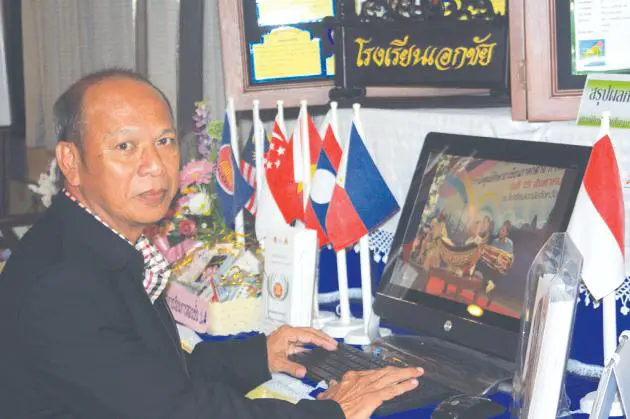
Ekachai School has been selected as one of four prototypes for the Asean Study Centre at the secondary school level. It has been funded jointly by an independent agency Quality Learning Foundation and the Romchatra Foundation, which are supported by local communities based on cooperation from schools, temples and homes.
The school’s director, Somchai Chawalitthada, said there were now 10 other schools taking part in this Asean Study Centre project, which would also expand to other subjects. They would emphasise on teaching students about social values apart from academic competency, while the focus would remain on the English-language course.
He said a survey revealed that 60 per cent of Thai respondents were aware a little about the AEC and more than half of them did not know how the AEC would impact them when it comes into effect in the next two years. He said the Asean Study Centre project would be important along with the government’s ongoing public relations drive to promote awareness of the AEC.
Three other prototype English course and Asean Study Centre projects at the secondary school level are being implemented at Mae Chan School in Chiang Rai in the North, Phibul Witthayakharn School in Ubon Ratchathani in the Northeast, and Nam Krajai School in Songkhla in the South.
The director of the Asean Study Centre project, Wassana Lertsil, said a large number of extensive projects relevant to it were underway. In certain schools in the South, Melayu language courses were given along with English language, and to many businesses located in the North, Myanmar language is taught to Thai employers and locals.
Endorsing this Asean Study Centre project at a recent seminar, former Finance Ministry secretary-general Sathit Limphongphan said English and computer literacy among Thai people were essential to keep up with Asean members and especially for Thailand’s role in the AEC.
