
Answer to Thai flood problems?


Play
South Korean waterway could serve as a model, K-water says
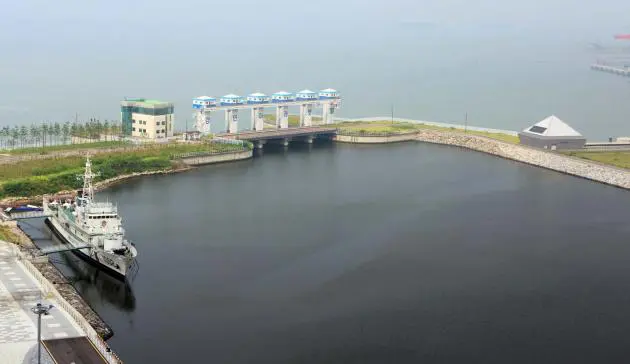
The Gyeong-In-Ara waterway in South Korea could be a model for Thailand on how to build a giant flood diversion channel to resolve the severe flood problem in the Chao Phraya river basin – even though details of this project are still to be revealed.
“This project would be a good example for us on how to build the flood diversion channel to minimise the impact of Chao Phraya flooding in Thailand,” according to Lee Byeong Hyeb, a director-general of Korea Water Resources Corporation (K-water)’s Ara Waterway Operation Department.
He was talking last week with Thai media crews who visited the water and flood management project run by K-water.
The Gyeong-In-Ara waterway is designed to minimise impacts from frequent flooding in South Korea’s Gulpo river basin, where 1.5 million people have faced severe inundation over the past 26 years due to low-lying land.
K-water is a South Korean state-run organisation that won a Thai government tender to build a flood diversion channel and ‘monkey cheek’ projects to resolve flood problems in the Chao Phraya basin.
K-water started construction of the Gyeong-In-Ara waterway in 2005 and finished it in 2011. The project, to connect the Han River with the Gulpo River and the west coast, started operating in 2012.
The waterway – which is 18 kilometres long, 80 metres wide and 6.3 metres deep – drains floodwater for 15 days during the heavy rain season. While it was under construction, it was used to drain a massive flood in the Gulpo basin in 2010, when the biggest deluge in 50 years hit the area.
In other seasons, this waterway is used as a navigation channel and to improve water quality in the river.
Under the project, three main facilities are used to drain floodwater hitting the waterway, the flood control weir plus the diversion gate. The other facilities include commercial, container and passenger ports, a logistics complex, bike route, park, and artificial waterfall.
Commercial ships of 4,000 tonnes can travel via this channel. Since the waterway started operation last year, the number of commercial ships using this route has increased by 200 per cent.
But Lee has agreed it was not easy to build as the waterway affected over 3,000 residents living in the local area. K-water had set up a huge budget with $US1-billion compensation fund and spent three years negotiating with local people on compensation and the way to minimise impacts of the project.
“We had to negotiate with local people continuously. At the same time we also had to provide true information related to the project and make them understand the benefit of the project. This was very important for the first step to run the project,” he said.
But he said the waterway would be a good model for Thailand on how to build a flood diversion channel.
In Thailand, the government plans to build a 289km-long, 245-metre-wide canal covering more than 43,239 rai (6,918 hectares) through six provinces, namely Kamphaeng Phet, Nakhon Sawan, Uthai Thani, Chai Nat, Suphan Buri and Kanchanaburi. The Bt150-billion project will be run by K-water.
However, it was suspended by the Central Administrative Court in late June until public hearings and an environmental impact assessment are conducted. The project will be allowed to go ahead when these requirements are met.
Korea and Thailand have different geographic and social conditions, but Lee said the most important thing for such a project was knowing how to dredge a canal and improve the waterway.
K-water managing director Monton Panupokin said K-water could not reveal the details and design of this project as K-water still has not signed a contract with the government. “All details of this project will be revealed to the public after the contract with the government is signed,” he said.
Kwater managing director Monton Panupokin wants the government to come up with an exact timeline to sign the contract with K-water so it can proceed with its plan. But there have been concerns among environmental experts over impacts the project could cause.
Asst Prof Komsan Maleesee of the Faculty of Engineering at King Mongkut’s Institute of Technology Lat Krabang previously told The Nation he did not think the flood-diversion channels would really be useful, whether they were on the eastern or the western banks.
“Geographically, the Chao Phraya River is flat in its last portion where it links to the sea. So, it’s not suitable for draining water,” he said.
He advised the authorities not to waste money building flood-diversion channels, adding that creating water-retention areas near the Chao Phraya River would be wiser.
