
Land consolidation scheme praised


Play
Long-term irrigation project a bonanza for farmers involved
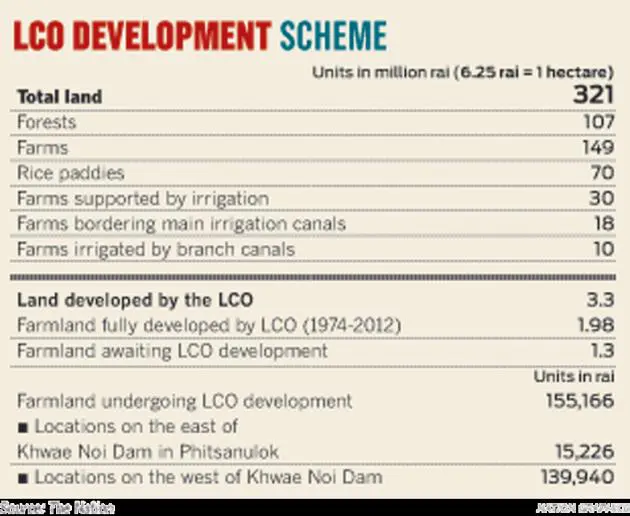
A government scheme to upgrade the productivity of farmland through state irrigation and self-invested cooperation from farmers will continue with a further 1.3 million rai – although it could take 26 years to complete.
The director of the Land Consolidation Office (LCO), Ekjit Tripakvasin, warned that the scheme could draw out for 50 years, if no sustainable support or sufficient budget is granted to the office, founded in 1969 under the Agriculture Ministry’s Royal Irrigation Department.
LCO projects have successfully relieved farmers of original debts and other bills incurred through cooperation wih the LCO within a few years of them getting involved in such development, thanks to far greater farm output and lower costs for irrigation and other farming methods.
Before taking part, most farmers resist the idea of losing 7 per cent of their farmland to such projects and 20 per cent in communal contributions, equal to a rate of Bt3,000 per rai.
“But after the projects’ are completed, they can relieve themselves of all debts within a few years – much shorter than the timeframe imposed to repay LCO-imposed debts – for communal contributions,” Ekjit said.
He cited an LCO report that said output of rice husk from farmland undergoing development had risen at a satisfactory rate, with some farmers boosting output from 300kg to 800kg.
The 1.3 million rai that the LCO is keen to develop is regarded as premium farmland with irrigation systems already in place to make it fully arable.
A village head in Phitsanulok, Jaroon Ratchabanjong, said he and other villagers originally opposed the LCO idea, thinking their land would be wasted or expropriated at cheap prices through the 7 per cent portion sequestered for the LCO scheme.
But after two years it being launched, Jaroon said all paddies in a total 1,530 rai owned by participating villagers were well fed with water and accessed easily by new roads. He could farm three crops, up from two previously, and farm output had jumped from 620kg to 860kg. Some farmers’ has yields of 900kg.
“There is no more squabbling between farmers over meagre water, like in the past, and no more fuel costs for pumping water into paddies,” he said. “And most importantly, the land price jumped from tens of thousands of baht to Bt200,000 now.”
A former LCO director, Jaran Phookhao, who now works as an adviser, said a budget request for Bt600 million two years ago was cut to Bt200 million, then reduced to only Bt150 million this year.
The limited budget and lack of support from the government meant just 1.98 million rai had been developed over 44 years, he said, as the LCO was set up in 1969.
“It may take another 100 years to fully develop all 30 million rai of farmland supported by existing irrigation or dams under the LCO scheme. Even so, the LCO is still aiming to develop some 60 million rai of farmland.”
