
Student movement alive and well in the provinces
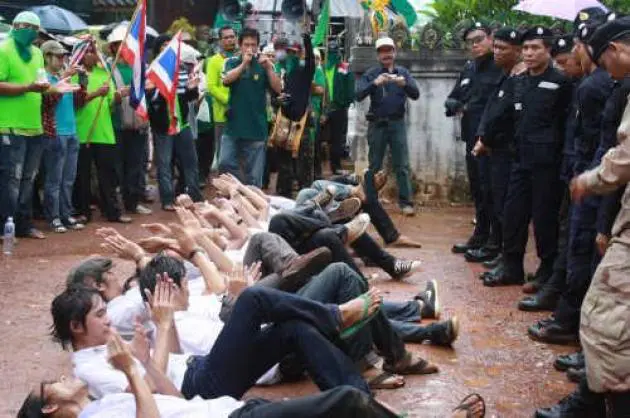


The student movement has seen a revival upcountry, particularly in Khon Kaen and Roi Et.
After the bloody crackdown of October 14, 1973, many might have written off student political activism as a thing of the past. But 40 years on, recent student activities to serve the greater good suggest otherwise.
Residents appear impressed with the peaceful intervention of Khon Kaen University students to fight heavy-handed police tactics at a public hearing on the issuance of a gold-mining licence.
On September 8, dozens of students braved the rain and stepped forward with nothing but a collective “wai” to beg anti-riot police to allow anti-mining protesters to attend the hearing.
The authorities initially stood firm in denying the protesters access. The students relied on their non-aggressive and polite manner to ward off a potential confrontation.
They managed to persuade the anti-riot forces and protesters to reason with one another to resolve the tensions. Pictures of the student intervention quickly spread via social media and news outlets, winning public commendation.
Law student Chatupat Boonpatraksa said the intervention was just an example of the tradition of activism that has been kept alive and well by 10 successive graduating classes.
In Khon Kaen, the Dao Din group is at the forefront of carrying on the student movement, he said, proudly identifying himself as one of its members.
Dao Din activists take a keen interest in the plight of local people. They aim to tackle villagers’ grievances, ensure justice and promote democracy.
Chatupat said he and other activists are very concerned that villagers have little say in their own livelihoods or the decision-making process for their community.
“Capitalists have always had their way in exploiting natural resources at the expense of villagers,” he said.
In their recent activities, students played a vital role in championing the interests of villagers, he said.
They intervened in cases related to Loei gold mining, a land dispute in Bo Kaeo, potash mining in Udon Thani, a planned nuclear power plant in Kalasin and the dredging of waterways in Nong Bua Lamphu.
The Dao Din member said the October 14 generation of activism was a role model for the present student activists.
“I firmly believe the student movement could be a vehicle of change for social justice,” he said.
To finance their activities, students rely on donations as well as Bt150,000 in annual support from the Komol Keemthong Foundation. At times they have to dip into their own purses.
The present-day student movement is seen as more fragmented than past movements, with individual advocacy groups carrying on their own struggles.
This is because there is no common cause uniting the movement to work in a concerted effort. The past movement seemed stronger as it shared a struggle against dictatorship.
Roi Et Rajabhat University student Chanin Yosbut said his Nok Kunchae (Pigeon) group strove for social change.
Chanin said his group pooled members’ financial resources to fund its activism.
The difference between present and past activism is that students now opt for constructive tactics, in contrast to the confrontational style of their predecessors, he said.
Should the situation warrant it, the student movement could unite and become strong, he said.
Nakhon Si Thammarat Rajabhat University student Sarayuth Dechthim said the revival of the southern student movement could be attributed to issues related to the construction of an industrial estate. For the past seven years, students have been helping villagers safeguard their community in the face of industrial expansion.
Former student activist Busaya Chaemfah said she remained in contact with the student movement. Busaya, who works as a public advocate, said legal professionals could help activists overcome problems, and also advise villagers of their legal options.
This is the third in a series of articles commemorating the October Uprising. The series will run until October 14 – the 40th anniversary of the day that students and the public took a stand against dictatorship in 1973.
