
Half-baked solutions will not ease Bangkok's traffic congestion


Play
THE METROPOLITAN Police's proposed solution to Bangkok's traffic problems is a step in the right direction, but given the absence of comprehensive planning, it is not surprising that the proposal has drawn major opposition. Bangkok's traffic system cer
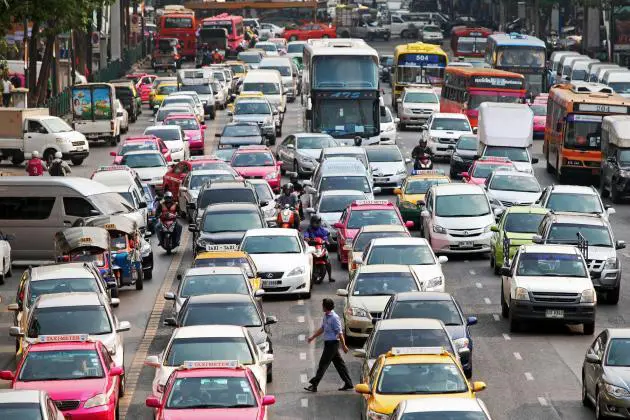
Bangkok roads cannot serve all 7 million vehicles registered in the city, and many more registered in the provinces, without causing congestion. Traffic and Transport Policy and Planning Office data show that each year, the average speed of automobiles in Bangkok has declined as the number of new cars continues to rise. According to the office, the average speed of vehicles on Bangkok’s main roads – such as Rama IV and Sukhumvit roads – during morning rush hour has dropped to 15.7km/h.
What should authorities do?
Much of the criticism is directed at the government’s first-car-buyer programme. The scheme initially drew orders for more than a million vehicles, but as many as 200,000 may be cancelled, since new campaigns by automakers are offering even more attractive packages than the tax-rebate package offered last year by the government. Whichever way you look at it, these policies allow for the easy purchase of automobiles, thus increasing the problems of carbon emissions, while also aggravating Bangkok’s congestion problems.
At a time when climate change is the greatest global challenge, carbon emissions should be a part of all government policy – particularly that related to transport.
This is why the Metropolitan Police’s proposal seems absurd. According to police, old cars should be banned from Bangkok roads, unless their owners are paying as much registration tax as new cars. The proposal should be fought against – not because it is pressing for old cars to pay higher registration taxes, but because it fails to take into account the carbon dioxide that old cars emit.
As Transport Minister Chadchart Sittipunt said recently, the proposal has also come at a bad time because Bangkok’s public-transport system is under fire.
In fast-expanding Greater Bangkok, which includes four peripheral provinces - Nonthaburi, Pathum Thani, Nakhom Pathom |and Samut Prakan – any changes should include planning for the whole area. The Skytrain and MRT are positive advances, but both systems have failed to solve transport problems for those people who have to commute from the suburbs, or beyond.
The German Academy for International Cooperation (GIZ), an institute specialising in development issues, is now working on a transport model for Asean, with Bangkok a key area of the study.
Principally, more transport infrastructure is needed, but at the same time, it must be friendly to the environment where we live.
Let’s look at what other metropolises have done.
London has introduced a Congestion Charge Zone (CCZ) for vehicles operating in the city centre between 7am and 6pm, Monday to Friday. Launched in 2003, the initiative is the first of its kind in the world. While it is intended to reduce the flow of traffic into and around the city centre, it also addresses the problem of carbon emissions.
For example, it offers a 100-per-cent discount on the Congestion Charge to cars or vans (not exceeding 3.5 tonnes in gross vehicle weight) that emit 75 grams per kilometre or less of carbon dioxide, and that meet also the Euro 5 standard for air quality.
Sound interesting? If the answer is yes, perhaps the very first thing that Thai authorities should do is identify roads where traffic must be strictly controlled. These roads are very likely located in the Rattanakosin Island area and in main business areas such as Siam, Silom and Sathorn.
To win public support, the Bangkok Metropolitan Administration would then need to come up with a comprehensive report as to why such traffic-control measures are worthwhile. The report should show how much money authorities have spent on fixing properties in those areas after they were damaged by volumes of heavy traffic.
It should also indicate how exhaust emissions have polluted the environment and hurt people’s health in these areas.
At the same time, the BMA must also present alternative means of transport for commuters in these areas.
Such measures could also be extended to other parts of the city later, leading to a comprehensive traffic system that would benefit all in the long term.
