
Nari swamps the East and Bangkok
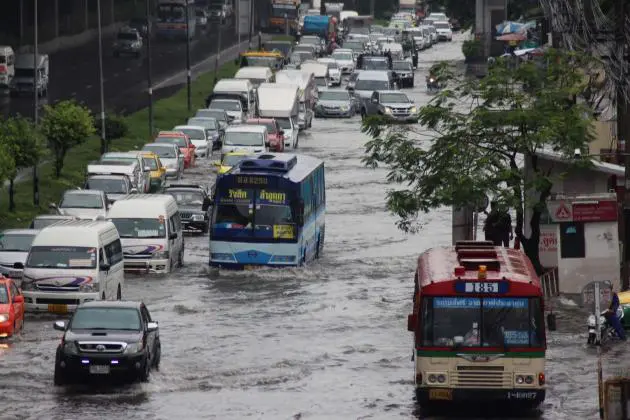


NARI storm has brought heavy rains to many parts of the country, including Bangkok, leaving some eastern provinces heavily flooded.
In the wake of the downpours, some of Bangkok’s roads were covered with floodwater and flooding in the East has turned grimmer.
“More rain means it is going to take more time to drain away all excess water,” Royol Chitradon said in his capacity as chair of the Water and Flood Management Commission’s subcommittee on water situation analysis.
Nari entered Thailand early yesterday and already weakened to low pressure ridge. Yet, the Royal Irrigation Department has admitted it initially underestimated the amount of rainfall it would bring. Now, it has been adjusting its water-drainage plans.
Although Nari spread over Thailand’s Northeast, its impact was also felt in many parts of the country, including Chon Buri, Chachoengsao, Prachin Buri and Sa Kaew in the East.
According to the Water Resources Department’s Water Operation Centre, the accumulated rainfall as of yesterday in these provinces measured from 50millimetres to 100mm.
“Heavy downpours caused by the Nari storm and high tide [which affects Bang Pakong River] adversely affected our water-drainage plan. It’s going to be hard to drain water into the sea in the coming days due to the high tide,” the Centre’s chief Niruthi Khunphol said.
He was also worried about eastern Bangkok, which sits next to the now-flooded Chachoengsao and also needs to rely on the Bang Pakong River for draining water into the sea.
“The river itself is now brimming with water,” he said, “We will need to use many pumps for the zone.”
Thongplew Kongjun, a director of the Royal Irrigation Department’s Water Management and Hydrology, said his agency had underestimated the influence of Nari, particularly the accumulated amount of rainfall.
The Bangkok Metropolitan Administration (BMA) yesterday opened all sluice gates in the eastern area after several hours of heavy rain over the capital. The downpours, which started around 2am yesterday, are likely to continue for the next few days.
BMA drainage office chief Adisak Khantee said as the water level in canals was on the rise, his office had decided to open all sluice gates in Eastern Bangkok to drain excess water out of the city in readiness for the expected rainfall. Officials would continue to monitor the situation at main canals, especially as high inflows of seawater are forecast for today, he added.
The BMA flood prevention centre reported that the city’s maximum accumulated rainfall was in Suan Luang at 139 millimetres, followed by Min Buri at 130mm, Sai Mai at 119.5mm, Din Daeng at 93mm – while other areas of the city braved scattered rainfall. While main roads were not flooded, roads in alleys such as those in Nawamin, Lat Phrao, Chokchai 4, Bang Na areas suffered clogged-drainage pipe flooding, the centre said.
The Royal Irrigation Department has warned people to monitor the high inflow of seawater that will affect Bangkok, Nonthaburi and Pathum Thani until October 30.
In the Northeast, Nari is also threatening to cause the Chi and Mun rivers in the northeastern provinces of Si Sa Ket, Surin, Mukdahan, and Ubon Ratchatani to overflow.
