
Urupong protest 'led by students not politicians'


Play
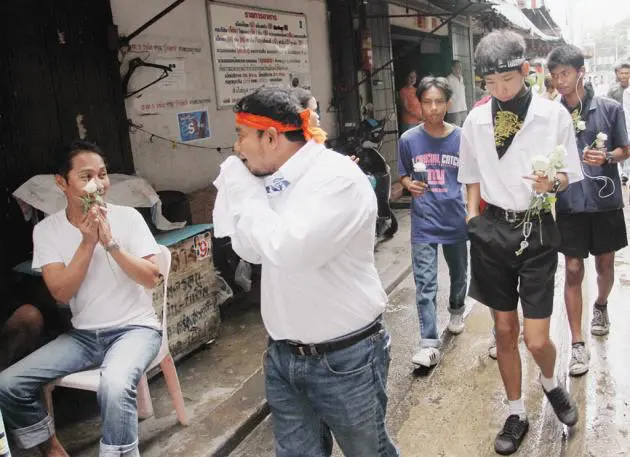
Hundreds of protesters camping out at the Urupong intersection in Bangkok have been there for 10 days now. The anti-government rally at the site began accidentally, but their supporters expect more backing from people who are increasingly dissatisfied wit
Protests that led to the ousting of unpopular governments in some countries also began in an accidental way, said a politician from the opposition Democrat Party. “The more the government pressures the protesters, the stronger support they will get,” said the politician, who asked not to be named.
The government on Friday extended the Internal Security Act in three Bangkok districts until November 30 to prevent protesters from getting close to Government House or Parliament.
On October 10, when leaders of the People’s Army to Overthrow the Thaksin Regime decided to end their “siege” of Government House ahead of a visit by Chinese Prime Minister Li Keqiang, many protesters were upset. They began to gather at the Urupong intersection, with Uthai Yodmanee, a student leader from Ramkhamhaeng University, acting as coordinator. The group calls itself the Network of Students and People for Thailand’s Reform.
Nitithorn Lamlua, a lawyer for the People’s Alliance for Democracy (PAD), said that Uthai asked him to act as an adviser to the group. He said he managed to calm the protesters down after the rally outside Government House was abruptly called off. Urupong was selected because it is not far from Government House and it is considered a safe place, thanks to an expressway and pedestrian flyovers above.
On the first day, there were about 300 protesters. He thought of asking them to return home the following day, but more people joined the protest the next morning, including vocational students and provincial people, Nitithorn said.
He said that later he called on Sondhi Limthongkul, the former leader of the PAD, to ask for his comment on why this “leader-less” group could be so bold. Sondhi told him it was because people felt frustrated with the government.
Nitithorn said he conducted a survey of the protesters on October 13 and 14. It was found that they wanted to continue with their demonstration at Urupong to scrutinise the government. They did not want to move elsewhere, unless it was Government House.
“The government should not pressure the protesters. They are just exercising their liberty in criticising the government,” Nitithorn said. “This force is led by students. It could make the government anxious. Govern-ments tend to fear this kind of force because they can’t bargain by offering positions.”
The Urupong rally has also attracted many school students and some celebrities. Noted social critic Sulak Sivaraksa and Dej Poomkacha, founder of the Thai Volunteer Service Foundation, came to address the protesters and voiced support to their rally. A number of civic groups also announced plans to take part.
Nitithorn said politicians could join the Urupong rally but it had nothing to do with the opposition Democrat Party. However, leaders of the ruling Pheu Thai Party agree that the Urupong protesters consist mainly of three groups of people – Democrat supporters, PAD backers, and people who are dissatisfied with the government’s performance.
