
Social media in Thailand proves its strength


Play
BACK WHEN "Black May" took place in 1992, people were mobilised via mobile phones and the protesters were thus called the "Mobile Mob". Later, before the Thaksin Shinawatra government was ousted by a military coup in 2006, protesters were mobilised vi
Now, however, more and more people are relying on the social media, with Facebook, Twitter, Instagram and LINE making breaking news go viral.
Social media has a much wider scope when compared to mobile phones, which can only be used to reach a circle of friends, and satellite television that can only focus on a fixed audience. In comparison, social-media users can freely post messages, photographs, video clips or share other people’s posts. Plus, posts on their timelines can also help raise a response from other users.
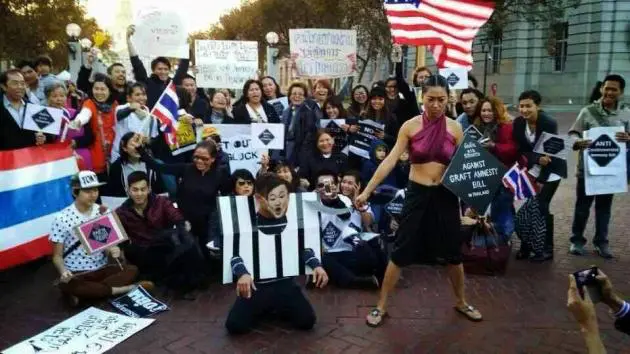
The ongoing battle against the government’s controversial amnesty bill is a great example. People have been posting real-time photographs as evidence of rallies in Bangkok and in other provinces – keeping people both inside and outside the country up-to-date about what is going on.
Also, this updated information offers a platform for debate and encourages others to make similar posts.
This time around, many users have gone one step further by setting up separate Facebook pages to show their opposition to the bill.
For instance, an “Anti-Amnesty Bill” page identifying itself as a “public figure” has won more than 143,000 “likes” already. It has also become a channel for protesters around the globe to voice their opinions in addition to those rallying at Democracy Monument.
Social media also allows people to make poignant gestures like changing their profile pictures or posting graphics with messages against the amnesty bill. In fact, some tech-savvy people have also created specific apps that allow people to customise their profile to match their political beliefs.
Though changing profile pictures is well and good, the real impact is measured more by how many social-media users are inspired to take their cause to the street.
It proved powerful when the social-media campaign in September mobilised enough people to fight against the construction of Mae Wong Dam, and now, more and more people are joining rallies to “blow the whistle” on the government.
Still, as this column has pointed out before, social media can also be misused to spread wrong information. For instance, some users are posting doctored photographs or images with inflammatory captions, which has lead to quarrels among people.
One “exclusive” report on LINE recently said that police were planning to disperse the crowds in a few days. Ironically, police officers were heard asking each other if this report was true.
Yet, though Thailand has yet to have its own version of the powerful “Arab Spring”, we can safely say that Thai social-media users have been somewhat successful in mobilising crowds.
