
Royal model woven into govt policy


Play
One-year mission to be spelt out on Friday
PRIME MINISTER Prayuth Chan-ocha’s government has mapped out policies for his one-year mission emphasising the King’s sufficiency philosophy, the junta’s guidelines and demands from the people, Deputy Prime Minister Wissanu Krea-ngam said after a special Cabinet meeting yesterday.
The policies to be announced on Friday to the National Legislative Assembly (NLA) cover 11 sectors and include parts of the 11th national development plan prepared by the National Economic and Social Development Board (NESDB), he said.
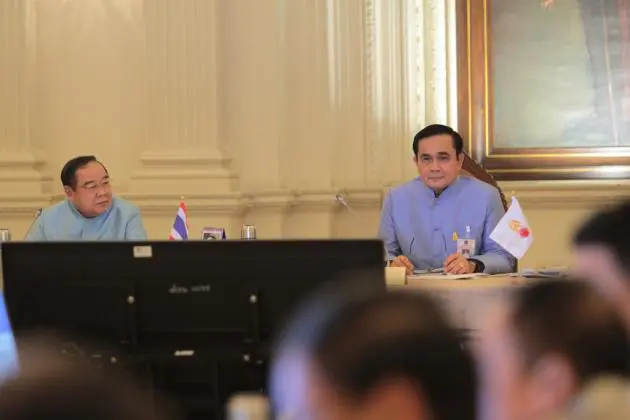
Prayuth called a special Cabinet meeting yesterday to explain working procedures to his ministers, Wissanu said. The premier wants ministers to check what relevant ministries have done since the May 22 coup, he said, noting that the ministers would be given a handbook on how to carry out their jobs.
The premier, his deputies and officials from the National Budget Bureau spent the last weekend adjusting a draft of the policies set to be announced to the NLA, he said.
The administration’s policies differ from those of elected governments, which are usually prepared by political parties ahead of election campaigns. The new government’s policies came from five sources within the state apparatus, Wissanu said. The five sources are royally granted strategy, sufficiency philosophy, the 11th national development plan, the National Council for Peace and Order (NCPO)’s roadmap, plus 12 principles and people demands, he said.
Prayuth has assimilated His Majesty’s grand strategy into all the policies, he said. The royal strategy has three principles: understand, reach out and develop. The King granted these to the Thaksin Shinawatra government to use for conflict resolution in the deep South. The sufficiency philosophy emphasises rational and social protection, he said.
“The prime minister wants to clarify people’s problems in the policy paper. People want to know clearly whether their home could be nationalised, how land zoning will look. And whether they are in agricultural or industrial zones,” Wissanu said.
“Over 60 governments in the past have only had a constitutional obligation to administer the country, but the provisional charter commissions three duties for this government – running the country, reform and reconciliation,” said Wissanu who drafted the 2014 Constitution.
The government’s policies cover 11 sectors including economics, education, religion, security, the environment and foreign affairs, he said. The policy has three timeframes; one month, one year for mid-term and 5-10 years for long-term plans, he said.
“The double rail system, for instance is a long-term plan for future governments, but this government must lay out the foundation and legal frameworks,” he said.
Prayuth’s motto was, he said, act first, do it seriously and yield results that can be turned into action, Wissanu said.
The government would also give importance to the National Reform Council (NRC) as architects of the country’s future. The government would coordinate and cooperate with the NRC, but not intervene in its work, he said. Only 250 people would be picked as NRC members, but others shortlisted would be able to give input to the forum. They may be selected as advisers or subcommittees for reform tasks.
Mapping out plans of action
After the policies are announced, the government would meet with ministries and departments to map out action plans to implement tasks.
“We have to realise that this government has only one year in office, not four as other elected government, so the policy will be completed within a year,” he said. “Democracy is the goal, ridding the country of corruption is another goal. We will do what we can to reach the objectives of having a new Constitution and a newly elected government.”
“Of course, we have to address human-rights issues in the policy paper. We talk about legal and justice reform. The policy mentions security as well as human rights and freedom,” he said.
Problems in the deep South were addressed in a security context, but no timeframe has been set for peace in the predominantly Muslim region, he said.
Ampon Kittiampon, the Cabinet’s secretary-general, said ministers would officially start working only after the policies are declared on Friday.
Yesterday, PM’s Office Minister Suwaphan Tanyuvardhana was assigned to represent the government in coordinating with the NLA.
As the government takes over, the NCPO will need to reduce its role after Cabinet starts working, Wissanu said. He said the NCPO would not have authority to issue orders or summon anyone for questioning, unless it takes recourse in martial law. Several panels appointed by the NCPO must be restructured under the government.
