
'Political will is the key to decentralisation'


Play
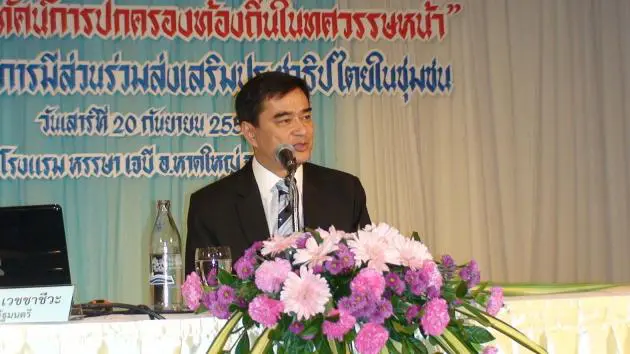
DEMOCRAT LEADER Abhisit Vejjajiva has said successful decentralisation reform can happen but political willingness - or lack of it - will be the key to its success or failure. He has also made reform proposals for three forms of local administration that
He said the answers to lot of debates and concerns regarding decentralisation, such as the delegation of powers and the responsibility and complexity in law drafting, had already been settled by the past reform committees and government bill. All that was required now was to study what had already been done and revise it to make it more complete, he said.
“Today’s real problem [about decentralisation] is the political motive to do or not to do,” he said.
However, he added: “We can’t just sit back and hope that the goal [for the empowerment of local administrations] that had already been proposed will suffice.”
Abhisit said the push for decentralisation and the empowerment of local administrations had been clearly written in the 1997 Constitution.
“If I just think in the same box and use the same methodology, we can’t really expect any substantial changes,” he said.
The three forms of local administration he proposed are large, small and special administration.
He said large local administrations should derive their administrative power from regional or central administrations, and it should be similar to a provincial administration. He said small administrations would face having insufficient income and relying on central government for up to 90 per cent of their budget. They would also face the challenge of adapting to the rapid growth of communities – from rural to urban.
The role, power and size of the administration must change according to the community it is administrating. “The challenge is to create the support mechanism that drives changes in those respective areas, and how to control and manage the change of those administrations according to the development of respective area,” he said.
“For example, should municipalities’ administrative area increase? Should district administration merge with the municipality?”
Abhisit said the special administrations should be used more widely, pointing out that they already existed in Bangkok and Pattaya, for example. He said Tak’s Mae Sot district, for example, should opt for this form of administration because of its unique characteristics. Mae Sot is considered a special economic area due to its cross-border-trading location and the allure for tourists.
Abhisit said a special administration should be set up to monitor and develop such affairs.
He said a special administration was suitable for unique communities.
“We could have a special administration to manage cross-border trade or the economy, or one for a tourist city, one for a big city and another for a highly dense population, for example,” he said.
He said that the push for amendments to the law might not be enough for local administrations to progress.
“What is needed is a change in working ethics and methodology, such as the high inclusion of people during the administrative process and a culture of cooperation amongst other local administrations, ministries and departments, for example,” he said.
